If you provide false information on your DMV application, you may face:
A)Receive a fine.
B)Sentenced to jail.
C)A one-year suspension of your driving privileges.
D)All of the above.
5.
Drivers often fail to see a motorcycle headed toward them. Why?
A)It is difficult to judge a motorcycle's speed.
B)Motorcycles are hard to see.
C)All of the above.
6.
Which of the following drugs could affect your ability to drive?
A)A cold remedy.
B)Marijuana.
C)All of the above.
7.
Your BAC depends on:
A)how much alcohol you drink.
B)how much time passes between drinks.
C)All of the above.
8.
Alcohol:
A)makes you less aware of what is happening to your driving abilities.
B)makes it easier to make correct decisions.
C)improves your reaction time.
9.
From top to bottom, traffic lights are:
A)green, red and yellow.
B)green, yellow and red.
C)red, yellow and green.
10.
This sign means:
A)You must yield the right-of-way ahead
B)Traffic signals ahead
C)You must stop ahead
D)Speeding is not allowed
11.
Highway hypnosis is a driving condition that can result from:
A)heavy traffic.
B)staring at the roadway for long periods of time.
C)travelling on HOV lanes.
D)frequent rest stops.
12.
You must come to a full stop at a yield sign:
A)Always.
B)Never.
C)If traffic conditions require it.
13.
What should you do if a vehicle is approaching head-on in your lane?
A)Pull over to the left and use your emergency lights to stop the other driver.
B)Decrease speed, pull over to the right and sound your horn to warn the other driver.
C)Turn off the ignition if your vehicle has power steering.
14.
This road sign warns drivers that:
A)the road surface ahead changes to a low-type surface or earth road.
B)vehicles must leave the pavement immediately.
C)the dirt on the side of the road is soft.
15.
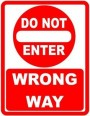
This road sign means:
A)U-turns are prohibited
B)You may proceed only if the way is clear
C)You are about to enter a one-way street the wrong way
D)Do not pass
16.
Arrows on the roadway:
A)show which lanes you must use.
B)indicate reserved lanes.
C)indicate HOV lanes.
17.
If your turn signals fail, you should use _____ to indicate your intention to turn.
A)your emergency flashers
B)your horn
C)your high beams
D)hand signals
18.
You reach an intersection that is not controlled at the same time as a driver on your right, and both of you prepare to go straight. Who has the right-of-way?
A)You.
B)No one.
C)The other driver.
19.
Keeping a space cushion between you and the other vehicles around you is important because it:
A)gives you time to react to situations.
B)prevents distractions from other vehicles.
C)keeps other drivers alert.
D)keeps traffic flowing at a safe pace.
20.
If you are blinded by headlights on an approaching vehicle, you should:
A)avoid looking directly at the bright lights.
B)glance toward the side of the road, then look quickly ahead to determine the other vehicle’s position.
C)All of the above.
21.
When drivers come to this sign, they must:
A)be ready to stop at the stop sign.
B)warn other drivers that a stop sign is ahead.
C)brake sharply and come to a complete stop.
22.
This sign warns drivers that:
A)they must turn either to the right or left.
B)there is a double curve ahead.
C)there is a winding road ahead.
23.
After stopping for a school bus that is unloading children you should:
A)accelerate quickly and pass.
B)put on your emergency flashers.
C)watch for children walking along the side of the road.
D)wait at least 4 minutes.
24.
__________ limit(s) your concentration, perception, judgment, and memory.
A)Even the smallest amount of alcohol
B)Only a blood alcohol level greater than .05
C)Alcohol does not
D)Only a blood alcohol level greater than the legal limit
25.
When you see this sign you should:
A)increase your speed and try to pass other vehicles.
B)slow your speed and be prepared to stop.
C)slow your speed and do not pass other vehicles.
26.
On slippery roads, drivers should:
A)leave more space in front of their vehicle.
B)increase their speed to avoid hydroplaning.
C)come to a complete stop.
27.
BAC is:
A)the acronym for Beer ACcumulation.
B)the number of ounces of alcohol in your blood.
C)the percentage of alcohol in your blood.
28.
To drive defensively, you must:
A)anticipate errors by other drivers.
B)assume that a driver who approaches a STOP sign on a side road is actually going to stop.
C)not check behind you through your mirrors.
29.
This sign warns of a ________ ahead.
A)hill
B)no passing zone
C)soft shoulder
30.
If you begin to feel drowsy while driving, you should:
A)open your window.
B)get some coffee.
C)get an energy drink.
D)stop driving.
31.
An orange-colored sign means:
A)Railroad crossing ahead
B)School zone ahead
C)Construction zone ahead
D)You must change lanes ahead
32.
___________ are green with white letters and symbols.
A)Warning signs
B)Destination signs (guide signs)
C)Regulation signs (regulatory signs)
33.
You are approaching an intersection when the signal turns yellow. You should:
A)speed up to get through the intersection before the red light comes on.
B)stop then enter the intersection when safe to do so.
C)slow down and proceed with caution through the intersection.
34.
This sign warns ____________ ahead.
A)of two-way traffic
B)of a reduction of lanes
C)that a divided highway ends
35.
Alcohol:
A)makes drivers more prone to take chances.
B)increases reaction time.
C)All of the above.
ANSWER KEYCheck answers after completing the test.