DriveQuiz drivequiz.com

OR DMV PERMİT PRACTİCE TEST 5

Oregon
Duration: 32 min
|
Questions: 35
Student Name:
Date:
Correct:      Incorrect:      Score:      
1.
Treat the flashing red signal exactly like a STOP sign: come to a complete stop, yield to cross traffic and pedestrians, then proceed when safe.
A flashing red light:
A) is used at dangerous intersections.
B) means the same thing as a stop sign.
C) All of the above.
2.
What should you do if your rear wheels start to skid?
A) Steer left if your rear wheels slide right.
B) If the vehicle has ABS, pump the pedal carefully.
C) Turn the steering wheel in the direction the vehicle is trying to go.
3.
At a stop sign there is no stop line or crosswalk. You must stop:
A) before you enter the intersection.
B) at the next crosswalk.
C) after you enter the intersection, if you have a clear view of traffic on the intersecting roadway.
4.
Your car stalls on the tracks at a railroad crossing, and a collision with a train is imminent. After getting yourself and your passengers out of the car, you should:
A) run toward the train but stay off the tracks.
B) signal the train to stop.
C) cross the tracks.
5.
What should you do in case of a brake failure?
A) Pull off the road into an open space, if available.
B) Apply the parking brake slowly.
C) All of the above.
6.
How can you prevent fatigue on a long trip?
A) Plan to drive long trips with a companion.
B) Get enough sleep.
C) All of the above.
7.
Come to a complete stop before the stop line, crosswalk, or intersection. Look left, right, and left again, and proceed only when it is safe and right-of-way is clear.
This road sign means:
A) Slow down or stop
B) Stop
C) Road narrows ahead
8.
Blind spots are:
A) Dangerous intersection where the maximum speed limit is 15 MPH or less.
B) At night, the darkest areas of a road, where emergency flashers should be used.
C) Areas to the side or rear of a vehicle that the driver cannot see with use of mirrors.
9.
The bridge ahead has narrower lanes or shoulders than the preceding road. Use caution when meeting oncoming vehicles.
This sign warns drivers of:
A) a reduction of lanes.
B) a dip in the road. Drivers should be ready to stop if the dip is filled with water.
C) a bridge ahead, wide enough to accommodate two lanes of traffic, but with very little clearance.
10.
When you approach a stopped public transit bus from behind, you must yield to the bus:
A) when the bus has its emergency lights on.
B) only when it is not safe to pass the bus.
C) only if it doesn't appear safe to proceed.
D) when the bus has its turn signal and flashing yield sign on.
11.
If an aggressive driver is behind you:
A) sound your horn and move to the left lane.
B) slow down and confront the aggressive driver.
C) try to get out of the aggressive driver’s way.
D) increase you speed and flash your brake lights.
12.
________ is the only effective way to reduce your Blood Alcohol Content (BAC).
A) Time
B) Drinking coffee
C) Taking a cold shower
D) Eating food
13.
When you see flashing amber lights near the top of a school bus, you should know that:
A) you must stop and remain stopped until the amber lights stop flashing.
B) the bus has finished loading or unloading children. You may proceed.
C) the bus is about to stop to load or unload children. Prepare to stop.
D) the bus is loading or unloading children. Proceed slowly.
14.
A steep downhill grade is ahead. Trucks and heavy vehicles should downshift to a lower gear to prevent brake overheating.
This road sign means:
A) No right turn
B) No left turn
C) Narrow Bridge
D) Steep downgrade
15.
Which of the following must you obey over the others?
A) A flashing red light.
B) A stop sign.
C) A steady red light.
D) A police officer.
16.
To keep your vehicle from rolling into traffic when parked on a hill, if you are facing uphill you should:
A) turn the front wheels away from the curb or edge of the road.
B) turn the back wheels towards the curb or edge of the road.
C) set the parking brake and keep the front wheels straight.
D) turn the front wheels towards the curb or edge of the road.
17.
You may not turn right (or left from a one-way onto a one-way) while the traffic signal is red. Wait for the green signal before turning.
This sign tells drivers:
A) they must wait for the traffic signal to turn green before turning right or left.
B) they may not turn right or left during the red light.
C) All of the above.
18.
Examples of proper glass maintenance include:
A) Replacing worn wiper blades.
B) Keeping your windows clean and clear.
C) All of the above.
19.
More than one vehicle is approaching a four-way stop sign. Who has the right of way?
A) The first driver to reach the intersection and stop.
B) The driver on the left.
C) The last driver to reach the intersection.
20.
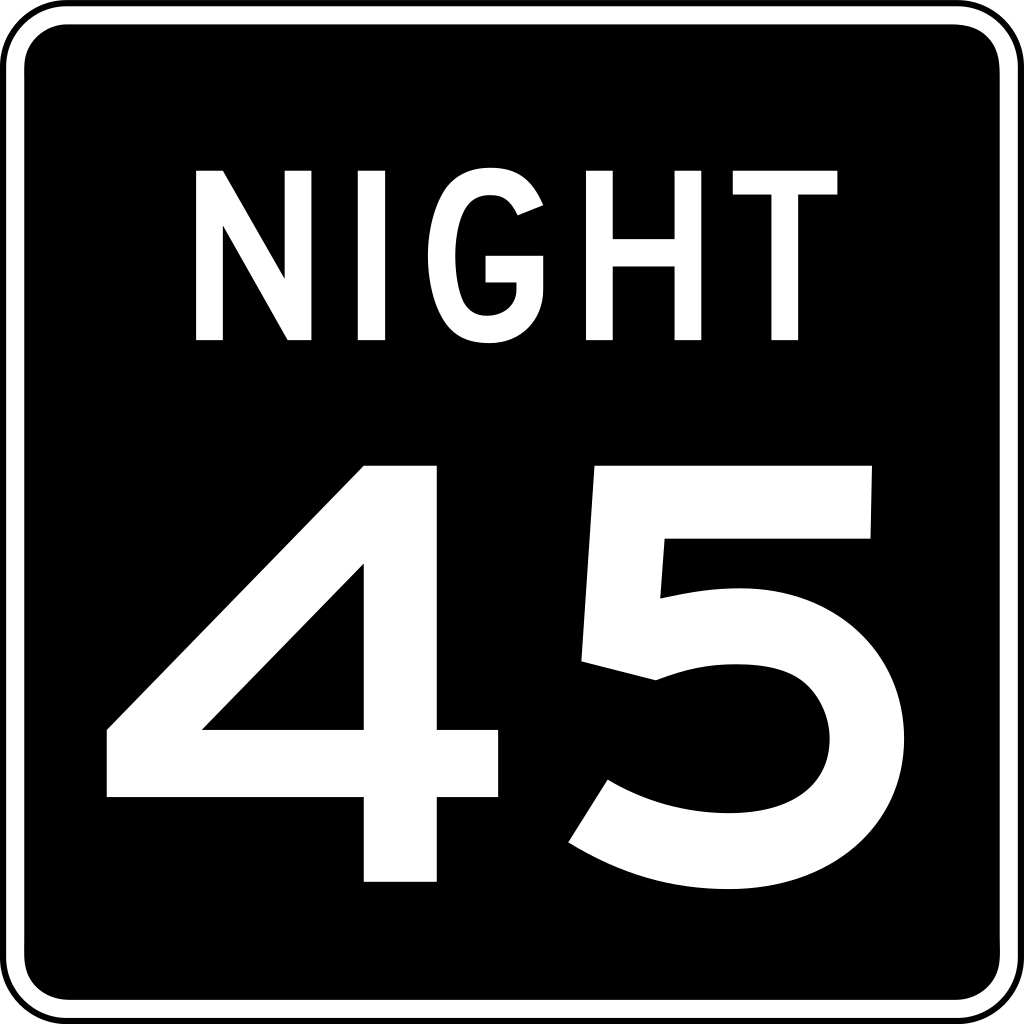
Indicates a lower maximum legal speed limit that applies only during nighttime hours for safety.
This sign means:
A) Take route 45 if you are driving at night.
B) The night-time speed limit is 45 MPH.
C) The minimum speed limit is 45 MPH.
21.
When drivers see the ‘Wrong Way’ sign:
A) they are going the wrong way on an expressway exit ramp.
B) they must drive past this sign and reach the next intersection.
C) they must not leave the pavement except in an emergency.
22.
Destination signs are ______ with ____ letters and symbols.
A) green; white
B) blue; white
C) white; black
23.
Slow down and give right-of-way to all oncoming vehicles, cyclists, and pedestrians. Stop completely if necessary before entering the intersection or merging.
The yield sign means:
A) Drive with caution in wet weather.
B) You must come to a complete stop.
C) Slow down and give vehicles crossing your path the right-of-way.
24.
The minimum drinking age in this State is ____ years.
A) 20
B) 21
C) 9
D) 18
25.
Before backing up, you should:
A) get off the car to see if it is clear to proceed.
B) rely on your mirrors to see if it is clear to proceed.
C) turn your head and look through the rear window.
D) flash your headlights.
26.
Parking is not allowed:
A) in an intersection, unless permitted by signs.
B) within 300 feet of a pedestrian safety area.
C) on public roads
27.
One broken line indicates:
A) You can pass other vehicles and change lanes, if it is safe.
B) You can not pass other vehicles or go across the line.
C) You can change lanes, but only when traffic conditions or obstructions in the road make it necessary.
28.
Standard yellow warning sign outline used across the US for all caution, hazard, and roadway change notifications.
This sign is a:
A) regulatory sign.
B) warning sign.
C) guide sign.
29.
Treat the flashing red signal exactly like a STOP sign: come to a complete stop, yield to cross traffic and pedestrians, then proceed when safe.
What does a flashing red light mean?
A) NO TURN ON RED.
B) The same thing as a stop sign.
C) Drivers may move forward with caution.
30.
To drive defensively, you must:
A) avoid scanning the road ahead.
B) keep one hand on the steering wheel.
C) keep your eyes moving.
31.
Who is most at risk?
A) Drivers who are fatigued.
B) Drivers who are driving on long, boring roads.
C) All of the above.
32.
What is the first thing to do when you make a three-point turn?
A) Signal with your left turn signal, then check carefully for traffic coming toward you.
B) Signal with your right turn signal, then pull over to the right and stop.
C) Turn left, go across the road so you come to a stop while you face the edge of the road.
33.
When driving near light rail vehicles, drivers should:
A) never drive around lowered crossing gates.
B) expect trains on any track at any time.
C) always obey signs and traffic signals.
D) All of the above.
34.
You are approaching an intersection with a yellow flashing light. You should:
A) stop and wait for the light to change.
B) speed up to beat the red light.
C) prepare to stop; the light is about to turn red.
D) proceed with caution through the intersection.
35.
The road makes a sharp 90-degree right turn ahead. Slow down considerably before entering the turn.
This road sign means:
A) School zone ahead
B) Side road
C) Construction zone ahead
D) Sharp turn, slow down
ANSWER KEY Check answers after completing the test.
1 C
2 C
3 A
4 A
5 C
6 C
7 B
8 C
9 C
10 D
11 C
12 A
13 C
14 D
15 D
16 A
17 C
18 C
19 A
20 B
21 A
22 A
23 C
24 B
25 C
26 A
27 A
28 B
29 B
30 C
31 C
32 B
33 D
34 D
35 D