DriveQuiz drivequiz.com

OR DMV PERMİT PRACTİCE TEST 3

Oregon
Duration: 32 min
|
Questions: 35
Student Name:
Date:
Correct:      Incorrect:      Score:      
1.
When you prepare to make a left turn from a one-way road into a one-way road, you must:
A) move into the right lane, or to the left side of a single lane.
B) move into the right lane, or to the right side of a single lane.
C) move into the left lane, or to the left side of a single lane.
2.
The median divider ends ahead, and you are returning to a two-way, two-lane undivided roadway. Watch for oncoming traffic on your left.
What does this sign indicate?
A) The highway ahead is divided into two one-way roadways.
B) Winding road ahead. Drive with caution.
C) Drivers will soon be on a roadway with two-way traffic.
3.
Which of the following must you obey over the others?
A) Red light
B) Stop sign
C) Police officer
4.
While inside the roundabout, you should:
A) remain in your lane until you are ready to exit.
B) change lanes before you check for vehicles behind you.
C) use your left turn signal if you are in position to exit now.
5.
Another road crosses the highway ahead. Look left and right for crossing or entering vehicles.
This road sign means:
A) Church ahead
B) Intersection ahead
C) Do not enter
D) Side road
6.
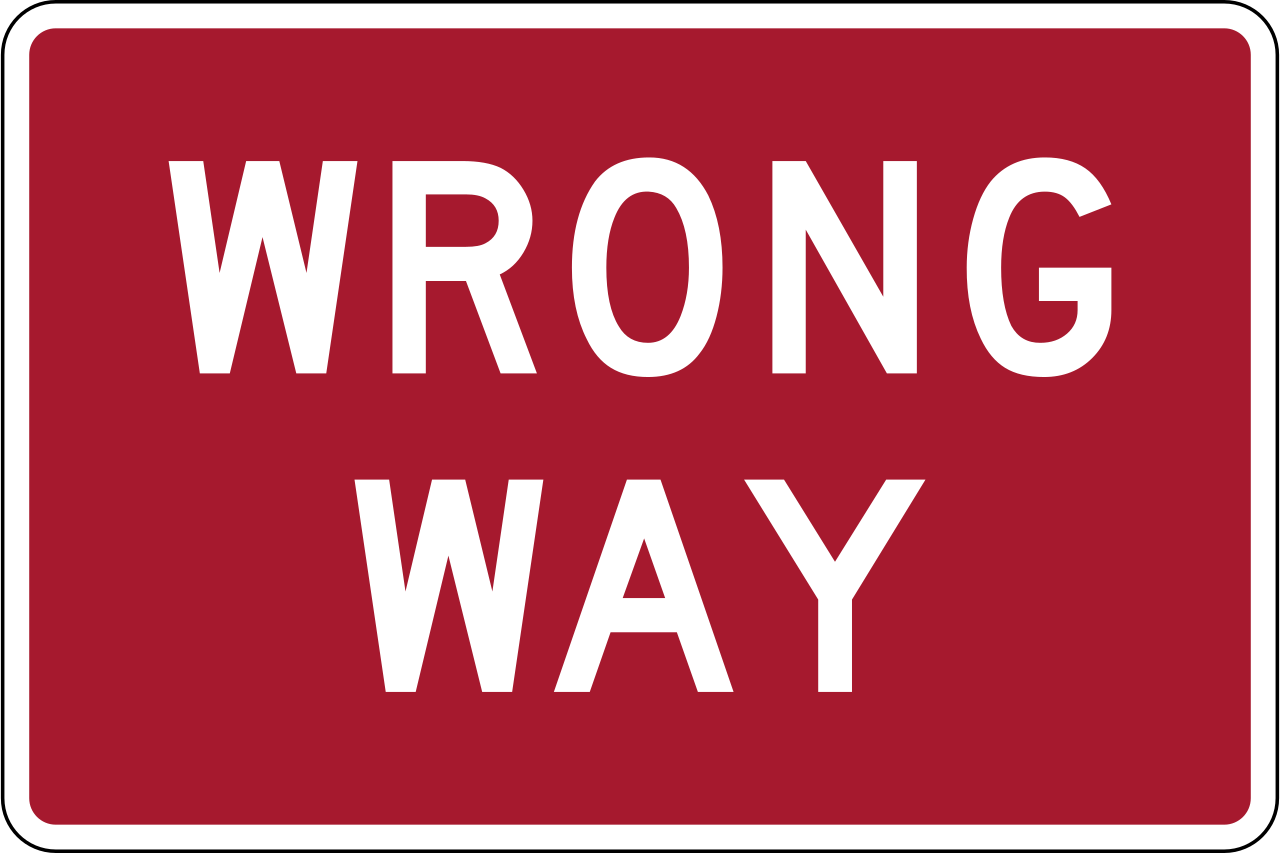
You are driving against the legal flow of traffic on a one-way street or freeway ramp. Immediately pull over, stop safely, and turn around when clear.
When drivers see this road sign:
A) they must come to a complete stop and call the police.
B) they must not drive past this sign.
C) they must turn around immediately.
7.
The yield sign is ___ and white, with ___ letters.
A) yellow; black
B) red; red
C) red; white
8.
If another vehicle passes you on the left, you must:
A) increase your speed slightly and keep to the right.
B) decrease your speed, then pull over to the right and stop.
C) decrease your speed slightly and keep to the right.
9.
Regulation signs normally are ____ rectangles with ____ letters or symbols.
A) yellow; black
B) white; black
C) green; white
10.
When driving through a curve, you should:
A) speed up as you enter, slow down as you exit.
B) stay near the right of your lane.
C) maintain constant speed.
D) slow as you enter, speed up as you exit.
11.
Prohibits drivers from making a 180-degree turn to travel in the opposite direction at this intersection or stretch of road.
This road sign means:
A) No left turn
B) No U-turn
C) Detour ahead
12.
As you approach an intersection, the traffic light changes from green to yellow. You should:
A) apply the brakes sharply and come to a complete stop.
B) be prepared to stop before the intersection.
C) be prepared to stop in the middle of the intersection.
D) speed up to beat the red light.
13.
When a driver is turning and a pedestrian is crossing without a traffic light, __________ must yield the right-of-way.
A) the pedestrian
B) the driver
C) both
D) whoever is slower
14.
Double solid lines on the roadway mean:
A) you cannot pass.
B) you can not go across the lines except to turn left to enter or leave the highway.
C) All of the above.
15.
Warns of two consecutive curves in opposite directions (e.g., curves right then left). Slow down to maintain control.
This sign warns drivers that:
A) the highway ahead is divided into two one-way roadways. Drivers should keep to the right.
B) there is a winding road ahead.
C) there is a double curve ahead.
16.
If you are continually being passed on the right, you should:
A) move into the right lane and allow other vehicles to pass you on the left.
B) move into the left lane and allow other vehicles to pass you on the right.
C) increase your speed immediately.
17.
An emergency vehicle that uses lights and a siren can be unpredictable. Why?
A) The driver can legally pass red lights.
B) Emergency vehicles must go faster than the posted speed limit when it is safe to do so.
C) Emergency vehicle drivers are not required to be careful.
18.
If you are 18 years or older with four traffic convictions in 24 months, you will get a:
A) six months suspension.
B) 90 days restriction.
C) eighteen months suspension.
D) 30 days suspension.
19.
Before entering a traffic circle, drivers must slow down and yield to ___________ in the traffic circle.
A) pedestrians
B) vehicles
C) bicyclists
D) All of the above.
20.
When you reach an intersection with a stop sign, you should:
A) follow the vehicle ahead of you.
B) stop, look right, then left, then right again.
C) stop, look left, then right, then left again.
D) check your rearview mirror, look left, then right, then proceed.
21.
What is the main reason night driving is more difficult than daytime driving?
A) The use of headlight is required by law.
B) Reduced visibility.
C) Driving within the range.
22.
A steep downhill grade is ahead. Trucks and heavy vehicles should downshift to a lower gear to prevent brake overheating.
This road sign means:
A) Truck stop ahead
B) No trucks allowed
C) Hill or downgrade up ahead
23.
Posted on the far side of a sharp curve or T-intersection to indicate a sharp change in direction of travel.
This sign means:
A) Not enter
B) Detour to the right
C) The road to the right is for one-way traffic only
24.
The ‘Slower Traffic Keep Right’ sign is used:
A) at most intersections.
B) on multiple lane highways.
C) in school zones.
25.
The road makes a sharp 90-degree right turn ahead. Slow down considerably before entering the turn.
This sign warns drivers of:
A) a side road.
B) a sharp turn.
C) a cross road.
26.
When entering a crowded freeway, to merge into traffic you should:
A) yield to vehicles already on the freeway.
B) use the acceleration lane to adjust your speed to the same speed as freeway traffic.
C) check your blind spots.
D) All of the above.
27.
When changing lanes, __________ to be sure no one is in the 'blind spot'.
A) check your right mirror
B) slow down gradually
C) check your left mirror
D) glance over your shoulder
28.
Worn tires:
A) may cause you to hydroplane even with very little water on the road.
B) can increase your stopping distance.
C) can make turning more difficult.
D) All of the above.
29.
Warns of an upcoming STOP sign that may not be immediately visible. Begin slowing down to prepare for a complete stop.
This road sign means:
A) Railroad Warning
B) Stop Sign Ahead
C) Lane ends
D) Stop if necessary
30.
When you are in a line of traffic that is crossing a railroad track that has no signals or gates:
A) you may pass slower drivers crossing the track.
B) before you start to cross, you need to make sure there is space to get all the way across the tracks without stopping.
C) you have the right of way and do not need to check for trains.
D) All of the above.
31.
When making a turn, drivers must _____ their speed.
A) reduce
B) maintain
C) increase
D) double
32.
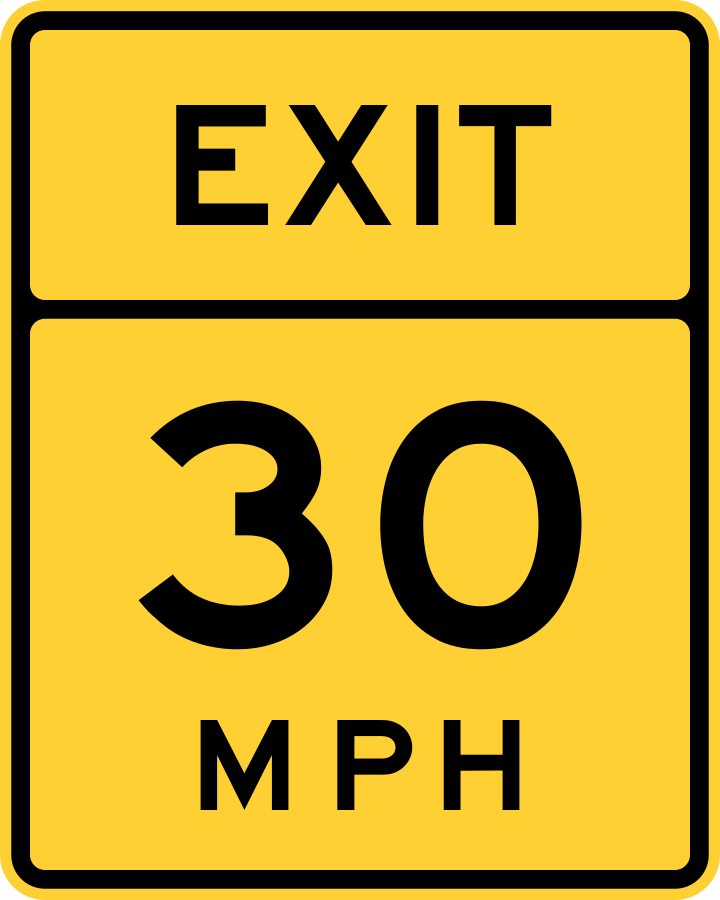
Recommends a safe speed of 30 MPH for negotiating the freeway exit ramp deceleration lane.
The sign in the picture:
A) shows the highest speed drivers can travel at the exit of the intersection.
B) is used to advise motorists of the appropriate ramp speed at the highway exit point.
C) indicates the minimum ramp speed at the highway exit point.
33.
When approaching a highway-rail intersection, the first sign drivers see is usually:
A) an RXR round sign on a yellow background.
B) a stop sign.
C) a yield sign.
34.
If a vehicle is approaching with high beams, drivers should look __________ until the vehicle passes.
A) to the right of the road
B) at the center of the road
C) to the left of the road
D) straight ahead
35.
Which shape is a yield sign?
A) Vertical rectangle
B) Upside-down triangle
C) Diamond
ANSWER KEY Check answers after completing the test.
1 C
2 C
3 C
4 A
5 B
6 C
7 B
8 C
9 B
10 D
11 B
12 B
13 B
14 C
15 C
16 A
17 A
18 D
19 D
20 C
21 B
22 C
23 B
24 B
25 B
26 D
27 D
28 D
29 B
30 B
31 A
32 B
33 A
34 A
35 B