DriveQuiz drivequiz.com

OR DMV PERMİT PRACTİCE TEST 13

Oregon
Duration: 32 min
|
Questions: 35
Student Name:
Date:
Correct:      Incorrect:      Score:      
1.
Which signs have black letters on a yellow or orange background?
A) Warning signs (diamond)
B) Regulatory signs (vertical rectangle)
C) Railroad advance warning signs (round)
2.
The roadway ahead is narrowing or a lane is ending. Merge smoothly into the continuing lane.
This sign warns drivers that:
A) there is a one lane bridge ahead.
B) the right lane ends.
C) the road ahead is narrow.
3.
You can pass on the right:
A) when a vehicle ahead makes a right turn.
B) when a vehicle ahead makes a left turn.
C) when a vehicle that is approaching from the opposite direction is prepared to turn left.
4.
When you come to an intersection with a flashing red light, you must:
A) stop at the intersection, then proceed when safe and observe the right-of-way rules.
B) slow down and drive carefully through the intersection.
C) stop at the intersection and wait for a flashing green light.
D) stop only if cars are approaching the intersection.
5.
The roadway becomes particularly slippery during wet or rainy conditions. Reduce your speed, increase following distance, and avoid abrupt braking or steering.
This sign means:
A) The road will curve to the right, then to the left.
B) Road slippery when wet. Drive slowly.
C) Winding road ahead. Drive with caution.
6.
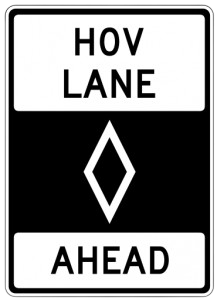
High-Occupancy Vehicle (HOV) diamond lane ahead. Only vehicles carrying the minimum required number of passengers (usually 2 or more) may use this lane.
This road sign indicates that:
A) a lane is reserved for certain purposes or certain vehicles.
B) buses and car pools may not travel in the restricted lane.
C) vehicles cannot go straight ahead. Cars must turn either to the right or left.
7.
Which of the following is NOT true about ABS?
A) It improves the vehicle stability.
B) It helps increase your stopping distance.
C) It improves the steering ability.
8.
The traffic light is green and you want to drive straight through an intersection. If a car is already in the intersection and is making a turn, you must:
A) enter the intersection and then stop.
B) drive through the intersection. You have the right-of-way.
C) let that car complete its turn before you enter the intersection.
9.
You hear a siren close by but can not see where the emergency vehicle is. What do you do?
A) Keep driving until you are sure the emergency vehicle is headed toward you.
B) Stop immediately and activate your emergency flashers.
C) Pull over to the right side of the road and stop until you are sure the emergency vehicle is not headed toward you.
10.
Which of the following does NOT affect the distance that it takes to stop your vehicle?
A) Perception time.
B) Braking distance.
C) Reaction distance.
D) Steering ability.
11.
The amount of space you need to cross traffic depends on the:
A) road and weather conditions and oncoming traffic.
B) number of cars behind you.
C) presence of a yield sign.
D) number of cars in front of you.
12.
Another road crosses the highway ahead. Look left and right for crossing or entering vehicles.
This road sign means:
A) Crossroads ahead
B) Side Road
C) Turn right or go through
D) Flagger ahead
13.
If another car has stopped in an adjacent lane in the same direction of travel, you should:
A) speed up and pass the vehicle on the right.
B) pass the car on the left.
C) be careful in case the other vehicle has stopped for a pedestrian.
D) tap your horn to let the other driver know you are passing.
14.
A driver who approaches an intersection:
A) must yield the right-of-way to traffic already in the intersection.
B) must drive straight through the intersection, even if another vehicle is already in the intersection.
C) has the right-of-way over traffic already in the intersection.
15.
Diamond-shaped signs:
A) are used to warn of hazards on roadways.
B) indicate no pass zones.
C) typically provide guidance to drivers.
16.
The road curves gradually to the right ahead. Reduce speed before entering the curve.
This sign is used to warn drivers about:
A) road construction.
B) changes in traffic lanes.
C) curves ahead.
D) drowsy driving.
17.
When in a motor vehicle on a highway, it is:
A) illegal to drink from, but permissible to transport, open containers of alcohol in the passenger compartment.
B) illegal to possess an open container of alcohol in the passenger compartment.
C) acceptable to drink alcoholic beverages if you are not driving.
D) permissible to drink a moderate amount of alcohol when driving with a passenger.
18.
The median divider ends ahead, and you are returning to a two-way, two-lane undivided roadway. Watch for oncoming traffic on your left.
This sign means:
A) Reversible lane ahead.
B) The divided highway ends ahead.
C) Drivers are coming to a point where another traffic lane joins the one they are on.
19.
Indicates a series of three or more consecutive sharp turns or curves ahead. Reduce speed and maintain lane control.
This road sign means:
A) Winding Road Ahead
B) No turns are allowed on this road
C) Right lane closed
D) Do Not Enter
20.
When you approach a railroad crossing, but you do not see a train. You must stop:
A) if a stop sign is posted.
B) if the crossing lights are flashing.
C) if a crossing gate is lowered.
D) All of the above.
21.
__________ are blue with white letters and symbols.
A) Warning signs
B) Service signs
C) Destination signs (guide signs)
22.
To avoid having to make an emergency stop while driving in traffic, drivers should:
A) drive in the right lane only.
B) look ahead and maintain a safe following distance.
C) sound their horn to warn other drivers.
D) drive slower than the flow of traffic.
23.
Reflective orange triangle displayed on vehicles traveling at 25 MPH or slower (such as farm tractors or construction machinery). Approach with caution and pass safely.
This sign indicates:
A) A slow-moving vehicle
B) A no-passing zone
C) Yield
24.
When they see a crossbuck sign, drivers:
A) must slow down and wait for the red lights to flash.
B) must always come to a complete stop.
C) are legally required to yield the right of way to trains.
25.
Two motorcyclists are allowed to:
A) ride side-by-side in a single lane.
B) share the lane with another vehicle.
C) race on empty roads.
26.
The roadway ahead is narrowing or a lane is ending. Merge smoothly into the continuing lane.
This sign warns that:
A) traffic must merge left.
B) the bridge ahead is wide enough for only one vehicle at a time.
C) traffic must merge right.
27.
Right turns are strictly prohibited at this intersection under all circumstances.
This sign tells drivers that:
A) they must make a left turn at the intersection.
B) U-turns are not allowed.
C) they must not make a right turn.
D) None of the above.
28.
What do flashing red lights on a school bus indicate?
A) The bus is stopped to load or discharge passengers.
B) Traffic that approaches from either direction may proceed.
C) The bus is about to stop.
29.
What should you do if you see smoke come from under the hood?
A) Call the fire department and then pull off the road and park your vehicle.
B) Pull off the road and park your vehicle. Turn off the ignition, get away from the car and call the fire department.
C) Try to fight the fire yourself.
30.
When meeting a car with blinding headlights, you should:
A) look toward the right side of the road.
B) dim your lights, then speed up and pass quickly.
C) use your emergency flashers to warn the other driver.
D) look toward the left side of the road.
31.
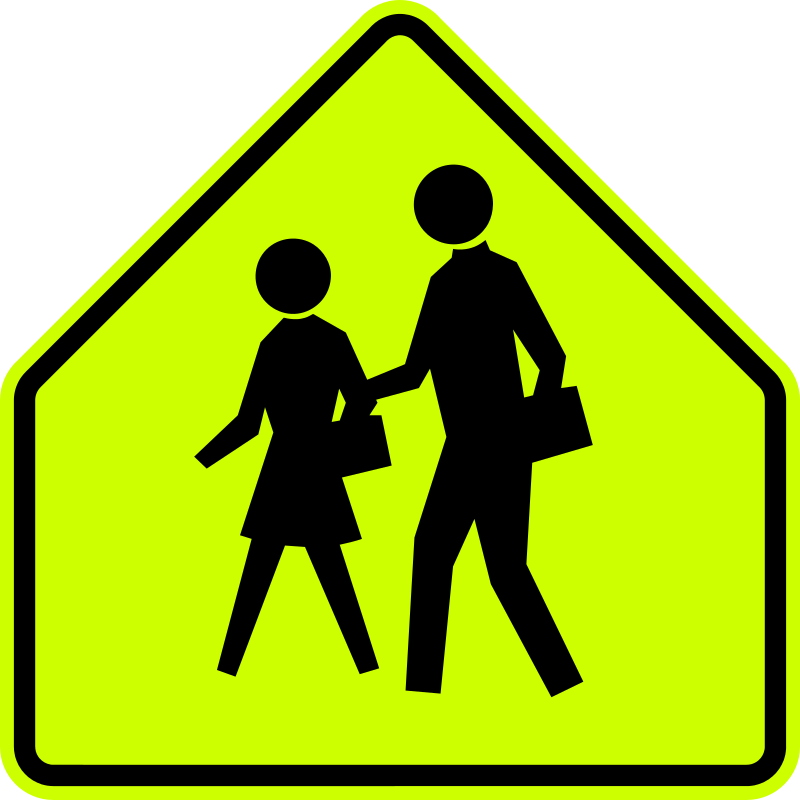
Five-sided pentagon sign indicating an upcoming school area. Watch for children crossing, school buses, and observe posted reduced school speed limits.
This sign means:
A) Business area nearby. Watch for business people.
B) There is a work zone ahead. Watch for workers.
C) The driver is near a school and should watch for children.
32.
Always maintain a safe following distance from the vehicle in front of you. A safe following distance is defined as:
A) 5-10 seconds.
B) One second.
C) 4-6 seconds.
D) 2-4 seconds.
33.
When you need to enter a freeway exit ramp:
A) don't slow down on the freeway itself. Wait until you are in the deceleration lane.
B) pass slower vehicles on the right.
C) slow down before entering the exit ramp.
D) don't slow down on the freeway itself, and maintain your speed once in the exit ramp.
34.
Drivers should use the horn:
A) if a driver is moving slowly, and you want them to drive faster.
B) only when necessary, to avoid collisions.
C) when feeling angry or upset.
D) to alert other drivers that they made a mistake.
35.
Does a vehicle prepared to enter a traffic circle or rotary have right-of-way over vehicles in the circle?
A) Yes, but only if they are entering the rotary from the right lane.
B) No. Vehicles already in the circle have the right-of-way.
C) Only if the light is green.
D) Yes.
ANSWER KEY Check answers after completing the test.
1 A
2 B
3 B
4 A
5 B
6 A
7 B
8 C
9 C
10 D
11 A
12 A
13 C
14 A
15 A
16 C
17 B
18 B
19 A
20 D
21 B
22 B
23 A
24 C
25 A
26 A
27 C
28 A
29 B
30 A
31 C
32 D
33 A
34 B
35 B