A)Narrow bridge ahead. Slow down and drive with caution.
B)Do not to enter if your vehicle is taller than the height listed on the sign.
C)No passing zone ahead.
3.
A 4-way stop sign means:
A)The first vehicle to reach the intersection should move forward first.
B)Traffic from all four directions must stop.
C)There are four stop signs at the intersection.
D)All of the above.
4.
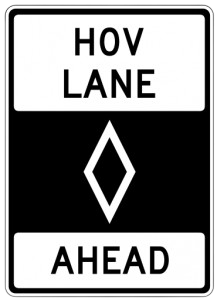
This road sign indicates that:
A)a lane is reserved for certain purposes or certain vehicles.
B)buses and car pools may not travel in the restricted lane.
C)vehicles cannot go straight ahead. Cars must turn either to the right or left.
5.
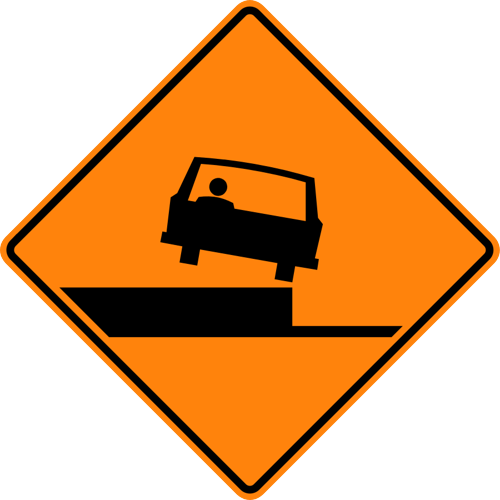
This road sign means:
A)Low shoulder
B)Stop ahead
C)Tow away zone
D)Buggy warning
6.
Regulation signs normally are:
A)white triangles.
B)green rectangles.
C)white rectangles.
7.
This road sign means:
A)Right turn permitted on red light
B)Drivers must turn right
C)No U-turns
D)No right turn permitted
8.
This road sign means:
A)No left turn
B)No U-turn
C)Detour ahead
9.
This sign warns drivers that:
A)the road will make a sharp turn to the right.
B)right turns are not allowed.
C)another road enters the highway from the direction shown.
10.
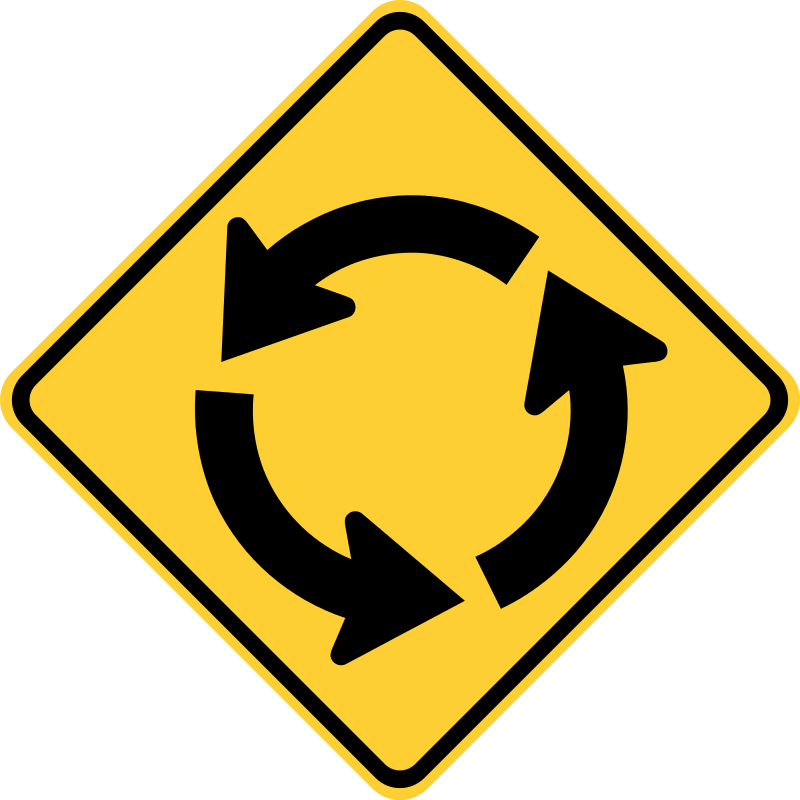
This road sign:
A)warns drivers of a sharp turn left. Drivers should slow their speed and keep to the left.
B)provides an advance notice of a roundabout.
C)warns drivers that U-turns are not permitted.
D)is a no-right-turns sign.
11.
This sign warns drivers of:
A)low clearance.
B)a narrow bridge ahead.
C)a low place in the road.
12.
This road sign means:
A)Stop before turning right
B)4-way stop ahead
C)Lane closed for traffic
D)There is a traffic signal ahead
13.
When they approach this sign, drivers must:
A)slow down and watch for children crossing the road.
B)obey signals from crossing guards.
C)stop if necessary.
D)All of the above.
14.
This sign means:
A)Divided highway ahead.
B)Divided highway ends.
C)Drivers will soon be on a roadway with two-way traffic.
15.
Vertical rectangles tell drivers:
A)the law.
B)what is not allowed.
C)the direction they should travel.
16.
When they see this sign, drivers should:
A)increase their speed and keep well to the right.
B)slow down and keep well to the right.
C)slow down and keep well to the left.
17.
This sign means:
A)No traffic signal ahead
B)Traffic signal ahead
C)Open intersection ahead
18.
What does a flashing yellow light mean?
A)The same thing as a stop sign.
B)Drivers may move forward with caution.
C)All of the above.
19.
A four-way stop sign means:
A)traffic from all four directions must stop.
B)if two vehicles reach the intersection at the same time, the driver on the left yields to the driver on the right.
C)All of the above.
20.
This sign tells drivers that:
A)left and right turns are not allowed.
B)a divided highway is ahead.
C)they cannot go straight ahead.
21.
Doing all you can to prevent crashes is called:
A)Anti-Collision Driving
B)Crash-Prevention Driving
C)Defensive Driving
D)ABS Driving
22.
In case of skidding, drivers should NOT:
A)take their foot off the gas pedal.
B)pump the brakes gently if they are about to hit something.
C)tap the gas pedal with their foot.
23.
Before backing up, you should:
A)get off the car to see if it is clear to proceed.
B)rely on your mirrors to see if it is clear to proceed.
C)turn your head and look through the rear window.
D)flash your headlights.
24.
While driving, it is important to slow down:
A)when the road is wet.
B)on narrow roads.
C)at intersections.
D)All of the above.
25.
Bicyclists must:
A)ride in a bicycle lane, if available.
B)remain to the right when they prepare for a left turn.
C)remain near the left edge of the road.
26.
You reach an intersection that is not controlled at the same time as a driver on your right, and both of you prepare to go straight. Who has the right-of-way?
A)You.
B)No one.
C)The other driver.
27.
When exiting a highway, you should slow down:
A)when you first see the exit sign.
B)before moving into the exit lane.
C)once you have moved into the exit lane.
D)once you see the toll booth.
28.
What is a likely effect when you take another drug while you drink alcohol?
A)The effects of the alcohol and the drug are enhanced.
B)There are no effects, unless the drug is prescription only.
C)If the drug is over-the-counter, there are no effects.
29.
Never make a U-turn from:
A)the lane you’re in.
B)the right lane.
C)the left part of the lane nearest to the centerline of the roadway.
30.
If a traffic officer signals you to drive through a red light:
A)you must do it.
B)you must wait for the red light to turn green.
C)you must not obey the officer. Signs and signals take precedence over directions given by traffic officers.
31.
What should you do in case of a brake failure?
A)Pull off the road into an open space, if available.
B)Apply the parking brake slowly.
C)All of the above.
32.
Double solid lines on the roadway mean:
A)you cannot pass.
B)you can not go across the lines except to turn left to enter or leave the highway.
C)All of the above.
33.
When changing lanes, you should not:
A)signal your intentions early.
B)check your side and rear view mirrors.
C)use the inside rearview mirror to check for blind spots
D)check to see if other drivers are moving into the same lane.
34.
Where there is no bicycle lane, where on the road must a bicyclist ride?
A)on the left shoulder of the road.
B)near the right curb or edge of the road.
C)near the left edge of the road.
35.
Vehicle stopping distance never depends on:
A)the condition of your vehicle's brakes.
B)your own reaction time.
C)the time of day.
D)the condition and type of vehicle tires.
36.
When driving on a wet road:
A)as you drive faster, your tires may lose traction.
B)you must be aware that the pavement gets even more slippery when it's been raining for long periods of time.
C)you should follow the vehicle ahead of you more closely.
D)as you decrease your speed, the road becomes more slippery.
37.
When the driver behind you wants to pass, you should:
A)change lanes.
B)speed up.
C)use your brake lights.
D)slow down to allow room for the other driver to complete the pass safely.
38.
When you pass another vehicle, before you return to the right lane, you must:
A)look at your interior rear-view mirror.
B)signal.
C)All of the above.
39.
You want to turn left at an intersection ahead. A car reaches the intersection from the opposite direction and moves straight ahead. You:
A)can turn left. You have the right of way.
B)must wait for the car to go through before you turn.
C)may not enter the intersection to prepare for your left turn if the light is green.
40.
When traveling on a highway divided into four traffic lanes, which vehicles are required to stop for a school bus that has stopped to unload children?
A)All vehicles approaching the bus from either direction.
B)No one is required to stop unless children are in view.
C)All vehicles may pass the bus after providing an audible signal.
D)Only vehicles approaching the rear of the bus traveling in the same direction as the bus.
ANSWER KEYCheck answers after completing the test.