←
Back to Test
Hide Answer Key
Print / Save as PDF
Print / PDF
drive
quiz
.com
NY DMV PERMİT PRACTİCE TEST 15
New York
Duration: 18 min
|
Questions: 20
Student Name:
Date:
Correct:
Incorrect:
Score:
1.

This sign indicates that:
A)
the highest safe speed drivers should travel around the curve ahead is 25 MPH.
B)
the safe speed around the curve ahead is at least 25 MPH.
C)
drivers may not turn right if traveling at 25 MPH or less.
2.
A large vehicle is backing up to unload goods. You should:
A)
enter one of the blind spots and wait.
B)
try to pass close behind.
C)
be patient and wait until the large vehicle has completed its backup maneuver.
3.
The driver of an emergency vehicle that uses lights and a siren can legally:
A)
pass red lights.
B)
exceed the speed limit
C)
All of the above.
4.
Driving with tires that have cuts down to the cords or bumps:
A)
decreases the stopping distance.
B)
is illegal.
C)
is only allowed on interstate highways.
D)
is not recommended.
5.
For a second Zero Tolerance violation, the driver license will be:
A)
be revoked for at least 18 months or until the driver reaches 18, whichever is longer.
B)
revoked for at least two years.
C)
revoked for at least one year or until the driver reaches 21, whichever is longer.
D)
suspended for 1 year.
6.
This sign tells drivers that:
A)
left and right turns are not allowed.
B)
a divided highway is ahead.
C)
they cannot go straight ahead.
7.
The speed limit on an expressway is normally:
A)
70 MPH
B)
45 MPH
C)
65 MPH
D)
55 MPH
8.
Never make a U-turn from:
A)
the lane you’re in.
B)
the right lane.
C)
the left part of the lane nearest to the centerline of the roadway.
9.
Drivers should be aware that a motorcyclist may:
A)
decrease speed and rise off the seat when approaching a railroad crossing.
B)
quickly change speed or lane position.
C)
All of the above.
10.
After you have parallel parked, how near to the curb must your vehicle be?
A)
No more than one foot.
B)
3 feet or less.
C)
2 feet.
D)
One foot or less.
11.
Which of the following must you obey over the others?
A)
Red light
B)
Stop sign
C)
Police officer
12.
What is the main reason night driving is more difficult than daytime driving?
A)
The use of headlight is required by law.
B)
Reduced visibility.
C)
Driving within the range.
13.
This sign means:
A)
The road will curve to the right, then to the left.
B)
Road slippery when wet. Drive slowly.
C)
Winding road ahead. Drive with caution.
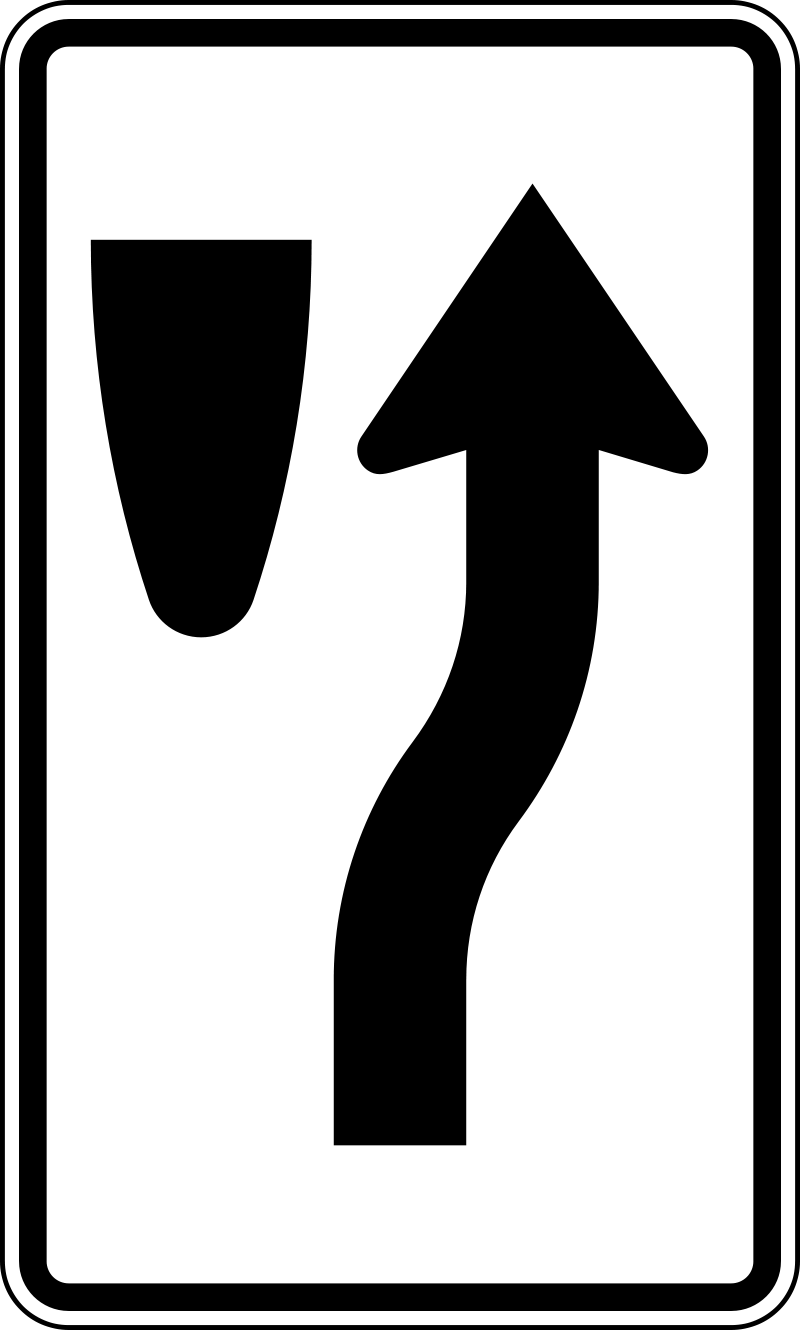
14.
This sign tells drivers that:
A)
there is a right turn ahead.
B)
they must stay on the right side of the divider
C)
a divided highway ends ahead.
15.
Vehicles must be inspected for maintenance and safety:
A)
at least once a year.
B)
at least twice a year.
C)
not less than 3 times a year.
D)
at least once every 18 months.
16.
What is the first thing to do when you make a three-point turn?
A)
Signal with your left turn signal, then check carefully for traffic coming toward you.
B)
Signal with your right turn signal, then pull over to the right and stop.
C)
Turn left, go across the road so you come to a stop while you face the edge of the road.
17.
If a driver follows you too closely, you should:
A)
move to another lane if possible.
B)
activate your stop lights.
C)
brake suddenly.
18.
Where must you position your vehicle when you prepare to make a left turn from a two-way roadway into a one-way roadway?
A)
As far to the right as possible.
B)
On the right curb.
C)
As close as possible to the center line.
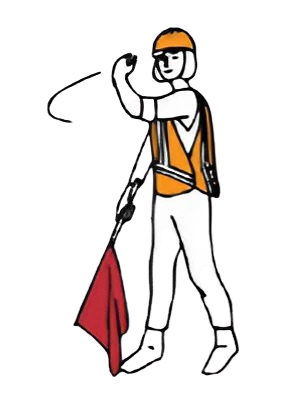
19.
This signal means:
A)
Slow down
B)
Turn right
C)
Stop
D)
Proceed
20.
In the following situations, drivers should increase their following interval:
A)
When following vehicles that are required to come to a stop at railroad crossings.
B)
When it is hard to see ahead because of bad weather.
C)
All of the above.
ANSWER KEY
Check answers after completing the test.
1
A
2
C
3
C
4
B
5
C
6
C
7
D
8
B
9
C
10
D
11
C
12
B
13
B
14
B
15
A
16
B
17
A
18
C
19
D
20
C