A)personal vehicles driven by volunteer firefighters.
B)authorized emergency vehicles.
C)hazard vehicles.
D)volunteer ambulance vehicles.
2.
Before crossing any railroad tracks, you must:
A)look and listen for trains.
B)make sure there is room for your vehicle on the other side.
C)All of the above.
3.
How far before a turn must you signal?
A)500 feet
B)100 feet
C)50 feet
D)250 feet
4.
Drivers of vehicles that display blue, green or amber lights:
A)can legally exceed the speed limit.
B)are free to go the wrong way when responding to an emergency.
C)must obey all traffic laws.
D)can legally pass red lights.
5.
To drink an alcoholic beverage in a motor vehicle on a public highway, street or road is:
A)a traffic infraction for a driver, but not for a passenger.
B)a criminal violation for a driver or passenger.
C)a misdemeanor for a driver, but not for a passenger.
D)a traffic infraction for a driver or passenger.
6.
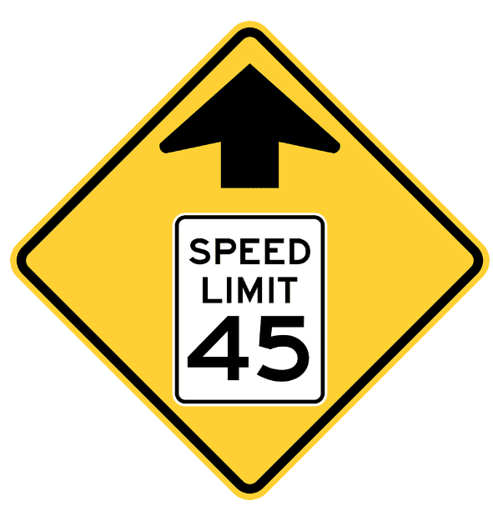
This warning sign:
A)provides advance notice to upcoming speed limit change.
B)shows the current speed limit that all vehicles traveling in the direction of the arrow must not exceed.
C)indicates the suggested highest safe speed.
7.
Which of the following is NOT a guideline for driving at night:
A)Use headlights between the hours of sunset and sunrise.
B)Don’t look directly at oncoming headlights.
C)Use high beams when you are within 100 feet of the vehicle ahead.
D)If you are leaving a brightly lit place, drive slowly until your eyes adjust to the darkness.
8.
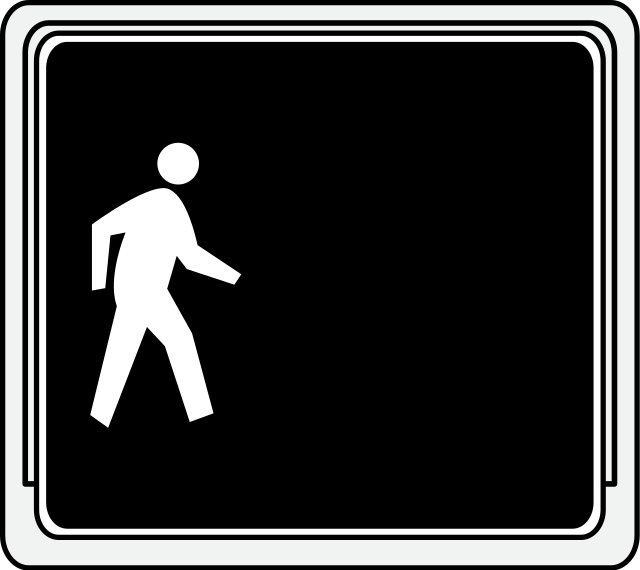
What does the pictured signal indicate?
A)A pedestrian may begin crossing the street.
B)Pedestrians may turn right.
C)A pedestrian may not not begin crossing the street.
9.
Parking is not allowed:
A)on the road side of a parked vehicle.
B)in a tunnel.
C)All of the above.
10.
If you are continually being passed on the right, you should:
A)move into the right lane and allow other vehicles to pass you on the left.
B)move into the left lane and allow other vehicles to pass you on the right.
C)increase your speed immediately.
11.
When they see this sign, drivers:
A)should be prepared to make sharp turns at a high speed.
B)need to be prepared to turn right and then left quickly.
C)should not speed up or brake quickly.
12.
In case of skidding, drivers should NOT:
A)take their foot off the gas pedal.
B)pump the brakes gently if they are about to hit something.
C)tap the gas pedal with their foot.
13.
When approaching any intersection or driveway, drivers should:
A)look both ways and be ready to stop.
B)pass other vehicles and then stop.
C)drive at the fastest speed just before entering the intersection.
14.
If no limit is posted, drive no more than:
A)55 MPH.
B)65 MPH.
C)the unposted speed limit.
D)35 MPH.
15.
New York State requires seat belt use:
A)by passengers 16 or older.
B)by adults, and seat belts, booster seats or child safety seats for children.
C)by the driver and front-seat passengers under 16.
D)None of the above.
16.
With conventional brakes, the correct way to stop in an emergency situation where traction is lost and the car slides is:
A)the “Push In” System.
B)the Anti-Slide System (ASS).
C)the ASB System.
D)by pumping the brakes.
17.
What should drivers do in case of a brake failure?
A)Shift to a lower gear.
B)Tie a white cloth on the left door handle.
C)Brake lightly.
18.
You can reduce the chance of a collision with a large vehicle if you:
A)delay near it.
B)cut abruptly in front of it.
C)pay close attention to the turn signals.
19.
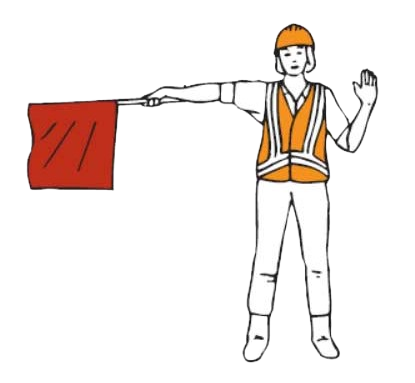
This signal means:
A)Stop
B)Move to the left
C)Slow down
D)Proceed
20.
You can not make a U-turn near the top of a hill or another location where other drivers can not see your vehicle from ___ feet away in either direction.
A)200
B)50
C)500
D)100
ANSWER KEYCheck answers after completing the test.