C)maintaining a 4-second following distance between your vehicle and any vehicle in front of you.
D)driving too fast for conditions.
2.
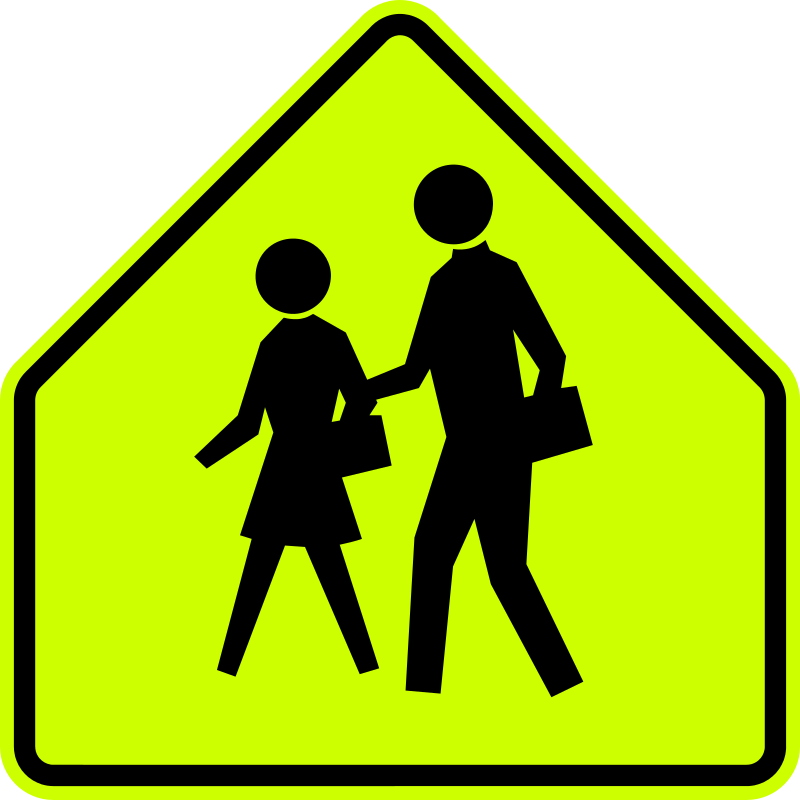
This sign means:
A)Business area nearby. Watch for business people.
B)There is a work zone ahead. Watch for workers.
C)The driver is near a school and should watch for children.
3.
If you become sleepy while driving you should:
A)get some rest or change drivers.
B)drink coffee.
C)open a window.
4.
When being passed by another vehicle, drivers should:
A)slow down.
B)slightly increase their speed.
C)maintain a constant speed.
5.
If your car goes into water, you should:
A)wait for water to rush in and let it out in small breaths through your nose.
B)call the fire department immediately.
C)remove yourself before it starts to sink.
6.
This sign means:
A)Bicycles should yield to vehicles ahead.
B)Warning: a bikeway crosses the roadway ahead.
C)The lane ahead is reserved for bicycles.
7.
Although there may be enough room in the traffic lane for an automobile and a motorcyclist, a vehicle driver should not share the lane with motorcyclists.
A)False
B)True
8.
The sign in the picture:
A)is a Construction and Maintenance Traffic Control sign.
B)is found at most intersections and indicates that drivers must yield to other vehicles.
C)is displayed on the rear of slow moving vehicles.
9.
This road sign means:
A)No left turn
B)No right turn
C)No U-turns
10.
Which of the following must you obey over the others?
A)Red light
B)Stop sign
C)Police officer
11.
When you see an emergency vehicle with flashing lights behind you, you must:
A)slow down and keep moving.
B)drive to the right edge of the road and slow down.
C)pull over to the right and stop.
D)stop as quickly as you can.
12.
If two vehicles arrive at a four-way stop at the same time:
A)both vehicles must stop.
B)the vehicle on the left must yield to the vehicle on the right.
C)the driver on the left must signal the driver on the right to go.
D)the vehicle on the right must yield to the vehicle on the left.
13.
If your vehicle has a mechanical problem, you should:
A)signal and pull into the slow lane.
B)stop in your lane and put on your emergency flashers.
C)turn on your hazard lights and pull off the road.
14.
When you drive into the street from any driveway you:
A)can disregard pedestrians if there is no sidewalk.
B)must drive slowly so approaching vehicles and pedestrians can get out of your way.
C)must honk the horn so approaching vehicles and pedestrians can allow you room.
D)must stop and proceed only when there are no pedestrians or vehicles approaching.
15.
When they approach this sign, drivers must:
A)slow down and watch for children crossing the road.
B)obey signals from crossing guards.
C)stop if necessary.
D)All of the above.
16.
You may park or stop along the shoulder of the freeway:
A)if you need to check your smartphone for directions.
B)only if you have an emergency.
C)if no part of your vehicle is on the road.
D)as long as you turn on your emergency flashers.
17.
What can you do to prevent skids on snow and ice?
A)Allow the wheels to keep turning.
B)Brake early and gently.
C)All of the above.
18.
What should drivers do when the red lights begin to flash?
A)Stop.
B)Yield.
C)Slow down.
19.
What should you do if you see smoke come from under the hood?
A)Call the fire department and then pull off the road and park your vehicle.
B)Pull off the road and park your vehicle. Turn off the ignition, get away from the car and call the fire department.
C)Try to fight the fire yourself.
20.
When you approach an intersection with a flashing yellow light, you must:
A)come to a complete stop, then proceed.
B)slow and proceed with caution.
C)maintain your normal speed.
21.
When changing lanes, you should not:
A)signal your intentions early.
B)check your side and rear view mirrors.
C)use the inside rearview mirror to check for blind spots
D)check to see if other drivers are moving into the same lane.
22.
This road sign means:
A)Winding road
B)Side road ahead
C)Slippery when wet
23.
BAC is:
A)the acronym for Beer ACcumulation.
B)the number of ounces of alcohol in your blood.
C)the percentage of alcohol in your blood.
ANSWER KEYCheck answers after completing the test.