DriveQuiz drivequiz.com

NJ DMV PERMİT PRACTİCE TEST 5

New Jersey
Duration: 45 min
|
Questions: 50
Student Name:
Date:
Correct:      Incorrect:      Score:      
1.
Proceed with caution. You do not need to stop unless pedestrians or hazards are present in the intersection.
What does a flashing yellow light mean?
A) The same thing as a stop sign.
B) Drivers may move forward with caution.
C) All of the above.
2.
If your car goes into water, you should:
A) wait for water to rush in and let it out in small breaths through your nose.
B) call the fire department immediately.
C) remove yourself before it starts to sink.
3.
What should you do in case of a brake failure?
A) Pull off the road into an open space, if available.
B) Apply the parking brake slowly.
C) All of the above.
4.
Regulation signs normally are:
A) white triangles.
B) green rectangles.
C) white rectangles.
5.
You may not turn right (or left from a one-way onto a one-way) while the traffic signal is red. Wait for the green signal before turning.
This sign tells drivers:
A) they must wait for the traffic signal to turn green before turning right or left.
B) they may not turn right or left during the red light.
C) All of the above.
6.
Double solid lines on the roadway mean:
A) you cannot pass.
B) you can not go across the lines except to turn left to enter or leave the highway.
C) All of the above.
7.
Your red traffic signal changes to green while a pedestrian is crossing in your traffic lane. The right of way should be given:
A) by the pedestrian, but only when vehicles are turning left.
B) by the pedestrian.
C) to the pedestrian.
8.
Which sign has white letters on a red background?
A) Stop
B) School zone
C) Yield
9.
A sharp curve is ahead with a recommended safe speed plate. Slow down before entering the curve to prevent vehicle rollover.
This sign indicates that:
A) the highest safe speed drivers should travel around the curve ahead is 25 MPH.
B) the safe speed around the curve ahead is at least 25 MPH.
C) drivers may not turn right if traveling at 25 MPH or less.
10.
At a stop sign there is no stop line, you must stop:
A) before you enter the intersection.
B) before you enter the crosswalk.
C) after you enter the crosswalk.
11.
On slippery roads, drivers should:
A) leave more space in front of their vehicle.
B) increase their speed to avoid hydroplaning.
C) come to a complete stop.
12.
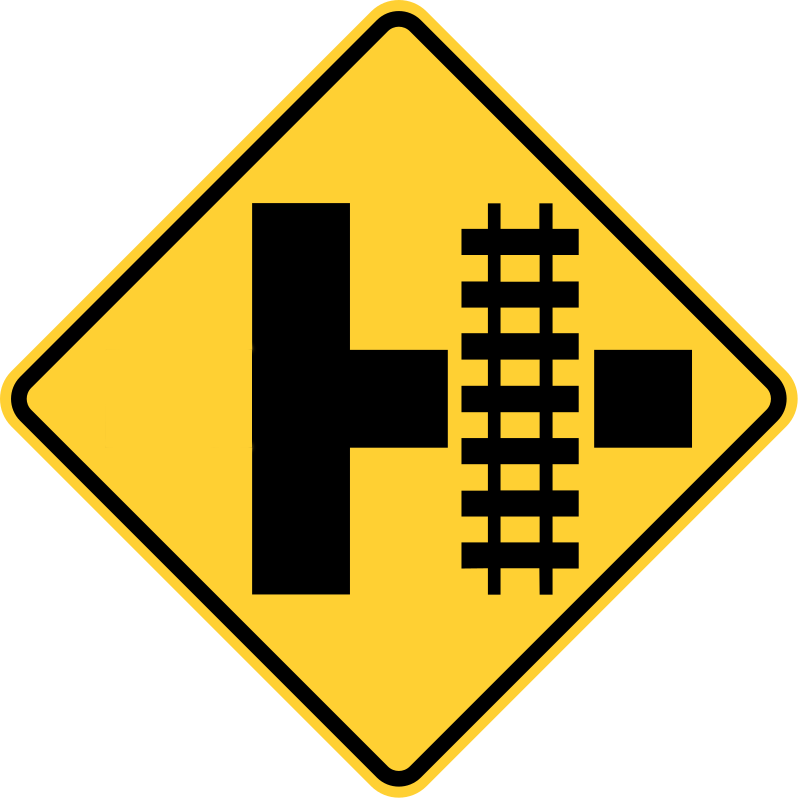
Four-way intersection ahead. Be prepared to yield right-of-way according to traffic control devices.
What does this sign indicate?
A) Parallel railroad crossing (side road)
B) Low ground clearance railroad crossing
C) Parallel railroad crossing (crossroad)
13.
When you reach an intersection with a stop sign, you should:
A) follow the vehicle ahead of you.
B) stop, look right, then left, then right again.
C) stop, look left, then right, then left again.
D) check your rearview mirror, look left, then right, then proceed.
14.
Warns of two consecutive curves in opposite directions (e.g., curves right then left). Slow down to maintain control.
When you see this sign you should:
A) increase your speed and try to pass other vehicles.
B) slow your speed and be prepared to stop.
C) slow your speed and do not pass other vehicles.
15.
As you drive on the expressway, make sure:
A) you cut off vehicles behind you when you change lanes.
B) to signal all lane changes.
C) your directional signal goes off before you change lanes.
16.
The median divider ends ahead, and you are returning to a two-way, two-lane undivided roadway. Watch for oncoming traffic on your left.
What does this sign indicate?
A) The highway ahead is divided into two one-way roadways.
B) Winding road ahead. Drive with caution.
C) Drivers will soon be on a roadway with two-way traffic.
17.
Regulatory signs are:
A) Suggestions
B) Warnings
C) Law
18.
The median divider ends ahead, and you are returning to a two-way, two-lane undivided roadway. Watch for oncoming traffic on your left.
This road sign means:
A) Curves ahead
B) Divided highway ahead
C) Divided highway ends
19.
Prohibits drivers from making a 180-degree turn to travel in the opposite direction at this intersection or stretch of road.
This road sign means:
A) No left turn
B) No U-turn
C) Detour ahead
20.
The amount of space you need to cross traffic depends on the:
A) road and weather conditions and oncoming traffic.
B) number of cars behind you.
C) presence of a yield sign.
D) number of cars in front of you.
21.
A steady yellow light means that a ______ light will soon appear.
A) steady green
B) steady red
C) flashing yellow
D) flashing green
22.
Where must you position your vehicle when you prepare to make a left turn from a two-way roadway into a one-way roadway?
A) As far to the right as possible.
B) On the right curb.
C) As close as possible to the center line.
23.
The road ahead is divided by a median strip or physical barrier into two separate one-way roadways. Keep to the right of the divider.
This sign means:
A) Divided highway ahead.
B) Divided highway ends.
C) Drivers will soon be on a roadway with two-way traffic.
24.
Your BAC depends on:
A) how much alcohol you drink.
B) how much time passes between drinks.
C) All of the above.
25.
Right turns are strictly prohibited at this intersection under all circumstances.
This road sign means:
A) No left turn
B) No right turn
C) No U-turns
26.
Drivers may pass another vehicle if the line dividing two lanes is a ________ line.
A) broken white
B) double solid yellow
C) solid yellow
D) solid white
27.
What do warning signs mean?
A) Danger ahead.
B) Drivers are approaching a location where there is a special rule.
C) All of the above.
28.
What do flashing red lights on a school bus indicate?
A) The bus is stopped to load or discharge passengers.
B) Traffic that approaches from either direction may proceed.
C) The bus is about to stop.
29.
Bicyclists must:
A) ride in a bicycle lane, if available.
B) remain to the right when they prepare for a left turn.
C) remain near the left edge of the road.
30.
If you begin to feel drowsy while driving, you should:
A) open your window.
B) get some coffee.
C) get an energy drink.
D) stop driving.
31.
If the entrance lane is too short to allow acceleration to highway speed, you should:
A) go to the next entrance ramp.
B) stop and wait for a large gap in traffic, then enter the highway and accelerate quickly.
C) merge into highway traffic as soon as possible.
32.
If you stop at a railroad crossing with more than one track:
A) proceed with caution until you see a train.
B) go through when one of the tracks is free.
C) go through as soon as the first train passes.
D) wait until you have a clear view of both tracks.
33.
The effects of alcohol on driving include:
A) None of the above.
B) Improved coordination
C) Better reflexes
D) Improved judgement
34.
Your BAC depends on:
A) how fit you are.
B) the type of beverage you drink.
C) the amount of alcohol you drink.
35.
If another car is in danger of hitting you, you should:
A) flash your brake lights.
B) sound your horn.
C) use your emergency lights.
D) flash your headlights.
36.
Indicates a series of three or more consecutive sharp turns or curves ahead. Reduce speed and maintain lane control.
This road sign means:
A) Pavement ends
B) Winding road
C) Double curve ahead
37.
__________ limit(s) your concentration, perception, judgment, and memory.
A) Even the smallest amount of alcohol
B) Only a blood alcohol level greater than .05
C) Alcohol does not
D) Only a blood alcohol level greater than the legal limit
38.
The road makes a sharp 90-degree right turn ahead. Slow down considerably before entering the turn.
This road sign means:
A) School zone ahead
B) Side road
C) Construction zone ahead
D) Sharp turn, slow down
39.
A steep downhill grade is ahead. Trucks and heavy vehicles should downshift to a lower gear to prevent brake overheating.
This road sign means:
A) No right turn
B) No left turn
C) Narrow Bridge
D) Steep downgrade
40.
Slow down and give right-of-way to all oncoming vehicles, cyclists, and pedestrians. Stop completely if necessary before entering the intersection or merging.
This road sign means:
A) You must come to a complete stop
B) Do not enter
C) Slow down, stop if necessary and yield the right-of-way
D) Merging traffic
41.
Slow down and give right-of-way to all oncoming vehicles, cyclists, and pedestrians. Stop completely if necessary before entering the intersection or merging.
The yield sign means:
A) Drive with caution in wet weather.
B) You must come to a complete stop.
C) Slow down and give vehicles crossing your path the right-of-way.
42.
The roadway ahead is narrowing or a lane is ending. Merge smoothly into the continuing lane.
This sign warns that:
A) traffic must merge left.
B) the bridge ahead is wide enough for only one vehicle at a time.
C) traffic must merge right.
43.
ABS is the acronym for:
A) Anti-Braking System
B) Average-Beam System
C) Anti-Locking Brake System
44.
Before backing up, you should:
A) get off the car to see if it is clear to proceed.
B) rely on your mirrors to see if it is clear to proceed.
C) turn your head and look through the rear window.
D) flash your headlights.
45.
For protection, motorcyclists are required to:
A) keep their headlights and taillights on at all times.
B) signal turns, lane changes and stops.
C) wear approved helmets.
46.
Warns drivers that two separate lanes moving in the same direction are merging into one. Drivers in the right lane must adjust speed and merge smoothly with existing traffic.
This road sign means:
A) Cars in right lane must slow down
B) Merging traffic ahead
C) Pass only in the right lane
D) No left turn
47.
Which of the following is a defensive driving skill/technique?
A) Maintain the correct speed.
B) Do not drive if you are very weary.
C) All of the above.
48.
The yield sign is ___ and white, with ___ letters.
A) yellow; black
B) red; red
C) red; white
49.
The roadway becomes particularly slippery during wet or rainy conditions. Reduce your speed, increase following distance, and avoid abrupt braking or steering.
This sign indicates:
A) Warning: drunk drivers.
B) Winding road. Drive with caution.
C) The road may be slippery when wet. Drive slowly.
50.
Are bicyclists required to obey traffic laws and signs?
A) No, bicyclists are considered pedestrians when it comes to the rules of the road.
B) Yes.
C) Yes, but only if they are riding in a bicycle lane.
ANSWER KEY Check answers after completing the test.
1 B
2 C
3 C
4 C
5 C
6 C
7 C
8 A
9 A
10 B
11 A
12 A
13 C
14 C
15 B
16 C
17 C
18 C
19 B
20 A
21 B
22 C
23 A
24 C
25 B
26 A
27 C
28 A
29 A
30 D
31 B
32 D
33 A
34 C
35 B
36 B
37 A
38 D
39 D
40 C
41 C
42 A
43 C
44 C
45 C
46 B
47 C
48 B
49 C
50 B