←
Back to Test
Hide Answer Key
Print / Save as PDF
Print / PDF
drive
quiz
.com
NJ DMV PERMİT PRACTİCE TEST 2
New Jersey
Duration: 45 min
|
Questions: 50
Student Name:
Date:
Correct:
Incorrect:
Score:
1.
When approaching someone using a white cane, you should proceed with caution because:
A)
the pedestrian might be using a guide dog.
B)
the pedestrian might be blind.
C)
the pedestrian is deaf.
D)
the pedestrian is blind.
2.
What should you do if your headlights suddenly go out?
A)
Brake immediately and activate your emergency lights.
B)
Use your emergency lights, parking lights or directional signals.
C)
Ease your foot off the gas pedal and brake gently.
3.
What do pennant-shaped signs indicate?
A)
A school crossing
B)
Yield
C)
A No Passing Zone
4.
If a driver follows you too closely, you should:
A)
move to another lane if possible.
B)
activate your stop lights.
C)
brake suddenly.
5.
If your gas pedal is stuck, you should:
A)
hook your shoe under the pedal and see if you can free it. If not, shift into neutral and use the brake to slow your vehicle and get off the road.
B)
ease your foot off the gas pedal and brake gently.
C)
turn off the ignition if your vehicle has power steering.
6.
A broken yellow line alongside a solid yellow line means:
A)
Passing is permitted on the side of the broken yellow line
B)
Passing is not permitted in either direction
C)
Passing on the right is permitted in either direction
7.
This sign warns drivers that:
A)
they must turn either to the right or left.
B)
there is a double curve ahead.
C)
there is a winding road ahead.
8.
When they see a yellow X signal, drivers should:
A)
come to a complete stop at the marked stop line.
B)
turn off the ignition.
C)
prepare to leave the lane safely.
9.
It is important for drivers to know that trucks:
A)
are easier for the driver to operate.
B)
require more space for turning movements.
C)
take longer than cars to stop.
D)
require less time to pass on an incline than cars.
10.
This sign means:
A)
divided highway ahead.
B)
narrow bridge ahead.
C)
road construction.
D)
lane ends, merge left.
11.
An edge line that angles toward the center of the road indicates that:
A)
the road is narrower ahead.
B)
there’s a narrow bridge ahead.
C)
you must turn right.
12.
This road sign means:
A)
School zone ahead
B)
Pedestrians must not cross here
C)
Pedestrian crossing ahead
13.
Smoking while driving:
A)
does not affect driving abilities.
B)
is not distracting.
C)
helps increase driver alertness.
D)
is distracting.
14.
When you make a left turn from a two-way road into a four-lane highway, you must:
A)
enter the left lane, to the right of the center line.
B)
enter the right lane, to the left of the center line.
C)
go straight through the intersection, and then make the turn.
15.
Yellow traffic signs:
A)
guide drivers.
B)
when combined with an octagonal shape, tell drivers they must come to a complete stop at the marked stop line.
C)
warn drivers.
16.
Examples of proper glass maintenance include:
A)
Replacing worn wiper blades.
B)
Keeping your windows clean and clear.
C)
All of the above.
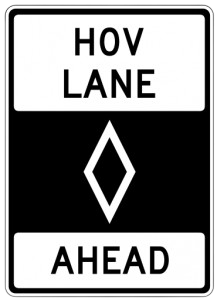
17.
This road sign indicates that:
A)
a lane is reserved for certain purposes or certain vehicles.
B)
buses and car pools may not travel in the restricted lane.
C)
vehicles cannot go straight ahead. Cars must turn either to the right or left.
18.
Are drivers allowed to exceed the speed limit to pass other vehicles?
A)
Yes, but only by 10 MPH or less.
B)
No.
C)
Yes, but only if they drive with caution.
19.
To avoid having to make an emergency stop while driving in traffic, drivers should:
A)
drive in the right lane only.
B)
look ahead and maintain a safe following distance.
C)
sound their horn to warn other drivers.
D)
drive slower than the flow of traffic.
20.
Drinking alcohol while taking drugs can:
A)
have a less pronounced effect than either taken separately.
B)
have a more pronounced effect than either taken separately.
C)
improves concentration.
D)
improve your driving performance.
21.
When driving in bad weather, drivers should:
A)
decrease the following distance.
B)
increase their speed to get to their destination more quickly.
C)
increase the following distance.
D)
None of the above.
22.
If your brakes are wet, you can dry them by:
A)
riding the pedal lightly.
B)
pull over to the right and wait until it stops raining.
C)
having them checked by a mechanic.
23.
This road sign means:
A)
Watch for bicycles
B)
Bicycle parking ahead
C)
Bicycles are not allowed in this area
24.
An octagonal sign means that drivers must:
A)
respect the posted speed limit.
B)
come to a complete stop at the marked stop line.
C)
be aware possible hazards ahead.
25.
When the road is slippery, you should:
A)
brake suddenly carefully.
B)
pump your brakes.
C)
press your brakes in slow, steady strokes.
26.
If your car starts to skid, turn your steering wheel:
A)
in the direction you want to go.
B)
in the opposite direction of the skid.
C)
to keep the front wheels straight.
D)
in any direction. It doesnt matter.
27.
This road sign means:
A)
No left turn
B)
No U-turn
C)
Detour ahead
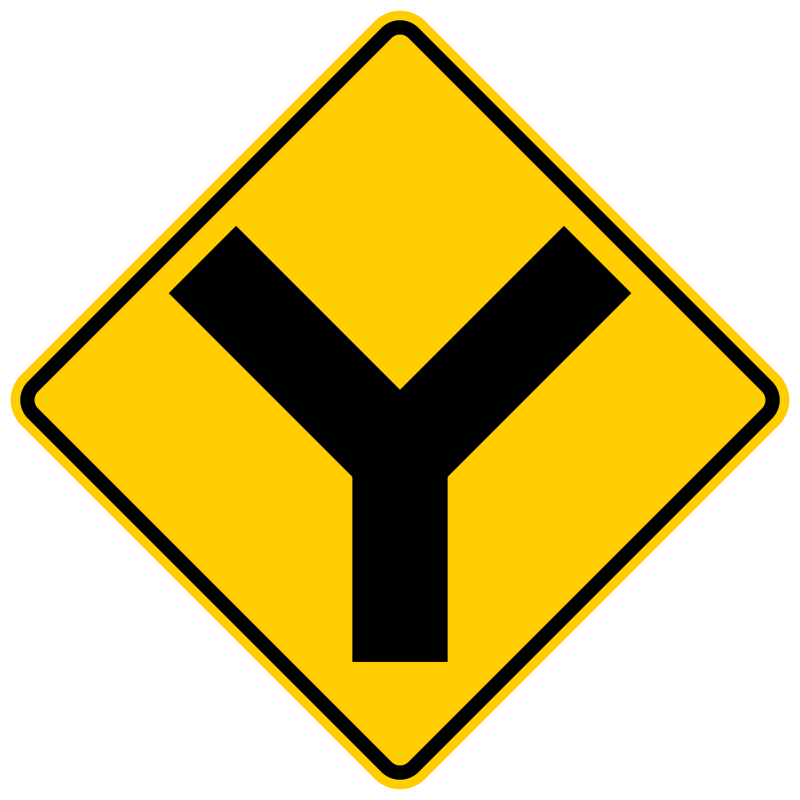
28.
This road sign means:
A)
The road ends ahead
B)
A four-way intersection is ahead
C)
“Y” intersection ahead
D)
A road joins from the right
29.
If an intersection has crosswalk lines but no STOP line, where must you stop for a red light?
A)
After the crosswalk.
B)
Before the stop line.
C)
Before the crosswalk.
30.
The Implied Consent Law means that:
A)
all passengers agree to wear their seat belts.
B)
you agree to let other passengers drive your vehicle after drinking alcohol.
C)
you agree to take a breath test when under arrest and suspected of drinking and driving.
D)
None of the above.
31.
This road sign means:
A)
School zone ahead
B)
Keep right
C)
Two-way Traffic
32.
At intersections where two or more drivers stop at STOP signs at the same time and they are at right angles:
A)
the driver on the left must yield to the driver on the right.
B)
the driver who is late for work has the right-of-way.
C)
the driver on the right must yield to the driver on the left.
33.
Air bags are meant to _________ seat belts.
A)
work with
B)
fix
C)
replace
34.
When children are close, what should you do before you back out of a driveway?
A)
Rely on your mirrors.
B)
Get out of the car and check behind the car.
C)
Look through your back window for children.
35.
Diamond-shaped signs:
A)
are used to warn of hazards on roadways.
B)
indicate no pass zones.
C)
typically provide guidance to drivers.
36.
All of the above.
A)
3 hours.
B)
30 minutes.
C)
one hour.
D)
10 minutes.
37.
When they see this sign, drivers should:
A)
be ready to brake sharply and stop.
B)
be ready to shift to lower gear.
C)
yield to trucks coming from the hill on the right.
38.
Pentagonal signs are used to indicate:
A)
possible hazards on roadways.
B)
no passing zones.
C)
school crossings.
39.
Drivers can not pass a vehicle on the left if:
A)
they approach the top of a hill on a two-way road and can not see over it.
B)
they can not safely return to the right lane before they reach a solid yellow center line for the right lane.
C)
All of the above.
40.
When driving on slick roads, drivers should:
A)
accelerate quickly.
B)
take turns more slowly.
C)
use alternate routes.
D)
drive as they would on dry roads.
41.
When getting ready to change lanes, you should:
A)
check your rearview mirror.
B)
quickly turn your head to check for other vehicles.
C)
check your side view mirror.
D)
All of the above.
42.
Drive below the posted speed limit when:
A)
anything makes conditions less than perfect.
B)
you are on a four lane road.
C)
entering a highway where there are other cars.
D)
others drive below the speed limit.
43.
After parking, are you allowed to open a door on the road side of your vehicle?
A)
Yes, always.
B)
Yes, but only if it does not interfere with bicyclists and other traffic.
C)
No, never.
44.
Warning signs normally are:
A)
rectangles.
B)
triangles.
C)
diamond-shaped.
45.
If you stop along the road at night:
A)
turn on your emergency flashers and leave your low beams on.
B)
turn off your emergency lights and leave your high beams on.
C)
turn on your headlights only.
D)
turn off all your lights.
46.
What should drivers do when the red lights begin to flash?
A)
Stop.
B)
Yield.
C)
Slow down.
47.
A large vehicle is backing up to unload goods. You should:
A)
enter one of the blind spots and wait.
B)
try to pass close behind.
C)
be patient and wait until the large vehicle has completed its backup maneuver.
48.
At night, it is hardest to see:
A)
street lights.
B)
pedestrians.
C)
other motorists.
D)
road signs.
49.
Drivers may continue carefully through a yellow light if:
A)
there are no pedestrians crossing.
B)
they are turning right.
C)
they already are within the intersection.
D)
an emergency vehicle is crossing your lane.
50.
This road sign warns drivers that:
A)
they are coming to a point where another traffic lane joins the one they are on.
B)
a divided highway is ahead.
C)
the one-way street or roadway is about to change to two-way traffic.
ANSWER KEY
Check answers after completing the test.
1
D
2
B
3
C
4
A
5
A
6
A
7
C
8
C
9
C
10
D
11
A
12
C
13
D
14
A
15
C
16
C
17
A
18
B
19
B
20
B
21
C
22
A
23
A
24
B
25
C
26
A
27
B
28
C
29
C
30
C
31
C
32
A
33
A
34
B
35
A
36
C
37
B
38
C
39
C
40
B
41
D
42
A
43
B
44
C
45
A
46
A
47
C
48
B
49
C
50
C