←
Back to Test
Hide Answer Key
Print / Save as PDF
Print / PDF
drive
quiz
.com
NH DMV PERMİT PRACTİCE TEST 8
New Hampshire
Duration: 36 min
|
Questions: 40
Student Name:
Date:
Correct:
Incorrect:
Score:
1.
If cars approaching from opposite directions reach an intersection at the same time:
A)
a car that moves straight must yield to cars that turn left.
B)
a car that turns left must yield to cars that move straight or turn right.
C)
a car that turns right must yield to cars that move straight or turn left.
2.
A driver cuts off another vehicle, or threatens another motorist or a pedestrian. These are examples of:
A)
excessive driving
B)
road rage
C)
defensive driving
3.
Two solid yellow lines on the pavement mean:
A)
passing is not allowed.
B)
passing is allowed during daylight only.
C)
passing is allowed for both drivers.
D)
passing is allowed if you are at the top of a hill.
4.
Which shape is a stop sign?
A)
Diamond
B)
Octagon
C)
Upside-down triangle
5.
What should drivers do when they see this road sign?
A)
come to a complete stop and wait for a train to cross.
B)
slow down, look for a train, and be prepared to stop.
C)
look for a human flagger.
6.
When meeting a car with blinding headlights, you should:
A)
look toward the right side of the road.
B)
dim your lights, then speed up and pass quickly.
C)
use your emergency flashers to warn the other driver.
D)
look toward the left side of the road.
7.
Many crashes are caused by:
A)
yielding the right of way.
B)
frequently checking mirrors and blind spot.
C)
maintaining a 4-second following distance between your vehicle and any vehicle in front of you.
D)
driving too fast for conditions.
8.
Who is most at risk?
A)
Drivers who have overslept.
B)
Drivers who are driving long distances without rest breaks.
C)
Experienced drivers.
9.
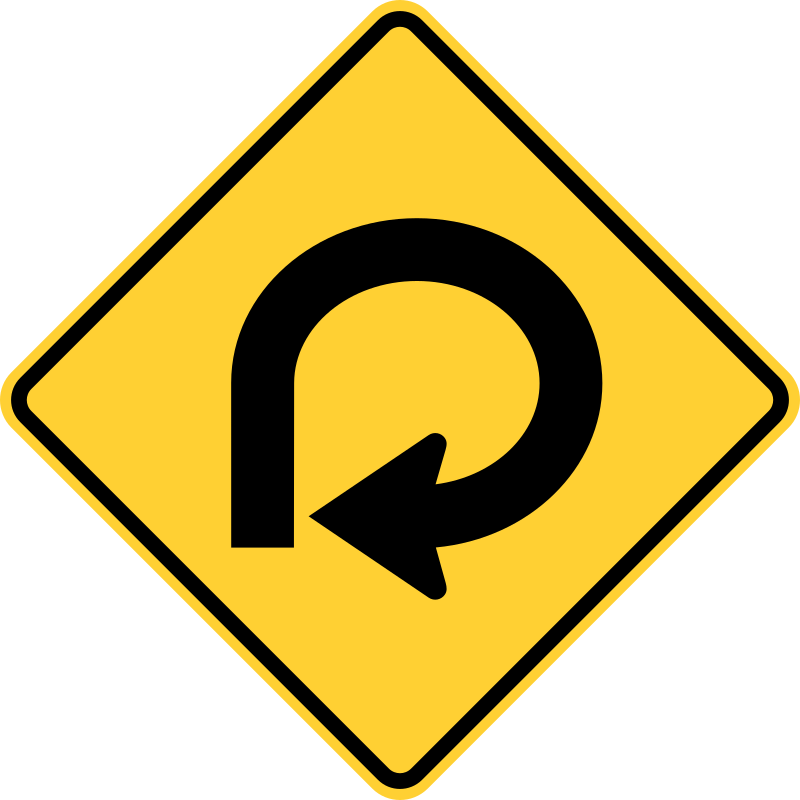
This sign means:
A)
Roundabout ahead.
B)
270 degree turn ahead.
C)
Wrong way; Turn around immediately.
10.
Passing is prohibited:
A)
when a school bus is stopped to load or unload children on a public road.
B)
at intersections.
C)
whenever a solid line marks the left side of your lane.
D)
All of the above.
11.
This road sign means:
A)
Merge
B)
Side Road
C)
Merging Traffic
D)
All traffic must go straight ahead
12.
When approaching a railroad crossing drivers should:
A)
slow down.
B)
be ready to stop.
C)
look for a train.
D)
All of the above.
13.
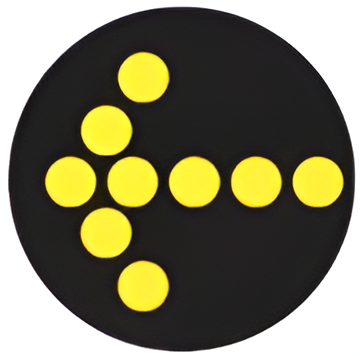
What does a flashing left yellow arrow mean?
A)
Vehicles turning left must stop if they can. The light will soon be red.
B)
Only right turns are allowed.
C)
Left turns are allowed. Yield to oncoming traffic and pedestrians.
D)
None of the above.
14.
This road sign means:
A)
Yield right-of-way to bicycles
B)
Bicycles cross or ride beside traffic
C)
Yield to motorcyles, but not to bicycles
D)
Bicycles have the same rights as other vehicles
15.
This road sign means:
A)
Railroad Warning
B)
Stop Sign Ahead
C)
Lane ends
D)
Stop if necessary
16.
This sign means:
A)
narrow road ahead.
B)
no turns are allowed on this road.
C)
series of curves ahead.
D)
the road may be slippery when wet.
17.
To safely pass a bicyclist you should:
A)
leave a safe distance when passing, and maintain clearance until safely past the overtaken bicycle.
B)
The other answers are all correct.
C)
honk at the bicyclist to let them know youre trying to pass.
D)
rush ahead to pull in front of the bicyclist.
18.
This road sign means:
A)
School zone ahead
B)
Pedestrians must not cross here
C)
Pedestrian crossing ahead
19.
When you approach a railroad crossing, but you do not see a train. You must stop:
A)
if a stop sign is posted.
B)
if the crossing lights are flashing.
C)
if a crossing gate is lowered.
D)
All of the above.
20.
________ is the only effective way to reduce your Blood Alcohol Content (BAC).
A)
Time
B)
Drinking coffee
C)
Taking a cold shower
D)
Eating food
21.
After stopping for a school bus that is unloading children you should:
A)
accelerate quickly and pass.
B)
put on your emergency flashers.
C)
watch for children walking along the side of the road.
D)
wait at least 4 minutes.
22.
This sign is used to warn drivers about:
A)
road construction.
B)
changes in traffic lanes.
C)
curves ahead.
D)
drowsy driving.
23.
Are bicyclists required to obey traffic laws and signs?
A)
No, bicyclists are considered pedestrians when it comes to the rules of the road.
B)
Yes.
C)
Yes, but only if they are riding in a bicycle lane.
24.
Never make a U-turn from:
A)
the lane you’re in.
B)
the right lane.
C)
the left part of the lane nearest to the centerline of the roadway.
25.
To avoid crashes with vehicles in your blind spots, you should:
A)
sound your horn right before turning or changing lanes.
B)
adjust your rear-view mirrors every few minutes.
C)
quickly turn your head to see if your blind spot is clear, before changing lanes.
D)
None of the above.
26.
When entering a crowded freeway, to merge into traffic you should:
A)
yield to vehicles already on the freeway.
B)
use the acceleration lane to adjust your speed to the same speed as freeway traffic.
C)
check your blind spots.
D)
All of the above.
27.
Signs containing information about hazardous conditions are known as _____ signs.
A)
regulatory
B)
guide
C)
information
D)
warning
28.
This sign means:
A)
You must stop ahead
B)
Railroad crossing ahead
C)
No Passing Zone
D)
There is a traffic signal ahead
29.
If a vehicle using high beams comes toward you, look towards __________ of the road.
A)
either side
B)
the center
C)
the right side
D)
the left side
30.
What should you do if one of your tires blows out?
A)
Hold the steering wheel tight and brake immediately to avoid the risk of skidding.
B)
Leave the road immediately.
C)
Hold the steering wheel tight and slowly take your foot off the gas pedal.
31.
Bicyclists must:
A)
ride in a bicycle lane, if available.
B)
remain to the right when they prepare for a left turn.
C)
remain near the left edge of the road.
32.
When you see an emergency vehicle with flashing lights, you must:
A)
pull over to the side of the road and stop.
B)
increase your speed to provide a clear path for the emergency vehicle.
C)
slow down until it passes you.
D)
drive with your flashers on.
33.
When driving behind a motorcycle:
A)
allow a following distance of at least 4 motorcycle lengths.
B)
allow a following distance of at least 2 car lengths.
C)
allow at least 2 seconds of following distance.
D)
allow at least 4 seconds of following distance.
34.
What do flashing red lights on a school bus indicate?
A)
The bus is stopped to load or discharge passengers.
B)
Traffic that approaches from either direction may proceed.
C)
The bus is about to stop.
35.
A red traffic sign means?
A)
Do not enter.
B)
Stop.
C)
All of the above.
36.
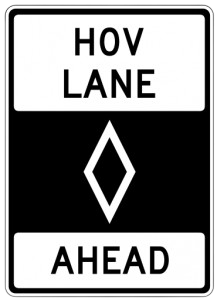
This road sign indicates that:
A)
a lane is reserved for certain purposes or certain vehicles.
B)
buses and car pools may not travel in the restricted lane.
C)
vehicles cannot go straight ahead. Cars must turn either to the right or left.
37.
This road sign means:
A)
Winding road
B)
Side road ahead
C)
Slippery when wet
38.
Yellow traffic signs:
A)
guide drivers.
B)
when combined with an octagonal shape, tell drivers they must come to a complete stop at the marked stop line.
C)
warn drivers.
39.
If you stop at a railroad crossing with more than one track:
A)
proceed with caution until you see a train.
B)
go through when one of the tracks is free.
C)
go through as soon as the first train passes.
D)
wait until you have a clear view of both tracks.
40.
When you drive into the street from any driveway you:
A)
can disregard pedestrians if there is no sidewalk.
B)
must drive slowly so approaching vehicles and pedestrians can get out of your way.
C)
must honk the horn so approaching vehicles and pedestrians can allow you room.
D)
must stop and proceed only when there are no pedestrians or vehicles approaching.
ANSWER KEY
Check answers after completing the test.
1
B
2
B
3
A
4
B
5
B
6
A
7
D
8
B
9
B
10
D
11
B
12
D
13
C
14
B
15
B
16
C
17
A
18
C
19
D
20
A
21
C
22
C
23
B
24
B
25
C
26
D
27
D
28
D
29
C
30
C
31
A
32
A
33
D
34
A
35
C
36
A
37
C
38
C
39
D
40
D