←
Back to Test
Hide Answer Key
Print / Save as PDF
Print / PDF
drive
quiz
.com
NH DMV PERMİT PRACTİCE TEST 1
New Hampshire
Duration: 36 min
|
Questions: 40
Student Name:
Date:
Correct:
Incorrect:
Score:
1.
Drinking alcohol while taking drugs can:
A)
have a less pronounced effect than either taken separately.
B)
have a more pronounced effect than either taken separately.
C)
improves concentration.
D)
improve your driving performance.
2.
A steady yellow light at an intersection means:
A)
Proceed with caution through the intersection
B)
Slow down and be prepared to stop
C)
Immediately come to a complete stop
D)
Yield to other vehicles
3.
ABS is the acronym for:
A)
Anti-Braking System
B)
Average-Beam System
C)
Anti-Locking Brake System
4.
Your ability to drive safely can be impaired by:
A)
alcohol.
B)
lack of sleep.
C)
drugs, even if they are over-the-counter.
D)
All of the above.
5.
This road sign means:
A)
Slow down or stop
B)
Stop
C)
Road narrows ahead
6.
Warning signs normally are:
A)
rectangles.
B)
triangles.
C)
diamond-shaped.
7.
If your vehicle starts to hydroplane you should:
A)
apply the brakes firmly to prevent your vehicle from sliding.
B)
slow down gradually and do not apply the brakes.
C)
maintain your current speed to gain better traction.
D)
All of the above.
8.
Drivers often fail to see a motorcycle headed toward them. Why?
A)
It is difficult to judge a motorcycle's speed.
B)
Motorcycles are hard to see.
C)
All of the above.
9.
When an aggressive driver confronts you, you should:
A)
Try to move away safely.
B)
Remain calm and relaxed.
C)
All of the above.
10.
___________ normally are white rectangles with black letters or symbols.
A)
Warning signs
B)
Destination signs (guide signs)
C)
Regulation signs (regulatory signs)
11.
This road sign means:
A)
Winding road ahead
B)
Warning, slippery when wet
C)
Railroad Warning
D)
Stop Sign Ahead
12.
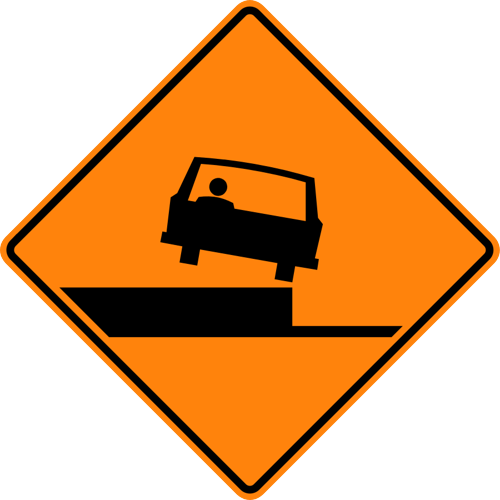
This sign warns of a ________ ahead.
A)
hill
B)
no passing zone
C)
soft shoulder
13.
When you reach an intersection with a stop sign, you should:
A)
follow the vehicle ahead of you.
B)
stop, look right, then left, then right again.
C)
stop, look left, then right, then left again.
D)
check your rearview mirror, look left, then right, then proceed.
14.
An aggressive driver:
A)
competes with other traffic.
B)
weaves in and out of traffic.
C)
shows little or no respect for traffic laws.
D)
All of the above.
15.
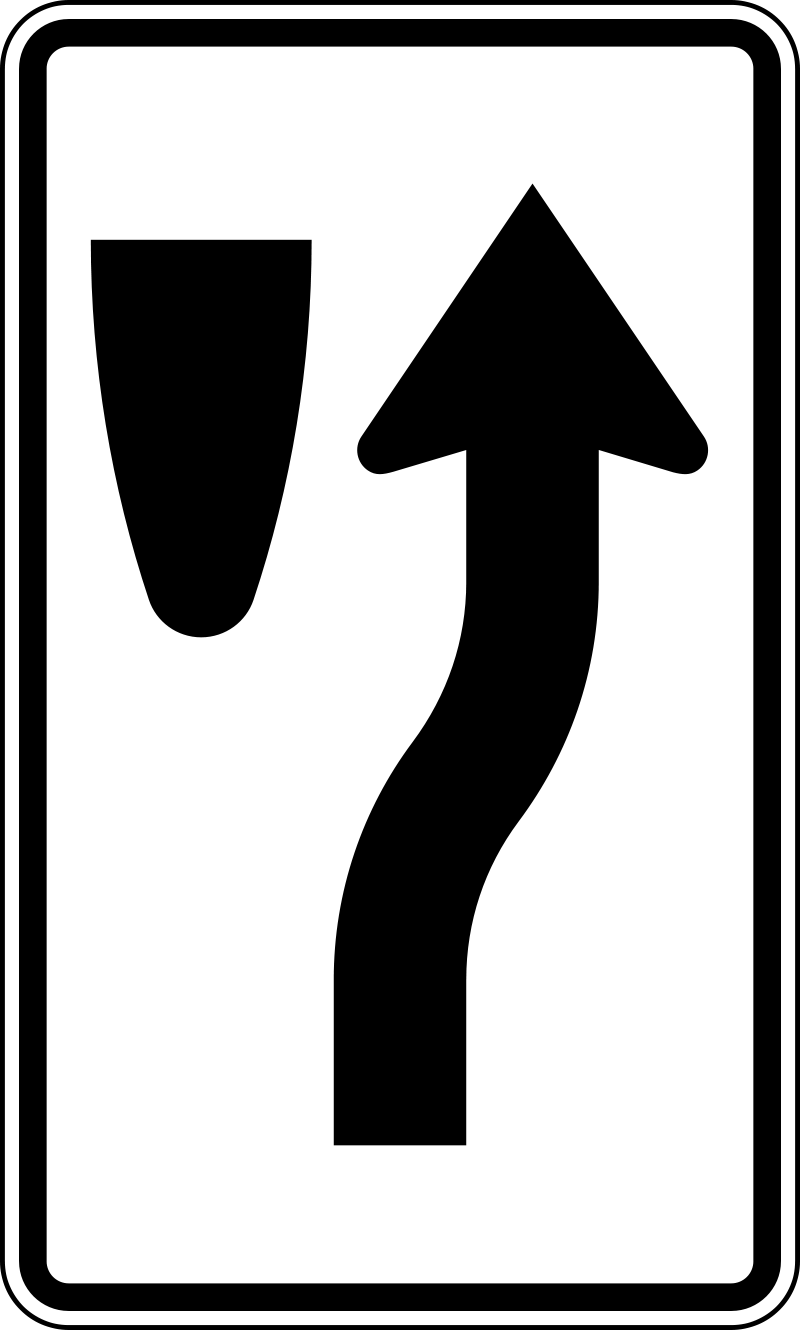
This road sign means:
A)
Stop sign ahead
B)
Keep to the side indicated by the arrow
C)
Side road
D)
Low shoulder
16.
Drivers may pass another vehicle if the line dividing two lanes is a ________ line.
A)
broken white
B)
double solid yellow
C)
solid yellow
D)
solid white
17.
When you are driving, turning your head and looking before changing lanes is:
A)
a good driving habit.
B)
unnecessary, you should use your rearview mirror instead.
C)
a bad driving habit.
D)
prohibited.
18.
If you suddenly have no control of the steering wheel, you should:
A)
turn on your emergency flashers and pull off the road.
B)
ease your foot off the gas pedal. Turn on your emergency flashers and allow your vehicle to come to a slow stop.
C)
pump your brake pedal to build pressure.
D)
react as you would with a blowout.
19.
Do not pass:
A)
on hills or curves.
B)
when approaching intersections.
C)
when school bus lights are flashing.
D)
All of the above.
20.
In heavy rain, tires can begin to ride on the water that is on top of the road pavement. This is called:
A)
rideplaning.
B)
hydroplaning.
C)
pavement-planing.
D)
waterplaning.
21.
Which shape is a speed limit sign?
A)
Round
B)
Pentagon
C)
Vertical rectangle
22.
The effects of alcohol on driving include:
A)
None of the above.
B)
Improved coordination
C)
Better reflexes
D)
Improved judgement
23.
When you see an emergency vehicle with flashing lights behind you, you should:
A)
slow down, provide a clear path for the emergency vehicle and stop.
B)
keep moving slowly, staying to the right side of the road.
C)
disregard the signal if there are other lanes available for the emergency vehicle.
D)
immediately come to a complete stop.
24.
When they approach this sign, drivers must:
A)
slow down and watch for children crossing the road.
B)
obey signals from crossing guards.
C)
stop if necessary.
D)
All of the above.
25.
More than one vehicle is approaching a four-way stop sign. Who has the right of way?
A)
The first driver to reach the intersection and stop.
B)
The driver on the left.
C)
The last driver to reach the intersection.
26.
When changing lanes, you can check your blind spot by:
A)
using the outside rearview mirror.
B)
using the inside rearview mirror.
C)
turning your head and glancing over your shoulder.
D)
checking the rearview and outside mirrors.
27.
You hear a siren close by but can not see where the emergency vehicle is. What do you do?
A)
Keep driving until you are sure the emergency vehicle is headed toward you.
B)
Stop immediately and activate your emergency flashers.
C)
Pull over to the right side of the road and stop until you are sure the emergency vehicle is not headed toward you.
28.
The octagonal shape is used:
A)
for stop signs and railroad advance warning signs.
B)
exclusively for stop signs.
C)
to warn drivers of existing or possible hazards on roadways.
29.
This road sign means:
A)
No left turn
B)
No right turn
C)
No U-turns
30.
When drivers see the ‘Wrong Way’ sign:
A)
they are going the wrong way on an expressway exit ramp.
B)
they must drive past this sign and reach the next intersection.
C)
they must not leave the pavement except in an emergency.
31.
If a vehicle is approaching with high beams, drivers should look __________ until the vehicle passes.
A)
to the right of the road
B)
at the center of the road
C)
to the left of the road
D)
straight ahead
32.
Where there is no bicycle lane, where on the road must a bicyclist ride?
A)
on the left shoulder of the road.
B)
near the right curb or edge of the road.
C)
near the left edge of the road.
33.
This sign tells drivers that:
A)
there is a right turn ahead.
B)
they must stay on the right side of the divider
C)
a divided highway ends ahead.
34.
You are approaching an intersection when the signal turns yellow. You should:
A)
speed up to get through the intersection before the red light comes on.
B)
stop then enter the intersection when safe to do so.
C)
slow down and proceed with caution through the intersection.
35.
Drivers must not drive at:
A)
a speed that is greater than reasonable.
B)
a speed that is not prudent for the circumstances.
C)
a speed that is greater than the posted speed limit.
D)
All of the above.
36.
This sign means:
A)
U-turns are not allowed.
B)
Parking is not allowed.
C)
No parking on pavement.
37.
Most signs used in street work areas are:
A)
round.
B)
diamond shaped.
C)
rectangle shaped.
38.
Before turning, you should:
A)
give the proper turn signal.
B)
sound your horn to alert the other drivers.
C)
increase your speed.
D)
change lanes.
39.
This road sign means:
A)
Buggy warning
B)
Stop ahead
C)
Low shoulder
D)
Tow away zone
40.
When approaching a highway-rail intersection, the first sign drivers see is usually:
A)
an RXR round sign on a yellow background.
B)
a stop sign.
C)
a yield sign.
ANSWER KEY
Check answers after completing the test.
1
B
2
B
3
C
4
D
5
B
6
C
7
B
8
C
9
C
10
C
11
B
12
A
13
C
14
D
15
B
16
A
17
A
18
B
19
D
20
B
21
C
22
A
23
A
24
D
25
A
26
C
27
C
28
B
29
B
30
A
31
A
32
B
33
B
34
B
35
D
36
B
37
B
38
A
39
C
40
A