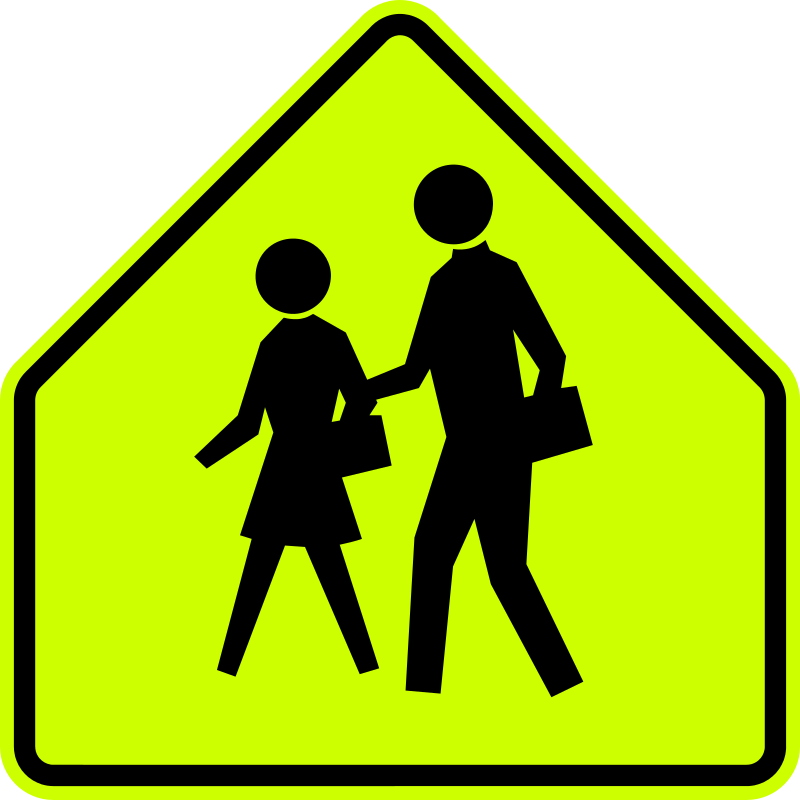
A)Business area nearby. Watch for business people.
B)There is a work zone ahead. Watch for workers.
C)The driver is near a school and should watch for children.
2.
You ________ traffic headed toward you when you turn left.
A)must not yield to
B)must interrupt
C)must yield to
3.
When you approach this sign, you must:
A)stop if necessary.
B)watch for workers crossing the road.
C)None of the above.
4.
Enter a roundabout:
A)when you have a green light.
B)after coming to a complete stop and looking both ways.
C)only when there is a safe gap in traffic.
5.
Drivers must be prepared for anything coming up in the road ahead. They should:
A)scan the road for traffic conditions and possible hazards.
B)drive with the right foot resting lightly on the brake pedal.
C)stare straight ahead at all times.
D)maintain focus toward the left of the road.
6.
You have stopped for a train at a railroad crossing. After the train passes, you must:
A)look to see if another train is coming, then cross the tracks if it is safe to do so.
B)watch for vehicles that must stop at railroad crossings (school buses, vehicles carrying hazardous materials, etc.).
C)All of the above.
7.
When passing a pedestrian who is walking on the road and an oncoming vehicle is approaching, you should:
A)keep driving, you have the right-of-way.
B)honk your horn to warn the pedestrian.
C)slow down and let the vehicle pass first.
8.
This sign means:
A)You may make a U-turn.
B)Hairpin corner ahead.
C)You must make a U-turn.
9.
If you change your name or address you must apply to the County Treasurer for a replacement operators license within ___ days.
A)10
B)90
C)60
10.
An edge line that angles toward the center of the road indicates that:
A)the road is narrower ahead.
B)there’s a narrow bridge ahead.
C)you must turn right.
11.
If your vehicle starts to hydroplane you should:
A)apply the brakes firmly to prevent your vehicle from sliding.
B)slow down gradually and do not apply the brakes.
C)maintain your current speed to gain better traction.
D)All of the above.
12.
You are approaching an intersection with a traffic signal indicating a steady yellow light. If you have not already entered the intersection, you should:
A)slow down and proceed with caution through the intersection.
B)speed up to cross the intersection before the light turns red.
C)stop before entering the intersection if it is safe to do so.
13.
Drivers who refuse to submit to a chemical test for alcohol or drugs will have their license suspended for:
A)90 days.
B)1 year.
C)30 days.
14.
Where must you position your vehicle when you prepare to make a left turn from a two-way roadway into a one-way roadway?
A)As far to the right as possible.
B)On the right curb.
C)As close as possible to the center line.
15.
A broken yellow line between two lanes of traffic means:
A)Passing is permitted when safe.
B)Passing is not permitted.
C)Passing on the right is permitted in either direction
16.
Which shape is a speed limit sign?
A)Round
B)Pentagon
C)Vertical rectangle
17.
Drivers who flee to avoid arrest:
A)could have their operators license revoked.
B)can be charged with a misdemeanor or felony offense.
C)All of the above.
18.
A flashing red light means:
A)The same as a STOP sign.
B)The light will soon change to steady red.
C)Drive with caution.
19.
To avoid becoming an aggressive driver, you should allow enough travel time to reach your destination on schedule.
A)False
B)True
20.
This sign means:
A)You must stop ahead
B)Railroad crossing ahead
C)No Passing Zone
D)There is a traffic signal ahead
21.
This sign warns drivers of:
A)low clearance.
B)a narrow bridge ahead.
C)a low place in the road.
22.
Barricades, drums, cones and vertical panels are the most commonly used devices to guide drivers safely through a work zone.
A)False
B)True
23.
When the pavement is marked with a double yellow line, drivers may pass other vehicles:
A)None of the other answers is correct.
B)only if there are no oncoming vehicles.
C)only if the vehicle ahead is driving 10 mph or more under the speed limit.
D)Never.
24.
A work zone:
A)is marked with black and white signs.
B)might involve vehicles and moving workers.
C)does not require that the driver slow down and pay extra attention.
D)All of the above.
25.
Alcohol:
A)makes drivers more prone to take chances.
B)increases reaction time.
C)All of the above.
ANSWER KEYCheck answers after completing the test.