←
Back to Test
Hide Answer Key
Print / Save as PDF
Print / PDF
drive
quiz
.com
NE DMV PERMİT PRACTİCE TEST 6
Nebraska
Duration: 23 min
|
Questions: 25
Student Name:
Date:
Correct:
Incorrect:
Score:
1.
A solid yellow line next to a broken yellow line means that vehicles:
A)
next to the solid line may pass.
B)
in both directions may pass.
C)
next to the broken line may pass.
2.
This road sign means:
A)
Divided highway ahead
B)
Merging traffic
C)
Flagger ahead
3.
Where are yield signs usually placed?
A)
At intersections, if there is no marked stop line.
B)
Where auxiliary roads lead into major roads.
C)
Where major roads lead into auxiliary roads.
4.
The golden rule of driving is to:
A)
treat others the way you want to be treated.
B)
put on your emergency flashers when driving at night.
C)
drive faster than the vehicle behind you.
5.
This sign means:
A)
The highway ahead is divided into two one-way roadways.
B)
Roundabout ahead. Slow down.
C)
The divided highway on which drivers are traveling ends ahead.
6.
A pedestrian in the crosswalk when the 'DON’T WALK' signal begins flashing must:
A)
stop immediately.
B)
go back and wait the “WALK” light
C)
finish crossing the street.
7.
The basic color for traffic control devices used in construction zones is:
A)
red.
B)
orange.
C)
yellow.
8.
What do flashing red lights on a school bus indicate?
A)
The bus is stopped to load or discharge passengers.
B)
Traffic that approaches from either direction may proceed.
C)
The bus is about to stop.
9.
This road sign means:
A)
No left turn
B)
No right turn
C)
No U-turns
10.
Using a smartphone to read, type or send written communication while operating a motor vehicle is:
A)
a secondary offense violation.
B)
permitted.
C)
a primary offense.
D)
not a traffic violation.
11.
A thumping sound can be a warning:
A)
that a tire blowout is about to occur.
B)
of a steering failure.
C)
of a brake failure.
12.
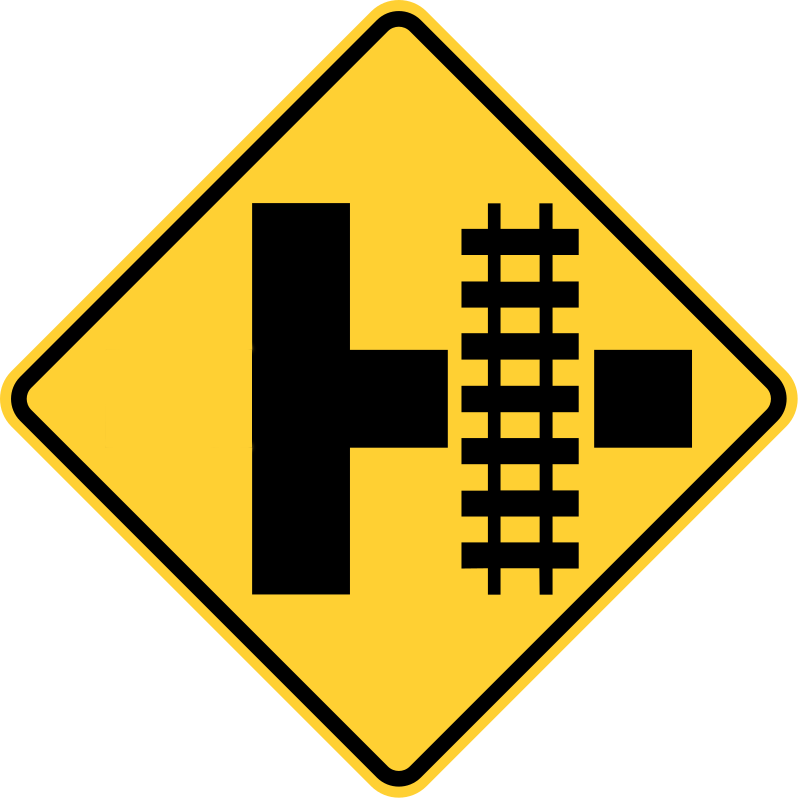
What does this sign indicate?
A)
Parallel railroad crossing (side road)
B)
Low ground clearance railroad crossing
C)
Parallel railroad crossing (crossroad)
13.
When a hazard is seen ahead, reaction distance:
A)
is the sum of perception distance and braking distance.
B)
equals total stopping distance minus perception distance.
C)
is how far a vehicle will continue to travel, in ideal conditions, before the driver hits the brakes.
14.
This regulatory road sign indicates that:
A)
Vehicles must slow down and stay in the right lane.
B)
The right hand lane is reserved for buses and car-pool vehicles.
C)
Slower vehicles traveling on multiple lane highways must stay in the right hand lane.
15.
Do not park a vehicle:
A)
within 20 feet of a crosswalk at an intersection.
B)
in front of a public or private driveway.
C)
on a roadway directly beside stopped or parked vehicles.
D)
All of the above.
16.
This sign warns drivers that:
A)
there is a one lane bridge ahead.
B)
the right lane ends.
C)
the road ahead is narrow.
17.
What is the meaning of blue traffic signs?
A)
A blue background indicates a regulatory sign.
B)
They give directional information.
C)
Blue indicates road user services.
18.
When driving in a construction zone you should:
A)
slightly increase your speed.
B)
come to a complete stop and check road conditions.
C)
expect the unexpected.
19.
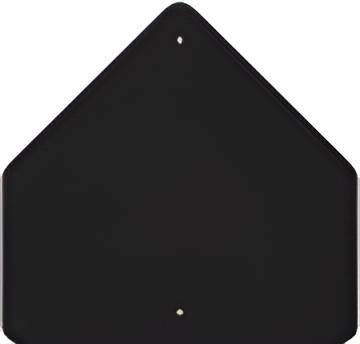
A pentagon-shaped sign means:
A)
Construction Zone
B)
Pedestrian Crossing
C)
School Zone
20.
What is the main reason night driving is more difficult than daytime driving?
A)
The use of headlight is required by law.
B)
Reduced visibility.
C)
Driving within the range.
21.
On two-lane, two-way streets or highways, you should start left turns close to the center line.
A)
True
B)
False
22.
You can reduce the chance of a collision with a large vehicle if you:
A)
delay near it.
B)
cut abruptly in front of it.
C)
pay close attention to the turn signals.
23.
A 4-way stop sign means:
A)
The first vehicle to reach the intersection should move forward first.
B)
Traffic from all four directions must stop.
C)
There are four stop signs at the intersection.
D)
All of the above.
24.
When you are about to make a left turn, you must signal at least _____ feet before turning.
A)
75
B)
100
C)
50
25.
The following symptoms are associated with drowsy driving:
A)
You continue to yawn.
B)
You don’t remember driving the last few miles.
C)
All of the above.
ANSWER KEY
Check answers after completing the test.
1
C
2
A
3
B
4
A
5
A
6
C
7
B
8
A
9
B
10
A
11
A
12
A
13
C
14
C
15
D
16
B
17
C
18
C
19
C
20
B
21
A
22
C
23
D
24
B
25
C