DriveQuiz drivequiz.com

NC DMV PERMİT PRACTİCE TEST 4

North Carolina
Duration: 34 min
|
Questions: 37
Student Name:
Date:
Correct:      Incorrect:      Score:      
1.

The road ahead is divided by a median strip or physical barrier into two separate one-way roadways. Keep to the right of the divider.
This road sign means:
A) Divided highway ahead
B) Merging traffic
C) Flagger ahead
2.
Warns drivers that two separate lanes moving in the same direction are merging into one. Drivers in the right lane must adjust speed and merge smoothly with existing traffic.
This sign means:
A) A road crosses the main highway ahead.
B) The divided highway on which drivers are traveling ends ahead.
C) Drivers are coming to a point where another traffic lane joins the one they are on.
3.
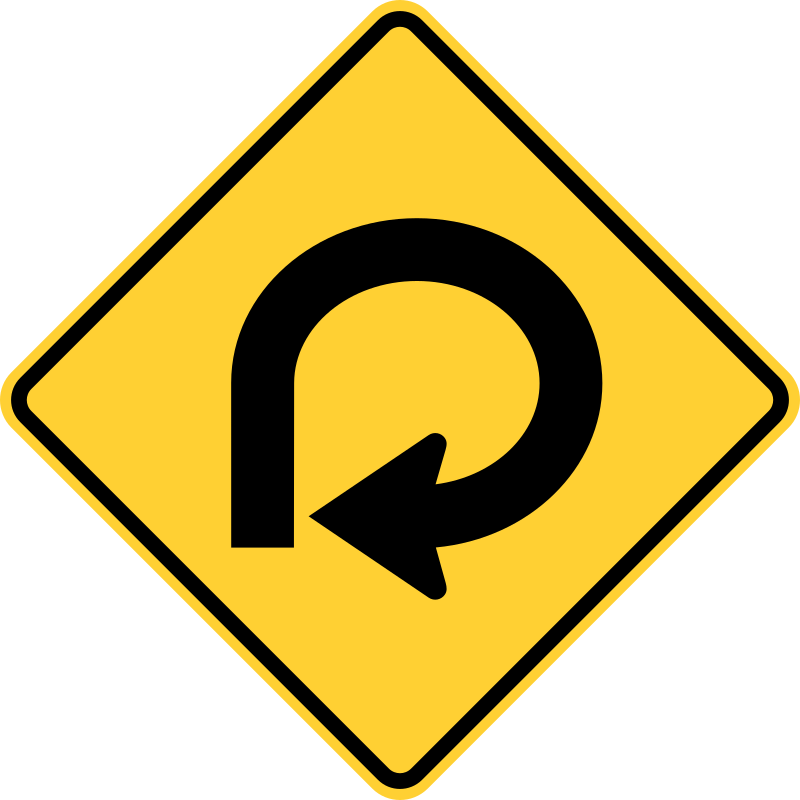
Warns of a circular exit or interchange ramp looping 270 degrees. Slow down significantly to the posted advisory speed.
This sign means:
A) Roundabout ahead.
B) 270 degree turn ahead.
C) Wrong way; Turn around immediately.
4.
Alerts drivers to an upcoming crosswalk where pedestrians frequently cross. Slow down and yield right-of-way to anyone in or about to enter the roadway.
This road sign means:
A) Railroad Crossing
B) One Way
C) Limited parking
5.
Slow down and give right-of-way to all oncoming vehicles, cyclists, and pedestrians. Stop completely if necessary before entering the intersection or merging.
This sign means drivers should:
A) not drive in this lane.
B) give the right-of-way to traffic on the road they wish to enter.
C) proceed at normal speed through the upcoming intersection.
D) come to a complete stop and check for oncoming traffic before proceeding.
6.
Another road crosses the highway ahead. Look left and right for crossing or entering vehicles.
This road sign means:
A) Crossroads ahead
B) Side Road
C) Turn right or go through
D) Flagger ahead
7.
The road ahead is divided by a median strip or physical barrier into two separate one-way roadways. Keep to the right of the divider.
This road sign means:
A) Divided highway ahead - stay to the right
B) Do not enter
C) Do not pass
8.
The median divider ends ahead, and you are returning to a two-way, two-lane undivided roadway. Watch for oncoming traffic on your left.
This road sign means:
A) Curves ahead
B) Divided highway ahead
C) Divided highway ends
9.
Alerts drivers to an upcoming crosswalk where pedestrians frequently cross. Slow down and yield right-of-way to anyone in or about to enter the roadway.
The picture shows:
A) a railroad advance warning sign.
B) a speeding fines doubled sign.
C) a reversible road sign.
10.
Indicates that traffic is permitted to pass on either the left or the right side of an island, median, or obstruction.
This sign tells drivers that:
A) left and right turns are not allowed.
B) a divided highway is ahead.
C) they cannot go straight ahead.
11.
Yellow diamond warning that pedestrians may be crossing ahead. Exercise caution and yield.
This road sign means:
A) Pedestrian crossing
B) School zone
C) School crossing
12.
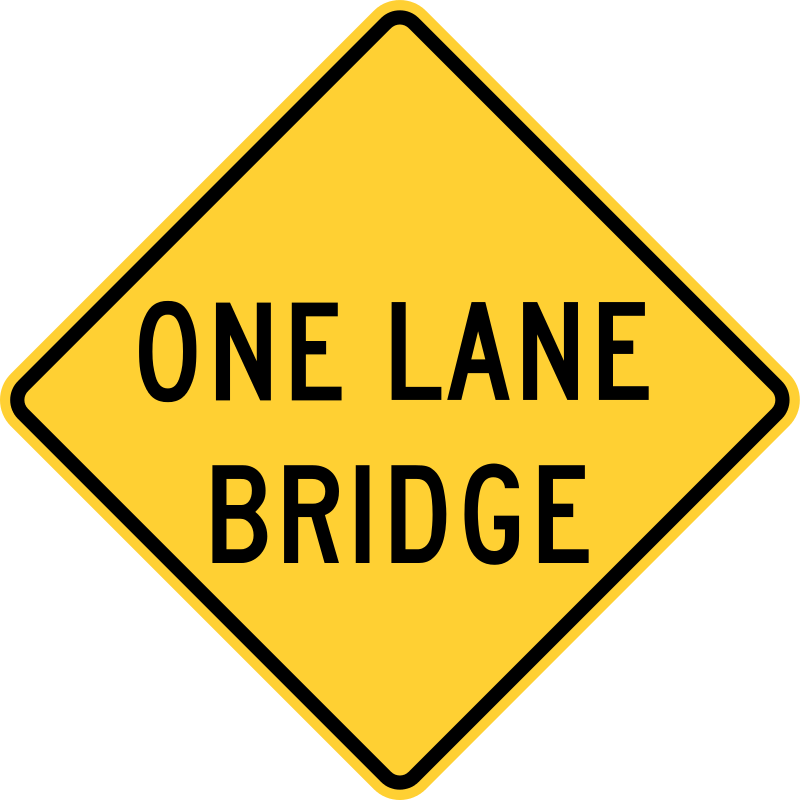
The bridge width allows only one vehicle to cross at a time. The vehicle reaching the bridge first has right-of-way; opposing traffic must wait.
What should drivers do when they see this sign?
A) Make sure the bridge is clear of oncoming traffic before they cross.
B) Look to the left and right for other traffic.
C) Allow others to merge smoothly.
13.
Gauging the speed of a motorcycle may be difficult because:
A) motorcycles take up less of your field of vision.
B) motorcycles often slow down by downshifting.
C) many motorcyclists do not activate the brake light.
14.
The driver of an emergency vehicle that uses lights and a siren can legally:
A) pass red lights.
B) exceed the speed limit
C) All of the above.
15.
If you stop along the road at night:
A) turn on your emergency flashers and leave your low beams on.
B) turn off your emergency lights and leave your high beams on.
C) turn on your headlights only.
D) turn off all your lights.
16.
ABS is the acronym for:
A) Anti-Braking System
B) Average-Beam System
C) Anti-Locking Brake System
17.
You are stopped at a stop sign and you are going to go straight through the intersection. A car on the cross road has stopped at a stop sign on your right and is going to go straight. Who has the right-of-way?
A) Whoever enters the intersection first.
B) You.
C) The car on your right.
18.
If an intersection has crosswalk lines but no STOP line, where must you stop for a red light?
A) After the crosswalk.
B) Before the stop line.
C) Before the crosswalk.
19.
When a stop is required at an intersection with no stop line or crosswalk:
A) Drivers should stop only at a place where the driver can see at least 100 feet on either side.
B) Drivers are required to slow down to make sure crossing traffic is clear.
C) Drivers are not required to stop.
D) Drivers should stop at the point nearest the intersecting roadway where the driver has a view of approaching traffic on the intersecting roadway before actually entering the roadway.
20.
When a hazard is seen ahead, reaction distance:
A) is the sum of perception distance and braking distance.
B) equals total stopping distance minus perception distance.
C) is how far a vehicle will continue to travel, in ideal conditions, before the driver hits the brakes.
21.
When two cars arrive at an intersection with no signs or signals at the same time, which car has the right-of-way?
A) The car that is traveling faster.
B) The car approaching from the right.
C) The car approaching from the left.
D) The car in which the driver sounds the horn.
22.
While driving, it is important to slow down:
A) when the road is wet.
B) on narrow roads.
C) at intersections.
D) All of the above.
23.
Who is most at risk?
A) Drivers who are fatigued.
B) Drivers who are driving on long, boring roads.
C) All of the above.
24.
Arrows on the roadway:
A) show which lanes you must use.
B) indicate reserved lanes.
C) indicate HOV lanes.
25.
On slippery roads, drivers should:
A) slow down.
B) increase their speed to avoid hydroplaning.
C) not drive faster than 25 MPH.
D) go faster.
26.
Your first response to reduced visibility should be:
A) to look for road edge markings to guide you.
B) to turn on your windshield wipers.
C) to reduce your speed.
D) to turn on your headlights.
27.
Braking distance is affected by:
A) the condition of your brakes and tires.
B) pavement conditions.
C) the speed your vehicle is traveling.
D) All of the above.
28.
For protection, motorcyclists are required to:
A) keep their headlights and taillights on at all times.
B) signal turns, lane changes and stops.
C) wear approved helmets.
29.
A driver approaching a flashing red traffic signal must:
A) merge to the left.
B) stop before the intersection.
C) carefully drive through the intersection without stopping.
D) slow down at the traffic signal.
30.
When following motorcycles, drivers should:
A) reduce the minimum following distance.
B) try to pass them as they have different braking capabilities than other motor vehicles.
C) keep more space in front of their vehicle.
31.
Drivers may cross solid yellow lines:
A) at any time.
B) only to pass traffic moving in the same direction.
C) when making turns.
D) during daylight hours only.
32.
When following a motorcycle, drivers must remember that motorcycles can ____________ than other vehicles.
A) accelerate much faster
B) stop much more quickly
C) stop much more slowly
33.
Following another vehicle too closely is known as:
A) speedgating.
B) closetailing.
C) tailgating.
34.
Anything that requires you to _______ could cause you to crash.
A) take your hands off the wheel
B) take your attention away from driving
C) take your eyes off the road
D) All of the above.
35.
When you are in a line of traffic that is crossing a railroad track that has no signals or gates:
A) you may pass slower drivers crossing the track.
B) before you start to cross, you need to make sure there is space to get all the way across the tracks without stopping.
C) you have the right of way and do not need to check for trains.
D) All of the above.
36.
Drivers can not pass a vehicle on the left if:
A) they approach the top of a hill on a two-way road and can not see over it.
B) they can not safely return to the right lane before they reach a solid yellow center line for the right lane.
C) All of the above.
37.
When driving in fog, drivers should use:
A) low beam headlights.
B) parking lights.
C) high beam headlights.
ANSWER KEY Check answers after completing the test.
1 A
2 C
3 B
4 A
5 B
6 A
7 A
8 C
9 A
10 C
11 A
12 A
13 A
14 C
15 A
16 C
17 C
18 C
19 D
20 C
21 B
22 D
23 C
24 A
25 A
26 C
27 D
28 C
29 B
30 C
31 C
32 B
33 C
34 D
35 B
36 C
37 A