DriveQuiz drivequiz.com

MT DMV PERMİT PRACTİCE TEST 4

Montana
Duration: 30 min
|
Questions: 33
Student Name:
Date:
Correct:      Incorrect:      Score:      
1.
Many crashes are caused by:
A) yielding the right of way.
B) frequently checking mirrors and blind spot.
C) maintaining a 4-second following distance between your vehicle and any vehicle in front of you.
D) driving too fast for conditions.
2.
If you see a “lane closed ahead” sign you should:
A) make a U-turn. You are on the wrong side of the road.
B) merge into the correct lane when it is safe.
C) speed to the end of the closed lane and try to get into the other lane.
3.
Another road crosses the highway ahead. Look left and right for crossing or entering vehicles.
This sign indicates:
A) a side road.
B) a cross road.
C) a church zone ahead.
4.
A broken yellow line alongside a solid yellow line means:
A) Passing is permitted on the side of the broken yellow line
B) Passing is not permitted in either direction
C) Passing on the right is permitted in either direction
5.
If you are blinded by headlights on an approaching vehicle, you should:
A) avoid looking directly at the bright lights.
B) glance toward the side of the road, then look quickly ahead to determine the other vehicle’s position.
C) All of the above.
6.
An inattentive driver:
A) carries on an eye-contact conversation with a passenger while driving.
B) gazes at objects off the roadway while driving.
C) daydreams.
D) All of the above.
7.
You go with a group of friends to a social event, and you plan to have a few drinks. You should:
A) make alcohol the focus of the event.
B) avoid alternating between drinks with alcohol and drinks without any alcohol.
C) arrange to ride home with a friend who does not drink.
8.
If another car has stopped in an adjacent lane in the same direction of travel, you should:
A) speed up and pass the vehicle on the right.
B) pass the car on the left.
C) be careful in case the other vehicle has stopped for a pedestrian.
D) tap your horn to let the other driver know you are passing.
9.
Drivers may pass another vehicle if the line dividing two lanes is a ________ line.
A) broken white
B) double solid yellow
C) solid yellow
D) solid white
10.
The road makes a sharp 90-degree right turn ahead. Slow down considerably before entering the turn.
This road sign means:
A) One way
B) No right turn
C) Exit
D) Sharp right turn ahead
11.
Warns drivers that two separate lanes moving in the same direction are merging into one. Drivers in the right lane must adjust speed and merge smoothly with existing traffic.
This road sign means:
A) Merging traffic from the right
B) Sharp curves ahead
C) Intersection ahead
12.
You hear a siren close by but can not see where the emergency vehicle is. What do you do?
A) Keep driving until you are sure the emergency vehicle is headed toward you.
B) Stop immediately and activate your emergency flashers.
C) Pull over to the right side of the road and stop until you are sure the emergency vehicle is not headed toward you.
13.
When you drive into the street from any driveway you:
A) can disregard pedestrians if there is no sidewalk.
B) must drive slowly so approaching vehicles and pedestrians can get out of your way.
C) must honk the horn so approaching vehicles and pedestrians can allow you room.
D) must stop and proceed only when there are no pedestrians or vehicles approaching.
14.
Emotions can affect your driving by:
A) decreasing your chances of an accident.
B) lessening your concentration on the driving task.
C) making you more aware of others around you.
D) causing you to go to sleep at the wheel.
15.
The roadway ahead is narrowing or a lane is ending. Merge smoothly into the continuing lane.
This sign means:
A) divided highway ahead.
B) narrow bridge ahead.
C) road construction.
D) lane ends, merge left.
16.
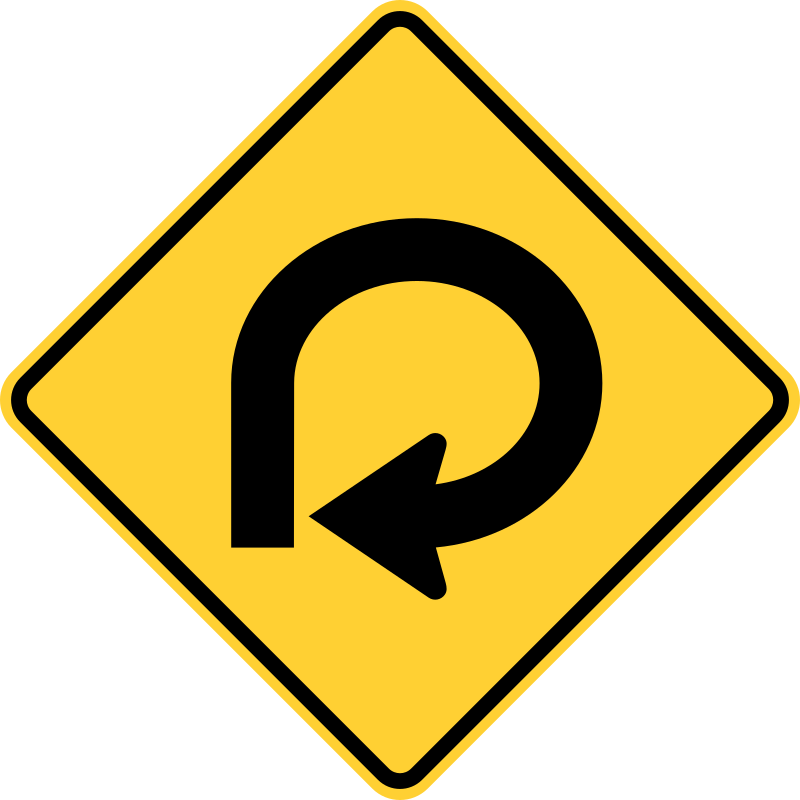
Warns of a circular exit or interchange ramp looping 270 degrees. Slow down significantly to the posted advisory speed.
This sign means:
A) Roundabout ahead.
B) 270 degree turn ahead.
C) Wrong way; Turn around immediately.
17.
You are stopped behind other vehicles waiting at a stop sign. When the intersection is clear:
A) you may follow the vehicle ahead without stopping again.
B) you may proceed with caution through the intersection without stopping if there is no other traffic.
C) you must stop again at the stop sign.
D) you must proceed through the intersection without stopping again.
18.
Drivers should always signal when:
A) pulling into traffic from a parking area or alley.
B) changing lanes.
C) pulling out of a parking space.
D) All of the above.
19.
The road ahead is divided by a median strip or physical barrier into two separate one-way roadways. Keep to the right of the divider.
This road sign means:
A) Keep left
B) Divided highway begins
C) Lane ends
20.
The octagonal (8-sided) shape is exclusively reserved for STOP signs so drivers can identify it immediately even in poor visibility or from behind.
The octagonal shape is used:
A) for stop signs and railroad advance warning signs.
B) exclusively for stop signs.
C) to warn drivers of existing or possible hazards on roadways.
21.
An edge line that angles toward the center of the road indicates that:
A) the road is narrower ahead.
B) there’s a narrow bridge ahead.
C) you must turn right.
22.
Flashing Upraised Hand signal indicates pedestrians should finish crossing if already in the crosswalk, but not start crossing.
A pedestrian in the crosswalk when the 'DON’T WALK' signal begins flashing must:
A) stop immediately.
B) go back and wait the “WALK” light
C) finish crossing the street.
23.
When parking uphill on a road with a curb, turn the front wheels:
A) towards the curb.
B) parallel to the curb.
C) straight ahead.
D) away from the curb.
24.
The road curves gradually to the right ahead. Reduce speed before entering the curve.
When they see this sign, drivers should:
A) increase their speed and keep well to the right.
B) slow down and keep well to the right.
C) slow down and keep well to the left.
25.
To avoid being in a truck driver’s blind spot, you should:
A) never pass the truck and put your headlights on.
B) avoid driving on either side of the truck and don’t tailgate.
C) flash your lights.
D) sound your horn.
26.
Prohibits drivers from making a 180-degree turn to travel in the opposite direction at this intersection or stretch of road.
This road sign means:
A) Left turns are not allowed where this sign is displayed.
B) Drivers cannot make a complete turn to go in the opposite direction.
C) Vehicles turning left must make a U-turn.
27.
You have been involved in a minor traffic collision with a parked vehicle and you can't find the owner. You must:
A) stay until the police arrive.
B) leave a note on the vehicle and report the accident with no delay.
C) wait for the owner to return.
D) call your insurance company within 14 days.
28.
Right turns are strictly prohibited at this intersection under all circumstances.
This road sign means:
A) No left turn
B) No right turn
C) No U-turns
29.
How can you prevent fatigue on a long trip?
A) Plan to drive long trips with a companion.
B) Get enough sleep.
C) All of the above.
30.
A steady yellow light means that a ______ light will soon appear.
A) steady green
B) steady red
C) flashing yellow
D) flashing green
31.
At night, it is hardest to see:
A) street lights.
B) pedestrians.
C) other motorists.
D) road signs.
32.
If an intersection has crosswalk lines but no STOP line, where must you stop for a red light?
A) After the crosswalk.
B) Before the stop line.
C) Before the crosswalk.
33.
Come to a complete stop before the stop line, crosswalk, or intersection. Look left, right, and left again, and proceed only when it is safe and right-of-way is clear.
This road sign means:
A) Drive with caution and be ready to stop
B) Slow down or stop
C) You must come to a complete stop
ANSWER KEY Check answers after completing the test.
1 D
2 B
3 B
4 A
5 C
6 D
7 C
8 C
9 A
10 D
11 A
12 C
13 D
14 B
15 D
16 B
17 C
18 D
19 B
20 B
21 A
22 C
23 D
24 C
25 B
26 B
27 B
28 B
29 C
30 B
31 B
32 C
33 C