DriveQuiz drivequiz.com

MT DMV PERMİT PRACTİCE TEST 14

Montana
Duration: 30 min
|
Questions: 33
Student Name:
Date:
Correct:      Incorrect:      Score:      
1.
If you miss your exit from an interstate expressway, you should:
A) go to the next exit and come back to the exit you missed.
B) use the right turn signal, check your mirrors and move to the right.
C) pull over to the right and back up with caution until you reach the exit ramp.
D) make a quick U-turn from your lane of travel.
2.
When a hazard is seen ahead, reaction distance:
A) is the sum of perception distance and braking distance.
B) equals total stopping distance minus perception distance.
C) is how far a vehicle will continue to travel, in ideal conditions, before the driver hits the brakes.
3.
Double solid lines on the roadway mean:
A) you cannot pass.
B) you can not go across the lines except to turn left to enter or leave the highway.
C) All of the above.
4.
When parked facing down hill, your wheels should be turned:
A) toward the curb.
B) in any direction.
C) parallel to the curb.
D) away from the curb.
5.
Warns that a one-way street or divided highway is ending, and you are entering a roadway with oncoming traffic in the opposing lane. Stay to the right.
This sign warns ____________ ahead.
A) of two-way traffic
B) of a reduction of lanes
C) that a divided highway ends
6.
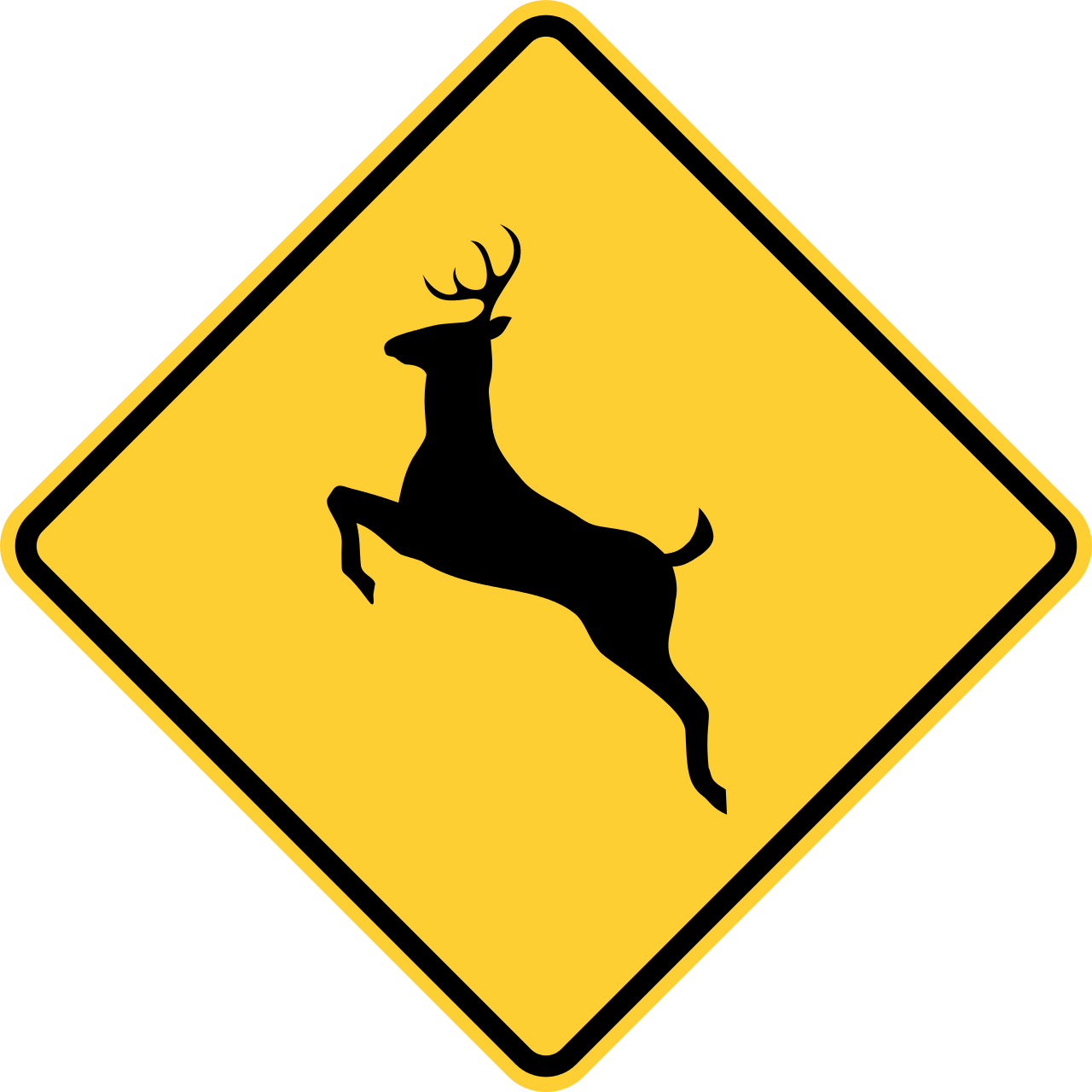
Wildlife and deer frequently cross in this area, especially at dawn and dusk. Scan the roadside and be prepared to brake safely.
When they see this road sign, drivers should:
A) drive carefully because the animal pictured on the sign is extremely rare in the area.
B) watch for this species crossing the road.
C) park in the zoo area.
7.
The road curves gradually to the right ahead. Reduce speed before entering the curve.
This road sign means:
A) Wrong Way
B) Merging Traffic
C) Curve ahead
8.
If you suddenly have no control of the steering wheel, you should:
A) turn on your emergency flashers and pull off the road.
B) ease your foot off the gas pedal. Turn on your emergency flashers and allow your vehicle to come to a slow stop.
C) pump your brake pedal to build pressure.
D) react as you would with a blowout.
9.
A traffic sign with a red circle around and a slash over a symbol means:
A) the maneuver shown by the symbol is not allowed.
B) Do not drive faster than the posted speed limit.
C) the maneuver shown on the sign should be executed with extreme caution.
10.
If an aggressive driver is behind you:
A) sound your horn and move to the left lane.
B) slow down and confront the aggressive driver.
C) try to get out of the aggressive driver’s way.
D) increase you speed and flash your brake lights.
11.
What should you do in case of a steering failure?
A) Pump your gas pedal a few times to increase the pressure.
B) Don't panic. Turn on your emergency lights to let other drivers know you are having car problems. Move toward the side of the road and bring the car to a gradual stop.
C) Leave the road immediately.
12.
Never make a U-turn from:
A) the lane you’re in.
B) the right lane.
C) the left part of the lane nearest to the centerline of the roadway.
13.
The road makes a sharp 90-degree right turn ahead. Slow down considerably before entering the turn.
This road sign means:
A) School zone ahead
B) Side road
C) Construction zone ahead
D) Sharp turn, slow down
14.
Signs containing information about hazardous conditions are known as _____ signs.
A) regulatory
B) guide
C) information
D) warning
15.
If your turn signals fail, you should use _____ to indicate your intention to turn.
A) your emergency flashers
B) your horn
C) your high beams
D) hand signals
16.
If cars approaching from opposite directions reach an intersection at the same time:
A) a car that moves straight must yield to cars that turn left.
B) a car that turns left must yield to cars that move straight or turn right.
C) a car that turns right must yield to cars that move straight or turn left.
17.
A vehicle that enters a road from a driveway:
A) has the right-of-way.
B) must yield to traffic approaching from the right, while it has the right-of-way over vehicles approaching from the left.
C) must stop and yield the right-of-way to traffic on the roadway and to pedestrians.
18.
A flashing red light means:
A) The same as a STOP sign.
B) The light will soon change to steady red.
C) Drive with caution.
19.
As long as you don’t leave the road, you may legally pass a vehicle on the right:
A) if you are on a two-lane, two-way road and the other vehicle is turning left.
B) when you are turning into a one-way street with no oncoming traffic.
C) Never.
D) Only during daylight hours.
20.
If the entrance lane is too short to allow acceleration to expressway speed, you should:
A) stop and wait for a large space in traffic.
B) enter the expressway and accelerate quickly.
C) reduce your speed to 15 MPH or less and blend with traffic.
21.
What do pennant-shaped signs indicate?
A) A school crossing
B) Yield
C) A No Passing Zone
22.
Smoking while driving:
A) does not affect driving abilities.
B) is not distracting.
C) helps increase driver alertness.
D) is distracting.
23.
To avoid the risk of being involved in an alcohol-related crash, you should:
A) decide before you start drinking that you are not going to drive.
B) say 'No, thanks' if someone offers you alcohol.
C) call a taxi if you've been drinking.
D) All of the above.
24.
Following another vehicle too closely is known as:
A) speedgating.
B) closetailing.
C) tailgating.
25.
Where are yield signs usually placed?
A) At intersections, if there is no marked stop line.
B) Where auxiliary roads lead into major roads.
C) Where major roads lead into auxiliary roads.
26.
Drivers who eat and drink while driving:
A) have no driving errors.
B) may have trouble controlling their vehicles.
C) must yield the right-of-way.
D) tend to be more aggressive.
27.
Your blind spot is the area of the road:
A) you see in your rearview mirror.
B) directly behind your vehicle.
C) you cannot see without moving your head.
D) you see in your side mirror.
28.
What is the first thing you should do if your wheels move off the pavement?
A) Pull the steering wheel back.
B) Pull over to the right and sound your horn to warn the other drivers.
C) Ease your foot off the gas pedal and brake gently.
29.
When two cars arrive at an intersection with no signs or signals at the same time, which car has the right-of-way?
A) The car that is traveling faster.
B) The car approaching from the right.
C) The car approaching from the left.
D) The car in which the driver sounds the horn.
30.
You can reduce the chance of a collision with a large vehicle if you:
A) delay near it.
B) cut abruptly in front of it.
C) pay close attention to the turn signals.
31.
If your accelerator becomes stuck while driving, you should:
A) hold the steering wheel firmly and turn the ignition off while the vehicle is moving.
B) turn the engine off and try to drive the car safely off the roadway.
C) shift to neutral, apply the brakes and try to drive the car safely off the road.
D) shift to park and apply the brakes until you come to a complete stop.
32.
Alcohol:
A) makes you less aware of what is happening to your driving abilities.
B) makes it easier to make correct decisions.
C) improves your reaction time.
33.
To pass a bicyclist traveling in the same direction on a two-lane road without bicycle lanes, you should:
A) continue driving straight, it is the bicyclist’s responsibility to get out of your way.
B) slow down and wait until there is no oncoming traffic, then pass the bicyclist leaving him or her sufficient space.
C) honk at the bicyclist to let him or her know you are about to pass.
D) not pass the bicyclist until you come to a traffic signal or stop sign.
ANSWER KEY Check answers after completing the test.
1 A
2 C
3 C
4 A
5 A
6 B
7 C
8 B
9 A
10 C
11 B
12 B
13 D
14 D
15 D
16 B
17 C
18 A
19 A
20 A
21 C
22 D
23 D
24 C
25 B
26 B
27 C
28 C
29 B
30 C
31 C
32 A
33 B