DriveQuiz drivequiz.com

MS DMV PERMİT PRACTİCE TEST 7

Mississippi
Duration: 27 min
|
Questions: 30
Student Name:
Date:
Correct:      Incorrect:      Score:      
1.
When a pedestrian is crossing a street guided carrying a white cane, drivers must:
A) help the pedestrian cross the street.
B) yield the right of way at corners only.
C) always yield the right-of-way.
2.
The road curves gradually to the right ahead. Reduce speed before entering the curve.
When they see this sign, drivers should:
A) increase their speed and keep well to the right.
B) slow down and keep well to the right.
C) slow down and keep well to the left.
3.
For protection, motorcyclists are required to:
A) keep their headlights and taillights on at all times.
B) signal turns, lane changes and stops.
C) wear approved helmets.
4.
Alerts drivers to an upcoming crosswalk where pedestrians frequently cross. Slow down and yield right-of-way to anyone in or about to enter the roadway.
What should drivers do when they see this road sign?
A) come to a complete stop and wait for a train to cross.
B) slow down, look for a train, and be prepared to stop.
C) look for a human flagger.
5.
What should you do in case of a steering failure?
A) Pump your gas pedal a few times to increase the pressure.
B) Don't panic. Turn on your emergency lights to let other drivers know you are having car problems. Move toward the side of the road and bring the car to a gradual stop.
C) Leave the road immediately.
6.
Drivers have to yield to pedestrians:
A) only when the pedestrian is in the crosswalk.
B) only if the pedestrians have a green light.
C) even if the pedestrian is not obeying traffic controls.
7.
Where there is no bicycle lane, where on the road must a bicyclist ride?
A) on the left shoulder of the road.
B) near the right curb or edge of the road.
C) near the left edge of the road.
8.
At intersections marked with stop lines, drivers must:
A) come to a complete stop.
B) slow down and enter the intersection.
C) signal other vehicles to stop.
9.
A vehicle that enters a road from a driveway:
A) has the right-of-way.
B) must yield to traffic approaching from the right, while it has the right-of-way over vehicles approaching from the left.
C) must stop and yield the right-of-way to traffic on the roadway and to pedestrians.
10.
When driving in rainy weather, you should:
A) steer and brake smoothly.
B) drive in low gear.
C) steer off the road.
11.
Alerts drivers to an upcoming crosswalk where pedestrians frequently cross. Slow down and yield right-of-way to anyone in or about to enter the roadway.
This sign is a warning that you are approaching:
A) a railroad crossing.
B) a crosswalk.
C) a dead-end street.
12.
More than one vehicle is approaching a four-way stop sign. Who has the right of way?
A) The first driver to reach the intersection and stop.
B) The driver on the left.
C) The last driver to reach the intersection.
13.
You arrive at an intersection where you have a green light, but the path ahead is blocked, you should:
A) turn left and find another route.
B) stay out of the intersection until traffic clears.
C) enter the intersection and wait until traffic clears.
14.
Blue service guide sign indicating that emergency medical and hospital facilities are located in the direction of the arrow.
What does this road sign indicate?
A) Hospital service
B) Area reserved for people with disabilities
C) Interstate highway
15.
A flashing red light means:
A) The same as a STOP sign.
B) The light will soon change to steady red.
C) Drive with caution.
16.
A diamond-shaped sign is a:
A) school zone sign.
B) warning sign.
C) regulatory sign.
17.
Drivers should not sound their horn when:
A) near blind pedestrians.
B) visibility ahead is limited.
C) they may hit another vehicle.
18.
The only effective way to reduce your blood alcohol content (BAC) is:
A) drinking coffee.
B) fresh air.
C) not to drink over a period of time.
19.
All approaching traffic must stop completely. The first vehicle to reach the intersection and stop has right-of-way; if two vehicles arrive simultaneously, the vehicle on the right goes first.
A 4-way stop sign means:
A) The first vehicle to reach the intersection should move forward first.
B) Traffic from all four directions must stop.
C) There are four stop signs at the intersection.
D) All of the above.
20.
In 55 MPH traffic you are least likely to be involved in a collision if you:
A) stay within that speed range.
B) drive a few MPH faster than most.
C) drive a few MPH slower than most.
21.
What should you do if your rear wheels start to skid?
A) Steer left if your rear wheels slide right.
B) If the vehicle has ABS, pump the pedal carefully.
C) Turn the steering wheel in the direction the vehicle is trying to go.
22.
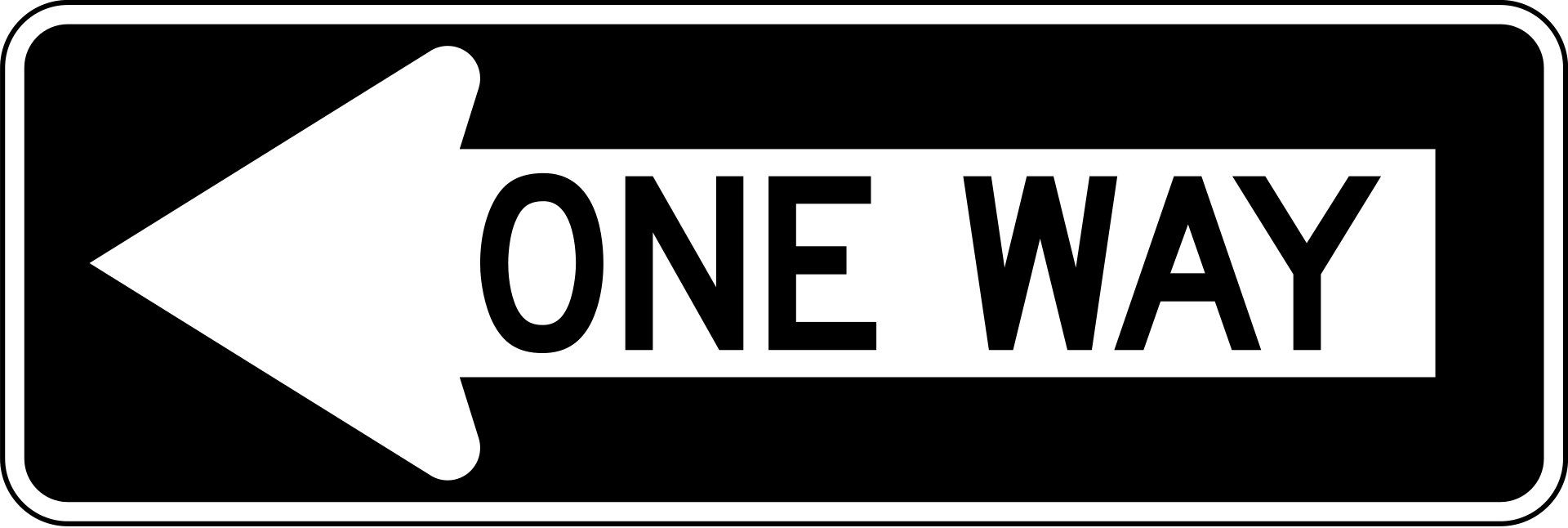
Traffic flows only in the direction indicated by the arrow. Never drive in the opposing direction.
The ‘One Way’ sign means that:
A) only vehicles turning left may travel in the direction of the arrow.
B) there is only one road that turns left at the intersection.
C) drivers may travel only in the direction of the arrow.
23.
Before crossing any railroad tracks, you must:
A) look and listen for trains.
B) make sure there is room for your vehicle on the other side.
C) All of the above.
24.
Parking is permitted only during specified hours and days as posted on the sign. Vehicles parked outside these hours are subject to ticketing or towing.
This sign means:
A) You can only park between 8:30 AM and 5:30 PM.
B) Parking is not allowed at 8:30 AM and at 5:30 PM
C) No parking between 8:30 AM and 5:30 PM.
25.
Gauging the speed of a motorcycle may be difficult because:
A) motorcycles take up less of your field of vision.
B) motorcycles often slow down by downshifting.
C) many motorcyclists do not activate the brake light.
26.
When children are close, what should you do before you back out of a driveway?
A) Rely on your mirrors.
B) Get out of the car and check behind the car.
C) Look through your back window for children.
27.
Drivers may legally block an intersection:
A) under no circumstances.
B) only during rush hour traffic.
C) only after entering the intersection on a green light.
28.
What is the most important rule to remember in any emergency?
A) Do not panic.
B) Run away.
C) Call the police.
29.
To drive defensively you should:
A) always put one car length between you and the car ahead.
B) keep your eyes moving to look for possible hazards.
C) look only at the car in front of you while driving.
30.
In work zones, barriers such as drums, panels and cones are used to:
A) reduce the flow of traffic.
B) keep traffic out of hazardous work zones.
C) keep workers out of the work zone.
ANSWER KEY Check answers after completing the test.
1 C
2 C
3 C
4 B
5 B
6 C
7 B
8 A
9 C
10 A
11 A
12 A
13 B
14 A
15 A
16 B
17 A
18 C
19 D
20 A
21 C
22 C
23 C
24 C
25 A
26 B
27 A
28 A
29 B
30 B