←
Back to Test
Hide Answer Key
Print / Save as PDF
Print / PDF
drive
quiz
.com
MS DMV PERMİT PRACTİCE TEST 17
Mississippi
Duration: 27 min
|
Questions: 30
Student Name:
Date:
Correct:
Incorrect:
Score:
1.
Which of the following drugs could affect your ability to drive?
A)
A cold remedy.
B)
Marijuana.
C)
All of the above.
2.
This road sign means the road you're driving on:
A)
turns sharply to the left and then right
B)
turns to the right and then the left
C)
turns only to the left
3.
This road sign means:
A)
Do not pass trucks
B)
Truck must back up
C)
Steep downgrade ahead
4.
Two drivers reach an uncontrolled intersection at the same time. Who has the right of way?
A)
The driver on the left.
B)
No one.
C)
The driver on the right.
5.
Night driving can be more difficult because:
A)
vehicle speed and distance are harder to judge.
B)
there are more cars on the roads at night.
C)
the speed limit is increased at night.
6.
To reduce their chances of colliding with an animal, drivers should:
A)
scan the sides of the road to watch for the reflection of vehicle headlights in the eyes of animals.
B)
look well down the road and far off to each side.
C)
All of the above.
7.
Drivers often fail to see a motorcycle headed toward them. Why?
A)
It is difficult to judge a motorcycle's speed.
B)
Motorcycles are hard to see.
C)
All of the above.
8.
To maintain an adequate 'space cushion' to the front, drivers need to:
A)
keep a safe distance between their car and the vehicle in front.
B)
The other answers are both correct.
C)
control their speed to suit the road and traffic conditions.
9.
Destination signs are ______ with ____ letters and symbols.
A)
green; white
B)
blue; white
C)
white; black
10.
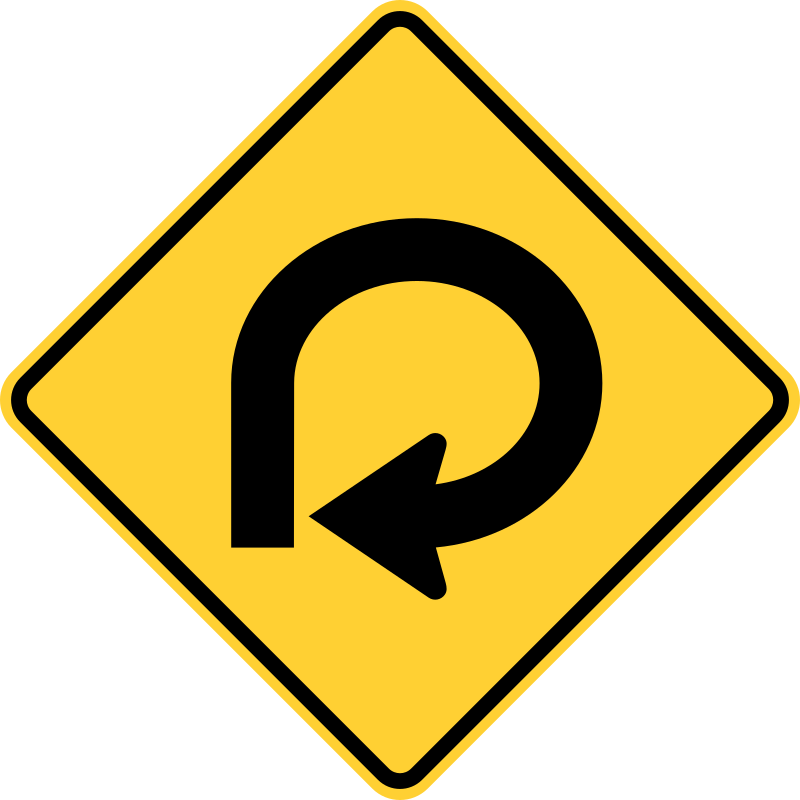
This sign means:
A)
Roundabout ahead.
B)
270 degree turn ahead.
C)
Wrong way; Turn around immediately.
11.
One broken line indicates:
A)
You can pass other vehicles and change lanes, if it is safe.
B)
You can not pass other vehicles or go across the line.
C)
You can change lanes, but only when traffic conditions or obstructions in the road make it necessary.
12.
Excessive speed:
A)
helps you to maneuver around obstacles.
B)
saves time so you can get to your destination more quickly.
C)
increases the likelihood of serious bodily injuries and death.
13.
Vertical rectangles tell drivers:
A)
the law.
B)
what is not allowed.
C)
the direction they should travel.
14.
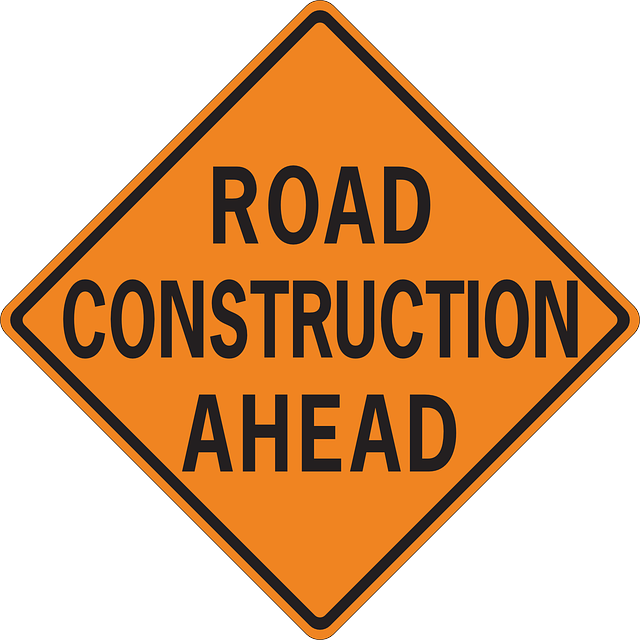
This road sign means:
A)
There is a detour ahead
B)
The highway ahead is being repaired
C)
Crossroads ahead
15.
To avoid glare from headlights of an approaching car:
A)
stay focused on the center line on the road.
B)
don't look directly into the oncoming headlights, look toward the right edge of your lane.
C)
flash your high beams.
16.
This sign tells drivers that:
A)
they must make a left turn at the intersection.
B)
U-turns are not allowed.
C)
they must not make a right turn.
D)
None of the above.
17.
When approaching a highway-rail intersection, the first sign drivers see is usually:
A)
an RXR round sign on a yellow background.
B)
a stop sign.
C)
a yield sign.
18.
Your BAC depends on:
A)
how fit you are.
B)
the type of beverage you drink.
C)
the amount of alcohol you drink.
19.
Does a vehicle prepared to enter a traffic circle or rotary have right-of-way over vehicles in the circle?
A)
Yes, but only if they are entering the rotary from the right lane.
B)
No. Vehicles already in the circle have the right-of-way.
C)
Only if the light is green.
D)
Yes.
20.
This is:
A)
a side road sign.
B)
a merging traffic sign.
C)
a right curve sign.
21.
Motorcycles:
A)
must share a traffic lane with another vehicle.
B)
are easier to see than cars.
C)
are entitled to use a complete traffic lane.
22.
Any use of a cell phone while operating a motor vehicle is considered a distraction because:
A)
it occupies the driver's mind, hands and eyes.
B)
it draws the attention of other drivers.
C)
it causes the driver to be concerned about the latest news.
23.
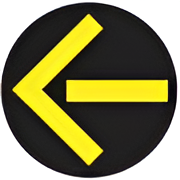
What does a yellow arrow signal mean?
A)
The same as the yellow light, but applies only to movement in the direction of the arrow.
B)
The same as a green light.
C)
Vehicles moving in all directions must stop if they can. The light will soon be red.
24.
Drinking alcohol:
A)
has no effect on either judgement or driving ability.
B)
has no effect on driving ability but affects your judgement.
C)
harms both judgement and driving skills.
25.
At intersections with a yield sign, you must:
A)
yield to the vehicles on your left only.
B)
yield the right-of-way to cross traffic close enough to cause conflict.
C)
slow down and proceed.
26.
This sign warns drivers that:
A)
they must turn either to the right or left.
B)
there is a double curve ahead.
C)
there is a winding road ahead.
27.
An octagonal sign means that drivers must:
A)
respect the posted speed limit.
B)
come to a complete stop at the marked stop line.
C)
be aware possible hazards ahead.
28.
Braking distance is how far a vehicle travels:
A)
before the driver hits the brakes.
B)
while the driver is braking.
C)
when pumping the brakes.
29.
The use of alcohol and/or drugs affects:
A)
concentration and reaction time.
B)
alertness and judgement.
C)
All of the above.
30.
Where must a pedestrian walk when there are no sidewalks?
A)
On the side of the road, in the same direction of traffic.
B)
In the middle of the road, facing oncoming traffic.
C)
On the side of the road, facing the traffic.
ANSWER KEY
Check answers after completing the test.
1
C
2
B
3
C
4
C
5
A
6
C
7
C
8
B
9
A
10
B
11
A
12
C
13
A
14
B
15
B
16
C
17
A
18
C
19
B
20
A
21
C
22
A
23
A
24
C
25
B
26
C
27
B
28
B
29
C
30
C