Which of the following must you obey over the others?
A)A flashing red light.
B)A stop sign.
C)A steady red light.
D)A police officer.
2.
What should you do in case of a steering failure?
A)Pump your gas pedal a few times to increase the pressure.
B)Don't panic. Turn on your emergency lights to let other drivers know you are having car problems. Move toward the side of the road and bring the car to a gradual stop.
C)Leave the road immediately.
3.
If another vehicle passes you on the left, you must:
A)increase your speed slightly and keep to the right.
B)decrease your speed, then pull over to the right and stop.
C)decrease your speed slightly and keep to the right.
4.
Drivers may need more space in front of their vehicle:
A)when following motorcycles.
B)when carrying a heavy load or pulling a trailer.
C)All of the above.
5.
You are approaching an intersection with a yellow flashing light. You should:
A)stop and wait for the light to change.
B)speed up to beat the red light.
C)prepare to stop; the light is about to turn red.
D)proceed with caution through the intersection.
6.
A vehicle that enters a road from a driveway:
A)has the right-of-way.
B)must yield to traffic approaching from the right, while it has the right-of-way over vehicles approaching from the left.
C)must stop and yield the right-of-way to traffic on the roadway and to pedestrians.
7.
A driver should be extra alert for motorcyclists, bicycles and pedestrians. Why?
A)They obey specific traffic laws.
B)They always have the right-of-way.
C)They are hard to see in traffic.
D)They don’t have rearview mirrors.
8.
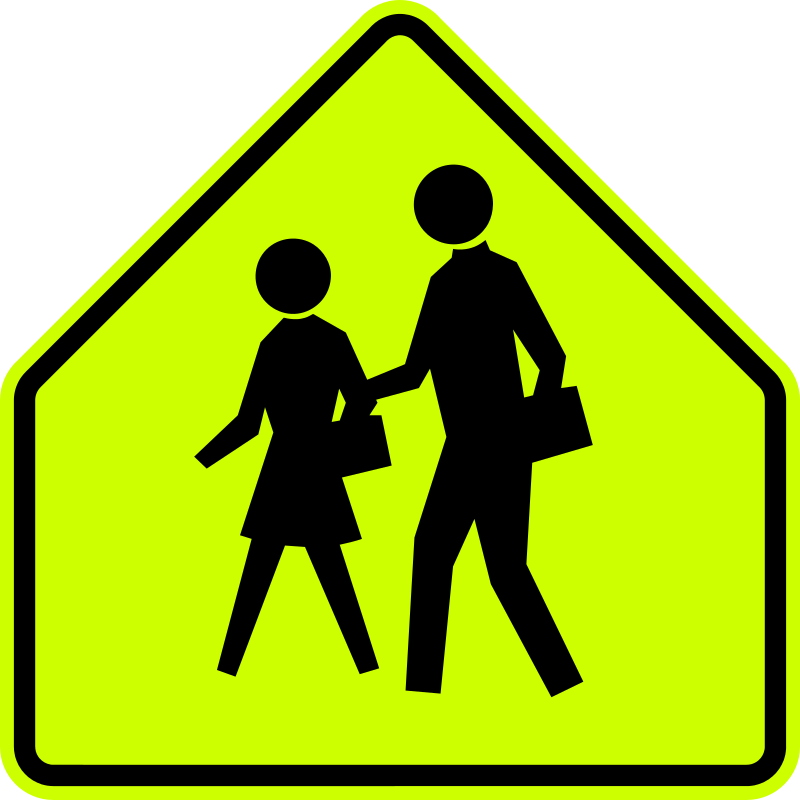
This warning sign means:
A)You are approaching a school
B)Watch out for children crossing the street
C)Slow down, drive with caution and watch for children
D)All of the above.
9.
This sign means:
A)You can only park between 8:30 AM and 5:30 PM.
B)Parking is not allowed at 8:30 AM and at 5:30 PM
C)No parking between 8:30 AM and 5:30 PM.
10.
Vehicle stopping distance never depends on:
A)the condition of your vehicle's brakes.
B)your own reaction time.
C)the time of day.
D)the condition and type of vehicle tires.
11.
You hear a siren close by but can not see where the emergency vehicle is. What do you do?
A)Keep driving until you are sure the emergency vehicle is headed toward you.
B)Stop immediately and activate your emergency flashers.
C)Pull over to the right side of the road and stop until you are sure the emergency vehicle is not headed toward you.
12.
You should never depend on your mirrors when you prepare to change lanes. Why?
A)Mirrors leave “blind spots” behind both sides of vehicles.
B)Mirrors need to be adjusted.
C)Mirrors are useless.
13.
A steady green light at intersections means:
A)You may drive through the intersection if the road is clear
B)You must increase your speed
C)You may not turn right
14.
When approaching a curve, remember to:
A)accelerate slightly before entering the curve.
B)drive at the posted speed limit throughout the curve.
C)slow down before entering the curve.
D)drive at the posted speed limit as you enter the curve, then slow down gradually.
15.
When children are close, what should you do before you back out of a driveway?
A)Rely on your mirrors.
B)Get out of the car and check behind the car.
C)Look through your back window for children.
16.
A broken white line:
A)means passing or crossing is prohibited in that lane.
B)separates two lanes traveling in the same direction.
C)marks the right edge of the roadway.
17.
Littering:
A)is against the law.
B)is unsightly.
C)may cause a traffic crash.
D)All of the above.
18.
This sign means:
A)The road will curve to the right.
B)Left turns are not allowed at the intersection.
C)Do not turn right.
19.
When following a motorcycle, drivers must remember that motorcycles can ____________ than other vehicles.
A)accelerate much faster
B)stop much more quickly
C)stop much more slowly
20.
This sign means:
A)Reversible lane ahead.
B)The divided highway ends ahead.
C)Drivers are coming to a point where another traffic lane joins the one they are on.
21.
When they see a yellow X signal, drivers should:
A)come to a complete stop at the marked stop line.
B)turn off the ignition.
C)prepare to leave the lane safely.
22.
When driving, it is important to keep a space cushion _______ of your vehicle.
A)only on the left and right side
B)only in back
C)on all sides
D)only in front
23.
When changing lanes on a multi-lane highway, you must signal your intentions _________ before changing lanes.
A)immediately
B)at least 50 feet
C)at least 150 feet
D)at least 100 feet
24.
This road sign means:
A)Winding road
B)Side road ahead
C)Slippery when wet
25.
If the entrance lane is too short to allow acceleration to expressway speed, you should:
A)stop and wait for a large space in traffic.
B)enter the expressway and accelerate quickly.
C)reduce your speed to 15 MPH or less and blend with traffic.
ANSWER KEYCheck answers after completing the test.