←
Back to Test
Hide Answer Key
Print / Save as PDF
Print / PDF
drive
quiz
.com
MO DMV PERMİT PRACTİCE TEST 18
Missouri
Duration: 23 min
|
Questions: 25
Student Name:
Date:
Correct:
Incorrect:
Score:
1.
Drivers often fail to see a motorcycle headed toward them. Why?
A)
It is difficult to judge a motorcycle's speed.
B)
Motorcycles are hard to see.
C)
All of the above.
2.
When you see this sign you should:
A)
increase your speed and try to pass other vehicles.
B)
slow your speed and be prepared to stop.
C)
slow your speed and do not pass other vehicles.
3.
Drivers may continue carefully through a yellow light if:
A)
there are no pedestrians crossing.
B)
they are turning right.
C)
they already are within the intersection.
D)
an emergency vehicle is crossing your lane.
4.
When in a motor vehicle on a highway, it is:
A)
illegal to drink from, but permissible to transport, open containers of alcohol in the passenger compartment.
B)
illegal to possess an open container of alcohol in the passenger compartment.
C)
acceptable to drink alcoholic beverages if you are not driving.
D)
permissible to drink a moderate amount of alcohol when driving with a passenger.
5.
If you missed your exit on a freeway, you should:
A)
use the right turn signal, check your mirrors and move to the right.
B)
None of the above.
C)
go to the next exit and come back to the exit you missed.
D)
make a quick U-turn from your lane of travel.
6.
This road sign means:
A)
Lane shifting
B)
Traffic is entering from another road, drive with caution
C)
Stop for other traffic
D)
Yield right-of-way
7.
This road sign means:
A)
Pedestrian crossing
B)
School zone
C)
School crossing
8.
If you get on a wrong expressway exit, you must:
A)
get off at the next exit and look for signs that tell you how to return to the expressway.
B)
use the the exit ramp to accelerate to expressway speed and blend with traffic.
C)
drive in reverse to return to the expressway.
9.
Before passing another vehicle, you should signal:
A)
early enough so other drivers know your intention.
B)
after changing lanes.
C)
at any time.
D)
just before changing lanes.
10.
If a driver follows you too closely, you should:
A)
move to another lane if possible.
B)
activate your stop lights.
C)
brake suddenly.
11.
This road sign means:
A)
Slow down, slippery when wet
B)
Detour ahead
C)
Road curves ahead
12.
If a bus has signaled and is pulling back onto the roadway, you must:
A)
yield.
B)
honk to let them know you’re there.
C)
move to the left lane.
D)
speed up to pass.
13.
One broken line indicates:
A)
You can pass other vehicles and change lanes, if it is safe.
B)
You can not pass other vehicles or go across the line.
C)
You can change lanes, but only when traffic conditions or obstructions in the road make it necessary.
14.
What does this sign indicate?
A)
The highway ahead is divided into two one-way roadways.
B)
Winding road ahead. Drive with caution.
C)
Drivers will soon be on a roadway with two-way traffic.
15.
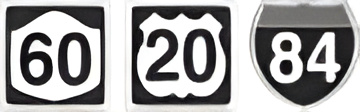
These are:
A)
route signs.
B)
miles-left signs.
C)
speed limit signs.
16.
This road sign is:
A)
a speed reduction sign.
B)
a warning sign.
C)
a regulatory sign.
17.
On slippery roads, drivers should:
A)
leave more space in front of their vehicle.
B)
increase their speed to avoid hydroplaning.
C)
come to a complete stop.
18.
Road signs that point out scenic areas and parks are:
A)
brown and white.
B)
black and orange.
C)
green and white.
19.
Bicyclists must:
A)
ride in a bicycle lane, if available.
B)
remain to the right when they prepare for a left turn.
C)
remain near the left edge of the road.
20.
When the road is slippery, you should:
A)
brake suddenly carefully.
B)
pump your brakes.
C)
press your brakes in slow, steady strokes.
21.
When the driver behind you wants to pass, you should:
A)
change lanes.
B)
speed up.
C)
use your brake lights.
D)
slow down to allow room for the other driver to complete the pass safely.
22.
When are you allowed to pass another vehicle by using the shoulder of the road?
A)
When the traffic ahead is blocked up for 250 feet.
B)
When the vehicle in front of you is making a left turn.
C)
Never.
D)
To go around a slow moving vehicle.
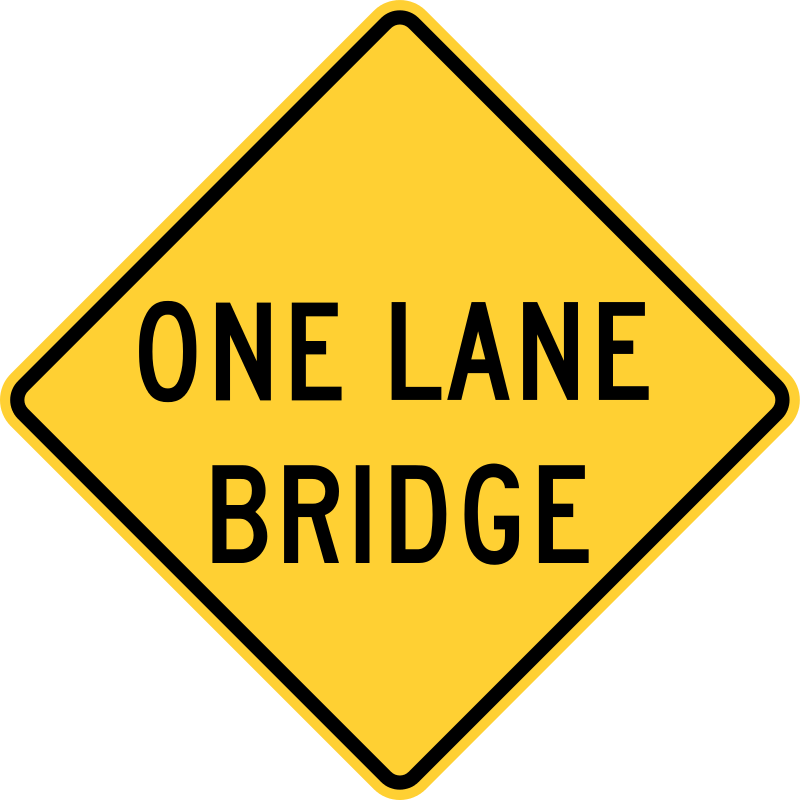
23.
What should drivers do when they see this sign?
A)
Make sure the bridge is clear of oncoming traffic before they cross.
B)
Look to the left and right for other traffic.
C)
Allow others to merge smoothly.
24.
What is the main reason night driving is more difficult than daytime driving?
A)
The use of headlight is required by law.
B)
Reduced visibility.
C)
Driving within the range.
25.
On what three conditions does your blood alcohol content (BAC) depend?
A)
Your weight. How much alcohol you drink. How much time passes between drinks.
B)
Your weight. The type of beverage you drink. How fit you are.
C)
Your height. How much alcohol you drink. The type of beverage you drink.
ANSWER KEY
Check answers after completing the test.
1
C
2
C
3
C
4
B
5
C
6
B
7
A
8
A
9
A
10
A
11
A
12
A
13
A
14
C
15
A
16
C
17
A
18
A
19
A
20
C
21
D
22
C
23
A
24
B
25
A