Where there is no bicycle lane, where on the road must a bicyclist ride?
A)on the left shoulder of the road.
B)near the right curb or edge of the road.
C)near the left edge of the road.
2.
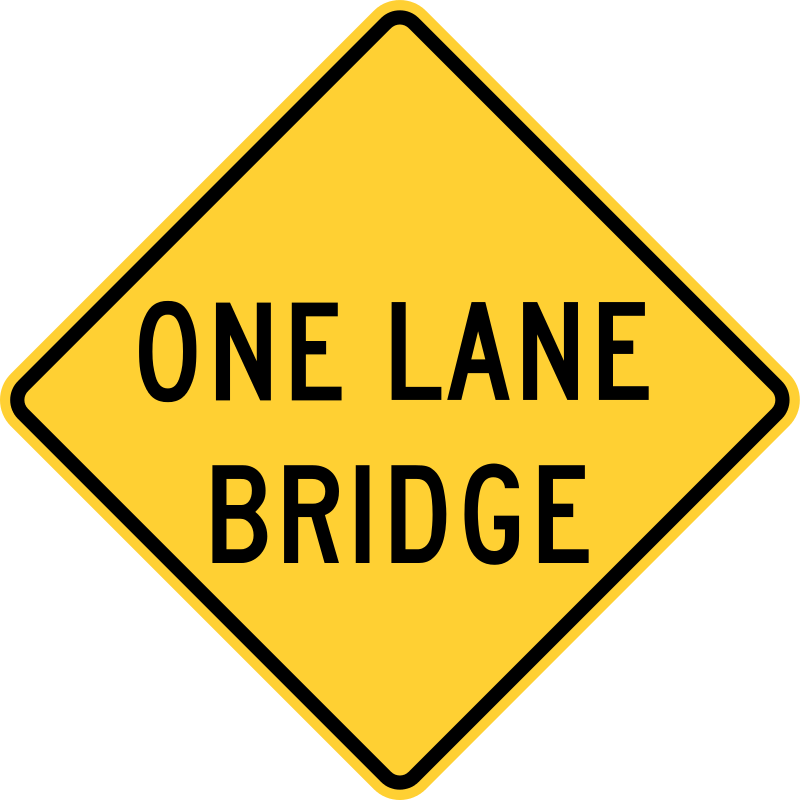
This sign warns that:
A)traffic must merge left.
B)the bridge ahead is wide enough for only one vehicle at a time.
C)traffic must merge right.
3.
What is the main reason night driving is more difficult than daytime driving?
A)The use of headlight is required by law.
B)Reduced visibility.
C)Driving within the range.
4.
Left turns on a red light are allowed:
A)from a one-way street into a one-way street.
B)Never.
C)at intersections, after stopping, if the way is clear.
5.
This sign means:
A)No traffic signal ahead
B)Traffic signal ahead
C)Open intersection ahead
6.
Unlike passenger cars, trucks have blind spots:
A)on the right.
B)directly behind them.
C)on the front.
7.
When the driver behind you wants to pass, you should:
A)change lanes.
B)speed up.
C)use your brake lights.
D)slow down to allow room for the other driver to complete the pass safely.
8.
When you drive near parks and playgrounds, you should expect children:
A)not to cross unless they are with an adult.
B)to know when it is safe to cross.
C)to stop at the curb before crossing the street.
D)to suddenly run into the street.
9.
This road sign means:
A)Divided highway ahead
B)Two-way traffic ahead
C)Four-lane traffic ahead
10.
If an aggressive driver is behind you:
A)sound your horn and move to the left lane.
B)slow down and confront the aggressive driver.
C)try to get out of the aggressive driver’s way.
D)increase you speed and flash your brake lights.
11.
This road sign means:
A)Wrong Way
B)Merging Traffic
C)Curve ahead
12.
A 4-way stop sign means:
A)The first vehicle to reach the intersection should move forward first.
B)Traffic from all four directions must stop.
C)There are four stop signs at the intersection.
D)All of the above.
13.
A driver should be extra alert for motorcyclists, bicycles and pedestrians. Why?
A)They obey specific traffic laws.
B)They always have the right-of-way.
C)They are hard to see in traffic.
D)They don’t have rearview mirrors.
14.
When meeting a car with blinding headlights, you should:
A)look toward the right side of the road.
B)dim your lights, then speed up and pass quickly.
C)use your emergency flashers to warn the other driver.
D)look toward the left side of the road.
15.
Drivers under 21 years of age are considered to be driving under the influence if their blood alcohol concentration (BAC) is:
A).10% or higher.
B).05% or higher.
C).08% or higher.
D).02% or higher.
16.
What does the flashing signal in the picture indicate?
A)The same thing as a stop sign.
B)Pedestrians should finish crossing the street if started.
C)Pedestrians should start crossing the street.
17.
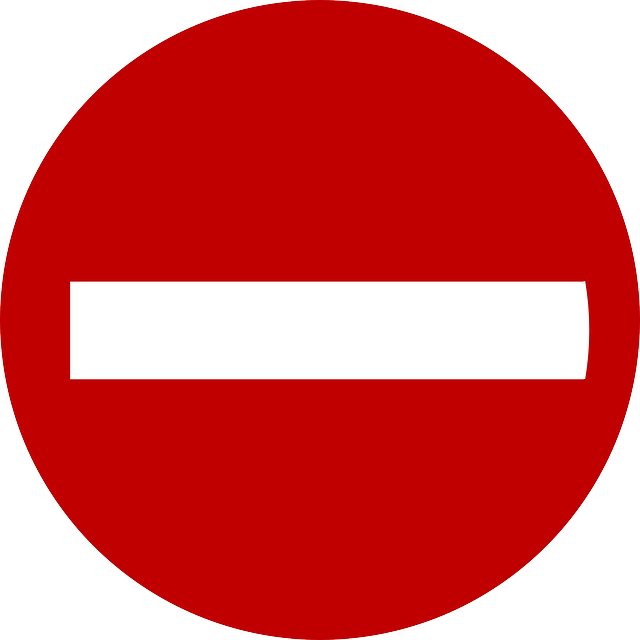
This road sign means:
A)No left turn
B)Lane ends
C)Do not enter
18.
This road sign means:
A)Right turn permitted on red light
B)Drivers must turn right
C)No U-turns
D)No right turn permitted
19.
The sign in the picture:
A)is a Construction and Maintenance Traffic Control sign.
B)is found at most intersections and indicates that drivers must yield to other vehicles.
C)is displayed on the rear of slow moving vehicles.
20.
This sign means:
A)divided highway ahead.
B)narrow bridge ahead.
C)road construction.
D)lane ends, merge left.
21.
A large vehicle is backing up to unload goods. You should:
A)enter one of the blind spots and wait.
B)try to pass close behind.
C)be patient and wait until the large vehicle has completed its backup maneuver.
22.
This road sign means:
A)Slow down and yield to traffic on main road when merging
B)Always come to a complete stop
C)Lane reduction ahead
D)You must come to a complete stop and yield right-of-way
23.
In the following situations, drivers should increase their following interval:
A)When following vehicles that are required to come to a stop at railroad crossings.
B)When it is hard to see ahead because of bad weather.
C)All of the above.
24.
A traffic light shows both a red light and a green arrow. The driver may not turn in the direction of the arrow until the red light has changed.
A)True
B)False
25.
When a stop is required at an intersection with no stop line or crosswalk:
A)Drivers should stop only at a place where the driver can see at least 100 feet on either side.
B)Drivers are required to slow down to make sure crossing traffic is clear.
C)Drivers are not required to stop.
D)Drivers should stop at the point nearest the intersecting roadway where the driver has a view of approaching traffic on the intersecting roadway before actually entering the roadway.
26.
Tailgating:
A)cannot result in a traffic citation.
B)helps reduce traffic congestion.
C)is a defensive driving tecnique.
D)can frustrate other drivers and make them angry.
27.
At intersections marked with stop lines, drivers must:
A)come to a complete stop.
B)slow down and enter the intersection.
C)signal other vehicles to stop.
28.
When exiting a highway, you should slow down:
A)when you first see the exit sign.
B)before moving into the exit lane.
C)once you have moved into the exit lane.
D)once you see the toll booth.
29.
After stopping for a school bus that is unloading children you should:
A)accelerate quickly and pass.
B)put on your emergency flashers.
C)watch for children walking along the side of the road.
D)wait at least 4 minutes.
30.
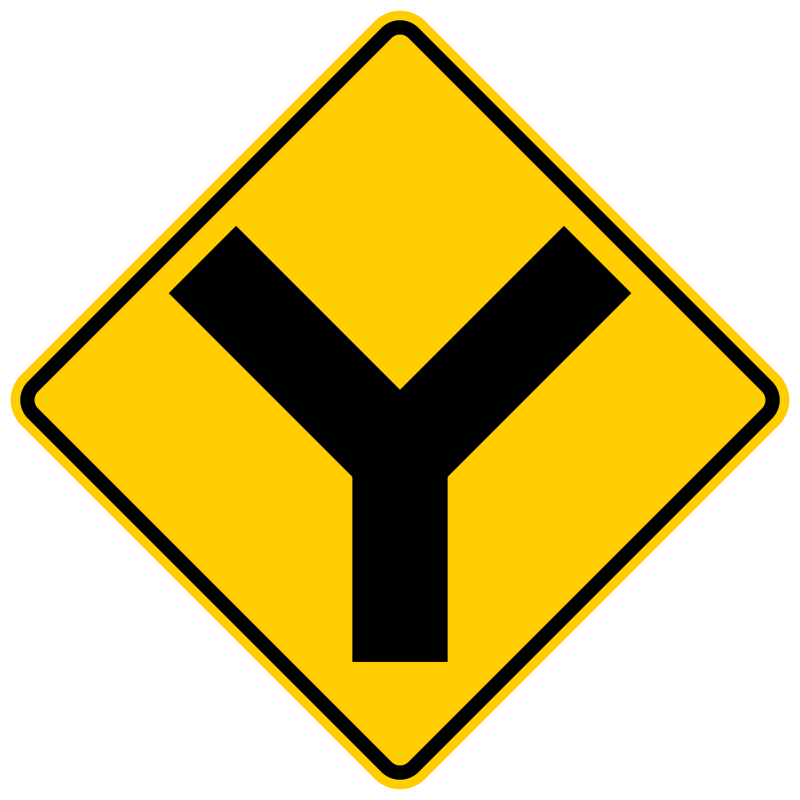
This road sign means:
A)The road ends ahead
B)A four-way intersection is ahead
C)“Y” intersection ahead
D)A road joins from the right
31.
A broken yellow line alongside a solid yellow line means:
A)Passing is permitted on the side of the broken yellow line
B)Passing is not permitted in either direction
C)Passing on the right is permitted in either direction
32.
This road sign means:
A)Curves ahead
B)Divided highway ahead
C)Divided highway ends
33.
Which of the following must you obey over the others?
A)Red light
B)Stop sign
C)Police officer
34.
Smoking while driving:
A)does not affect driving abilities.
B)is not distracting.
C)helps increase driver alertness.
D)is distracting.
35.
Yellow traffic signs:
A)guide drivers.
B)when combined with an octagonal shape, tell drivers they must come to a complete stop at the marked stop line.
C)warn drivers.
36.
This sign indicates:
A)Winding road
B)Merging traffic
C)Divided highway ends
37.
If your turn signals fail, you should use _____ to indicate your intention to turn.
A)your emergency flashers
B)your horn
C)your high beams
D)hand signals
38.
What should drivers do when they see this sign?
A)Make sure the bridge is clear of oncoming traffic before they cross.
B)Look to the left and right for other traffic.
C)Allow others to merge smoothly.
39.
A merge sign means drivers should be prepared to change lanes or allow other traffic to come into their lane.
A)False
B)True
ANSWER KEYCheck answers after completing the test.