A vehicle is stopped at a crosswalk to permit a pedestrian to cross the roadway. The driver of the vehicle approaching from the rear should:
A)sound the horn.
B)overtake and pass the stopped vehicle.
C)not overtake and pass the stopped vehicle.
2.
Road signs that direct drivers to services are:
A)brown and white.
B)blue and white.
C)green and white.
3.
When driving in fog, drivers should use:
A)low beam headlights.
B)parking lights.
C)high beam headlights.
4.
This road sign means:
A)Divided highway ahead
B)Merging traffic
C)Flagger ahead
5.
This sign indicates:
A)A slow-moving vehicle
B)A no-passing zone
C)Yield
6.
This sign means:
A)Divided highway ahead.
B)Divided highway ends.
C)Drivers will soon be on a roadway with two-way traffic.
7.
When in a motor vehicle on a highway, it is:
A)illegal to drink from, but permissible to transport, open containers of alcohol in the passenger compartment.
B)illegal to possess an open container of alcohol in the passenger compartment.
C)acceptable to drink alcoholic beverages if you are not driving.
D)permissible to drink a moderate amount of alcohol when driving with a passenger.
8.
Traffic lights are normally ____________ from the top to bottom or left to right.
A)red, green and yellow
B)green, yellow and red
C)red, yellow and green
9.
If cars approaching from opposite directions reach an intersection at the same time:
A)a car that moves straight must yield to cars that turn left.
B)a car that turns left must yield to cars that move straight or turn right.
C)a car that turns right must yield to cars that move straight or turn left.
10.
Directions given by traffic officers ___________ signs, signals or pavement markings.
A)take precedence over
B)are less important than
C)must obey
11.
You are stopped at a stop sign and you are going to go straight through the intersection. A car on the cross road has stopped at a stop sign on your right and is going to go straight. Who has the right-of-way?
A)Whoever enters the intersection first.
B)You.
C)The car on your right.
12.
Before crossing any railroad tracks, you must:
A)look and listen for trains.
B)make sure there is room for your vehicle on the other side.
C)All of the above.
13.
This sign warns drivers that:
A)they cannot go straight ahead.
B)they will soon be facing oncoming traffic.
C)a shared lane starts ahead.
14.
When driving at night with no other vehicles ahead, a driver should use:
A)high beam lights.
B)low-beam lights.
C)parking lights.
15.
What is the purpose of minimum speed limits?
A)To keep a smooth traffic flow.
B)To halt the traffic flow.
C)To allow emergency vehicles with red flashing lights to safely pass other vehicles.
16.
At night, it is hardest to see:
A)street lights.
B)pedestrians.
C)other motorists.
D)road signs.
17.
Who is most at risk?
A)Drivers who are fatigued.
B)Drivers who are driving on long, boring roads.
C)All of the above.
18.
You face a green light, but traffic on the other side of the intersection does not allow you to travel all the way through the intersection. What must you do?
A)Enter the intersection and wait until traffic ahead clears.
B)Wait for the next green light.
C)Wait until traffic ahead clears, so you do not block the intersection.
19.
When a driver is turning and a pedestrian is crossing without a traffic light, __________ must yield the right-of-way.
A)the pedestrian
B)the driver
C)both
D)whoever is slower
20.
What should drivers do when they see this sign?
A)Make sure the bridge is clear of oncoming traffic before they cross.
B)Look to the left and right for other traffic.
C)Allow others to merge smoothly.
21.
When you prepare to make a left turn from a one-way road into a two-way road, you must:
A)enter the two-way road to the left of its center line.
B)approach the turn in the right lane or from the right side of a single lane.
C)approach the turn in the left lane or from the left side of a single lane.
22.
To reduce their chances of colliding with an animal, drivers should:
A)scan the sides of the road to watch for the reflection of vehicle headlights in the eyes of animals.
B)look well down the road and far off to each side.
C)All of the above.
23.
Where must you position your vehicle when you prepare to make a left turn from a two-way roadway into a one-way roadway?
A)As far to the right as possible.
B)On the right curb.
C)As close as possible to the center line.
24.
This road sign means:
A)Stop before turning right
B)4-way stop ahead
C)Lane closed for traffic
D)There is a traffic signal ahead
25.
Drivers may pass another vehicle if the line dividing two lanes is a ________ line.
A)broken white
B)double solid yellow
C)solid yellow
D)solid white
26.
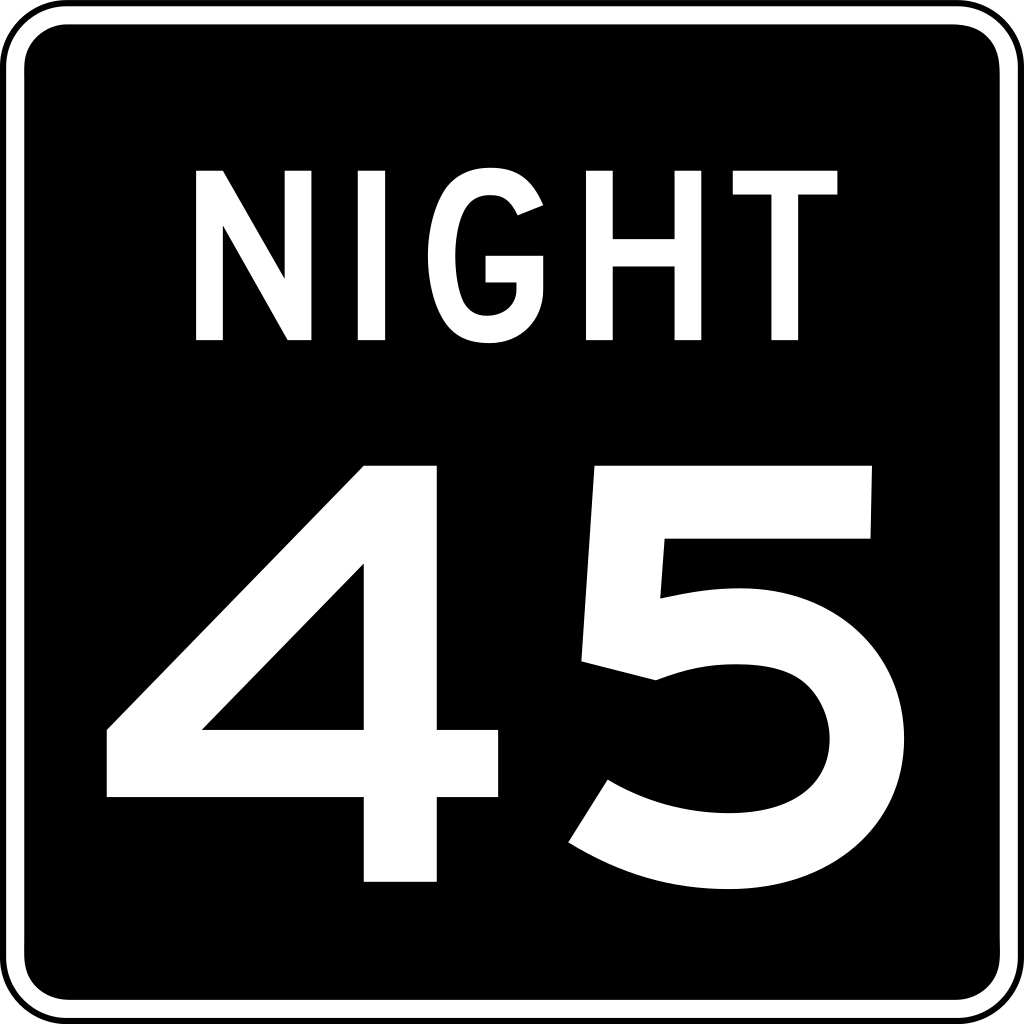
This sign means:
A)Take route 45 if you are driving at night.
B)The night-time speed limit is 45 MPH.
C)The minimum speed limit is 45 MPH.
27.
When drivers come to this sign, they must:
A)be ready to stop at the stop sign.
B)warn other drivers that a stop sign is ahead.
C)brake sharply and come to a complete stop.
28.
Which of the following is true about the Anti-Locking Brake System?
A)It prevents skidding.
B)It allows drivers to steer during an emergency braking situation.
C)All of the above.
29.
This sign means:
A)Not enter
B)Detour to the right
C)The road to the right is for one-way traffic only
30.
When driving on a wet road:
A)as you drive faster, your tires may lose traction.
B)you must be aware that the pavement gets even more slippery when it's been raining for long periods of time.
C)you should follow the vehicle ahead of you more closely.
D)as you decrease your speed, the road becomes more slippery.
31.
What do flashing red lights on a school bus indicate?
A)The bus is stopped to load or discharge passengers.
B)Traffic that approaches from either direction may proceed.
C)The bus is about to stop.
32.
This road sign means:
A)Slow down, slippery when wet
B)Detour ahead
C)Road curves ahead
33.
This road sign means:
A)Railroad Crossing
B)One Way
C)Limited parking
34.
This road sign means:
A)A road joins from the left
B)The road ahead turns sharply right then sharply left
C)Sharp right turn
D)Winding road ahead
35.
________ is the only effective way to reduce your Blood Alcohol Content (BAC).
A)Time
B)Drinking coffee
C)Taking a cold shower
D)Eating food
36.
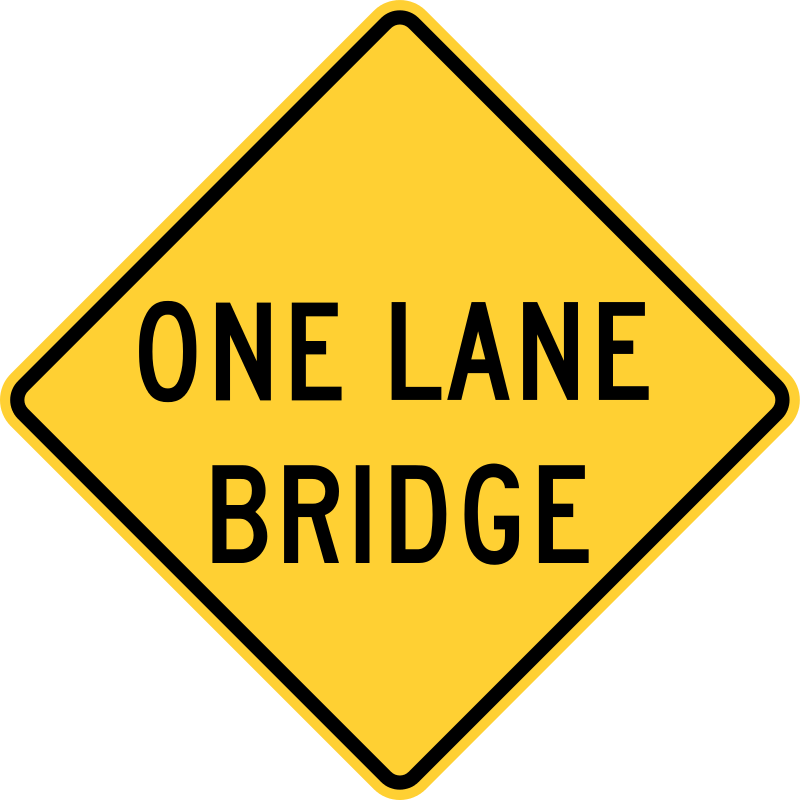
This sign warns drivers that:
A)there is a one lane bridge ahead.
B)the right lane ends.
C)the road ahead is narrow.
37.
Never make a U-turn from:
A)the lane you’re in.
B)the right lane.
C)the left part of the lane nearest to the centerline of the roadway.
38.
A flashing red light:
A)is used at dangerous intersections.
B)means the same thing as a stop sign.
C)All of the above.
39.
At a stop sign there is no stop line or crosswalk. You must stop:
A)before you enter the intersection.
B)at the next crosswalk.
C)after you enter the intersection, if you have a clear view of traffic on the intersecting roadway.
40.
An emergency vehicle that uses lights and a siren can be unpredictable. Why?
A)The driver can legally pass red lights.
B)Emergency vehicles must go faster than the posted speed limit when it is safe to do so.
C)Emergency vehicle drivers are not required to be careful.
41.
When exiting a highway, you should slow down:
A)when you first see the exit sign.
B)before moving into the exit lane.
C)once you have moved into the exit lane.
D)once you see the toll booth.
42.
The ‘Slower Traffic Keep Right’ sign is used:
A)at most intersections.
B)on multiple lane highways.
C)in school zones.
43.
A four-way stop sign means:
A)traffic from all four directions must stop.
B)if two vehicles reach the intersection at the same time, the driver on the left yields to the driver on the right.
C)All of the above.
44.
Your first response to reduced visibility should be:
A)to look for road edge markings to guide you.
B)to turn on your windshield wipers.
C)to reduce your speed.
D)to turn on your headlights.
45.
Drivers often fail to see a motorcycle headed toward them. Why?
A)It is difficult to judge a motorcycle's speed.
B)Motorcycles are hard to see.
C)All of the above.
46.
You are approaching an intersection with a yellow flashing light. You should:
A)stop and wait for the light to change.
B)speed up to beat the red light.
C)prepare to stop; the light is about to turn red.
D)proceed with caution through the intersection.
47.
This sign means:
A)You may make a U-turn.
B)Hairpin corner ahead.
C)You must make a U-turn.
48.
If you remain in the back blind spot of a large vehicle:
A)you increase the chance of a crash.
B)the large vehicle will take much longer to stop.
C)you can reduce fuel consumption.
49.
When you pass another vehicle, before you return to the right lane, you must:
A)look at your interior rear-view mirror.
B)signal.
C)All of the above.
50.
Service signs are ____ with ____ letters and symbols.
A)blue; white
B)white; black
C)green; white
ANSWER KEYCheck answers after completing the test.