DriveQuiz drivequiz.com

MI DMV PERMİT PRACTİCE TEST 2

Michigan
Duration: 45 min
|
Questions: 49
Student Name:
Date:
Correct:      Incorrect:      Score:      
1.
Drivers under 21 years of age are considered to be driving under the influence if their blood alcohol concentration (BAC) is:
A) .10% or higher.
B) .05% or higher.
C) .08% or higher.
D) .02% or higher.
2.
Parking is permitted only during specified hours and days as posted on the sign. Vehicles parked outside these hours are subject to ticketing or towing.
This sign means:
A) You can only park between 8:30 AM and 5:30 PM.
B) Parking is not allowed at 8:30 AM and at 5:30 PM
C) No parking between 8:30 AM and 5:30 PM.
3.
If an approaching driver does not dim the headlights, you should:
A) move your eyes to the left to help avoid the glare of approaching high beams.
B) move your eyes to the right and avoid looking directly at the bright lights.
C) flash your headlights to low beam for a second, then return to high beam.
4.
When approaching a curve, remember to:
A) accelerate slightly before entering the curve.
B) drive at the posted speed limit throughout the curve.
C) slow down before entering the curve.
D) drive at the posted speed limit as you enter the curve, then slow down gradually.
5.
Right turns are strictly prohibited at this intersection under all circumstances.
This road sign means:
A) No left turn
B) No right turn
C) No U-turns
6.
If another vehicle passes you on the left, you must:
A) increase your speed slightly and keep to the right.
B) decrease your speed, then pull over to the right and stop.
C) decrease your speed slightly and keep to the right.
7.
Which shape is a speed limit sign?
A) Round
B) Pentagon
C) Vertical rectangle
8.
Your BAC depends on:
A) how fit you are.
B) the type of beverage you drink.
C) the amount of alcohol you drink.
9.
The median divider ends ahead, and you are returning to a two-way, two-lane undivided roadway. Watch for oncoming traffic on your left.
This sign means:
A) Reversible lane ahead.
B) The divided highway ends ahead.
C) Drivers are coming to a point where another traffic lane joins the one they are on.
10.
A steep downhill grade is ahead. Trucks and heavy vehicles should downshift to a lower gear to prevent brake overheating.
This road sign means:
A) No right turn
B) No left turn
C) Narrow Bridge
D) Steep downgrade
11.
Which of the following is NOT true about ABS?
A) It improves the vehicle stability.
B) It helps increase your stopping distance.
C) It improves the steering ability.
12.
The shape of a route sign tells you:
A) the type of route you are on.
B) the speed limit on that route.
C) that the route you are on might be dangerous.
13.
When you make a left turn from a one-way road into a one-way road, if the road you enter has two lanes, you:
A) must turn into its right lane.
B) can not turn left.
C) must turn into its left lane.
14.
Your brake lights tell other drivers that you:
A) are changing lanes.
B) are slowing down or stopping.
C) are making a turn.
D) have your emergency brake on.
15.
When changing lanes, you should not:
A) signal your intentions early.
B) check your side and rear view mirrors.
C) use the inside rearview mirror to check for blind spots
D) check to see if other drivers are moving into the same lane.
16.
Warns of two consecutive curves in opposite directions (e.g., curves right then left). Slow down to maintain control.
When you see this sign you should:
A) increase your speed and try to pass other vehicles.
B) slow your speed and be prepared to stop.
C) slow your speed and do not pass other vehicles.
17.
A signalized intersection is ahead. Prepare to stop if the light turns yellow or red.
This sign means:
A) No traffic signal ahead
B) Traffic signal ahead
C) Open intersection ahead
18.
A vehicle that enters a road from a driveway:
A) has the right-of-way.
B) must yield to traffic approaching from the right, while it has the right-of-way over vehicles approaching from the left.
C) must stop and yield the right-of-way to traffic on the roadway and to pedestrians.
19.
When driving on slippery roads, drivers should:
A) increase their following distance.
B) avoid crossing bridges or intersections.
C) brake harder than usual.
D) change lanes quickly.
20.
The road makes a sharp 90-degree right turn ahead. Slow down considerably before entering the turn.
This road sign means:
A) School zone ahead
B) Side road
C) Construction zone ahead
D) Sharp turn, slow down
21.
If another car is in danger of hitting you, you should:
A) flash your brake lights.
B) sound your horn.
C) use your emergency lights.
D) flash your headlights.
22.
When following motorcycles, drivers should:
A) reduce the minimum following distance.
B) try to pass them as they have different braking capabilities than other motor vehicles.
C) keep more space in front of their vehicle.
23.
Drivers who eat and drink while driving:
A) have no driving errors.
B) may have trouble controlling their vehicles.
C) must yield the right-of-way.
D) tend to be more aggressive.
24.
You should increase your following distance when:
A) exiting a freeway.
B) following a motorcycle.
C) driving behind a large vehicle that blocks your vision.
D) All of the above.
25.
Warns drivers that two separate lanes moving in the same direction are merging into one. Drivers in the right lane must adjust speed and merge smoothly with existing traffic.
This road sign means:
A) Merging traffic from the right
B) Sharp curves ahead
C) Intersection ahead
26.
Your car stalls on the tracks at a railroad crossing, and a collision with a train is imminent. After getting yourself and your passengers out of the car, you should:
A) run toward the train but stay off the tracks.
B) signal the train to stop.
C) cross the tracks.
27.
The road makes a sharp 90-degree right turn ahead. Slow down considerably before entering the turn.
This sign warns drivers that:
A) the road will make a sharp turn to the right.
B) right turns are not allowed.
C) another road enters the highway from the direction shown.
28.
You want to turn left at an intersection ahead. A car reaches the intersection from the opposite direction and moves straight ahead. You:
A) can turn left. You have the right of way.
B) must wait for the car to go through before you turn.
C) may not enter the intersection to prepare for your left turn if the light is green.
29.
Following another vehicle too closely is known as:
A) speedgating.
B) closetailing.
C) tailgating.
30.
You can pass on the right:
A) when a vehicle ahead makes a right turn.
B) when a vehicle ahead makes a left turn.
C) when a vehicle that is approaching from the opposite direction is prepared to turn left.
31.
Yellow diamond warning that pedestrians may be crossing ahead. Exercise caution and yield.
This road sign means:
A) Pedestrian crossing
B) School zone
C) School crossing
32.
On average, how long does it take your body to remove the alcohol contained in 5 ounces of wine?
A) one hour.
B) 30 minutes.
C) 3 hours.
33.
On what three conditions does your blood alcohol content (BAC) depend?
A) Your weight. How much alcohol you drink. How much time passes between drinks.
B) Your weight. The type of beverage you drink. How fit you are.
C) Your height. How much alcohol you drink. The type of beverage you drink.
34.
You reach an intersection that is not controlled at the same time as a driver on your right, and both of you prepare to go straight. Who has the right-of-way?
A) You.
B) No one.
C) The other driver.
35.
Indicates an upcoming bicycle crossing or shared road zone. Always leave at least 3 feet of clearance when passing cyclists.
This road sign means:
A) Watch for bicycles
B) Bicycle parking ahead
C) Bicycles are not allowed in this area
36.
When children are close, what should you do before you back out of a driveway?
A) Rely on your mirrors.
B) Get out of the car and check behind the car.
C) Look through your back window for children.
37.
Prohibits drivers from making a 180-degree turn to travel in the opposite direction at this intersection or stretch of road.
This road sign means:
A) Left turns are not allowed where this sign is displayed.
B) Drivers cannot make a complete turn to go in the opposite direction.
C) Vehicles turning left must make a U-turn.
38.
Destination signs are ______ with ____ letters and symbols.
A) green; white
B) blue; white
C) white; black
39.
Drinking alcohol while taking drugs:
A) reduces the effects of the alcohol.
B) reduces the effects of the drug or medicine.
C) has no effect, they are different substances.
D) could multiply the effects of the alcohol.
40.
When you reach an intersection with a stop sign, you should:
A) follow the vehicle ahead of you.
B) stop, look right, then left, then right again.
C) stop, look left, then right, then left again.
D) check your rearview mirror, look left, then right, then proceed.
41.
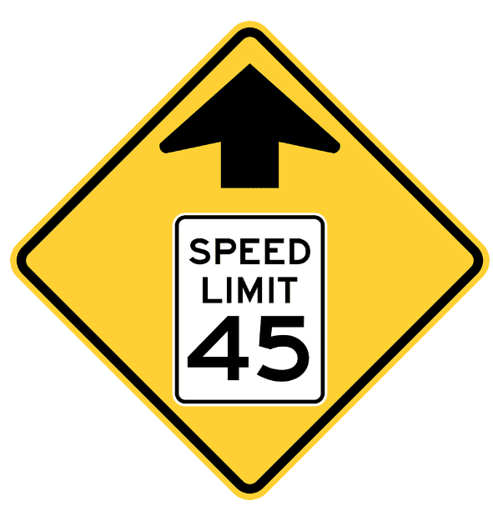
Recommended safe maximum driving speed in ideal conditions for an upcoming curve, ramp, or hazardous stretch of road.
This warning sign:
A) provides advance notice to upcoming speed limit change.
B) shows the current speed limit that all vehicles traveling in the direction of the arrow must not exceed.
C) indicates the suggested highest safe speed.
42.
What is a likely effect when you take another drug while you drink alcohol?
A) The effects of the alcohol and the drug are enhanced.
B) There are no effects, unless the drug is prescription only.
C) If the drug is over-the-counter, there are no effects.
43.
Your blind spot is the area of the road:
A) you see in your rearview mirror.
B) directly behind your vehicle.
C) you cannot see without moving your head.
D) you see in your side mirror.
44.
Drivers should be aware that a motorcyclist may:
A) decrease speed and rise off the seat when approaching a railroad crossing.
B) quickly change speed or lane position.
C) All of the above.
45.
Aggressive driving includes:
A) quick lane changes without a signal.
B) chasing or challenging other drivers.
C) All of the above.
46.
Indicates an upcoming bicycle crossing or shared road zone. Always leave at least 3 feet of clearance when passing cyclists.
This road sign means:
A) Yield right-of-way to bicycles
B) Bicycles cross or ride beside traffic
C) Yield to motorcyles, but not to bicycles
D) Bicycles have the same rights as other vehicles
47.
Vehicle stopping distance never depends on:
A) the condition of your vehicle's brakes.
B) your own reaction time.
C) the time of day.
D) the condition and type of vehicle tires.
48.
Drivers may continue carefully through a yellow light if:
A) there are no pedestrians crossing.
B) they are turning right.
C) they already are within the intersection.
D) an emergency vehicle is crossing your lane.
49.
When driving in heavy rain, drivers should use:
A) parking lights.
B) low beam headlights.
C) high beam headlights.
ANSWER KEY Check answers after completing the test.
1 D
2 C
3 B
4 C
5 B
6 C
7 C
8 C
9 B
10 D
11 B
12 A
13 C
14 B
15 C
16 C
17 B
18 C
19 A
20 D
21 B
22 C
23 B
24 D
25 A
26 A
27 A
28 B
29 C
30 B
31 A
32 A
33 A
34 C
35 A
36 B
37 B
38 A
39 D
40 C
41 A
42 A
43 C
44 C
45 C
46 B
47 C
48 C
49 B