DriveQuiz drivequiz.com

ME DMV PERMİT PRACTİCE TEST 8

Maine
Duration: 54 min
|
Questions: 60
Student Name:
Date:
Correct:      Incorrect:      Score:      
1.
A driver who approaches an intersection:
A) must yield the right-of-way to traffic already in the intersection.
B) must drive straight through the intersection, even if another vehicle is already in the intersection.
C) has the right-of-way over traffic already in the intersection.
2.
Your red traffic signal changes to green while a pedestrian is crossing in your traffic lane. The right of way should be given:
A) by the pedestrian, but only when vehicles are turning left.
B) by the pedestrian.
C) to the pedestrian.
3.
While inside the roundabout, you should:
A) remain in your lane until you are ready to exit.
B) change lanes before you check for vehicles behind you.
C) use your left turn signal if you are in position to exit now.
4.
If you missed your exit on a freeway, you should:
A) use the right turn signal, check your mirrors and move to the right.
B) None of the above.
C) go to the next exit and come back to the exit you missed.
D) make a quick U-turn from your lane of travel.
5.
A flashing yellow traffic signal means:
A) Slow down and be alert at the upcoming intersection.
B) The same thing as a stop sign.
C) Stop and proceed when a green light appears.
D) No right turn.
6.
Warns drivers that two separate lanes moving in the same direction are merging into one. Drivers in the right lane must adjust speed and merge smoothly with existing traffic.
This road sign means:
A) Cars in right lane must slow down
B) Merging traffic ahead
C) Pass only in the right lane
D) No left turn
7.
Before crossing any railroad tracks, you must:
A) look and listen for trains.
B) make sure there is room for your vehicle on the other side.
C) All of the above.
8.
Do not pass:
A) on hills or curves.
B) when approaching intersections.
C) when school bus lights are flashing.
D) All of the above.
9.
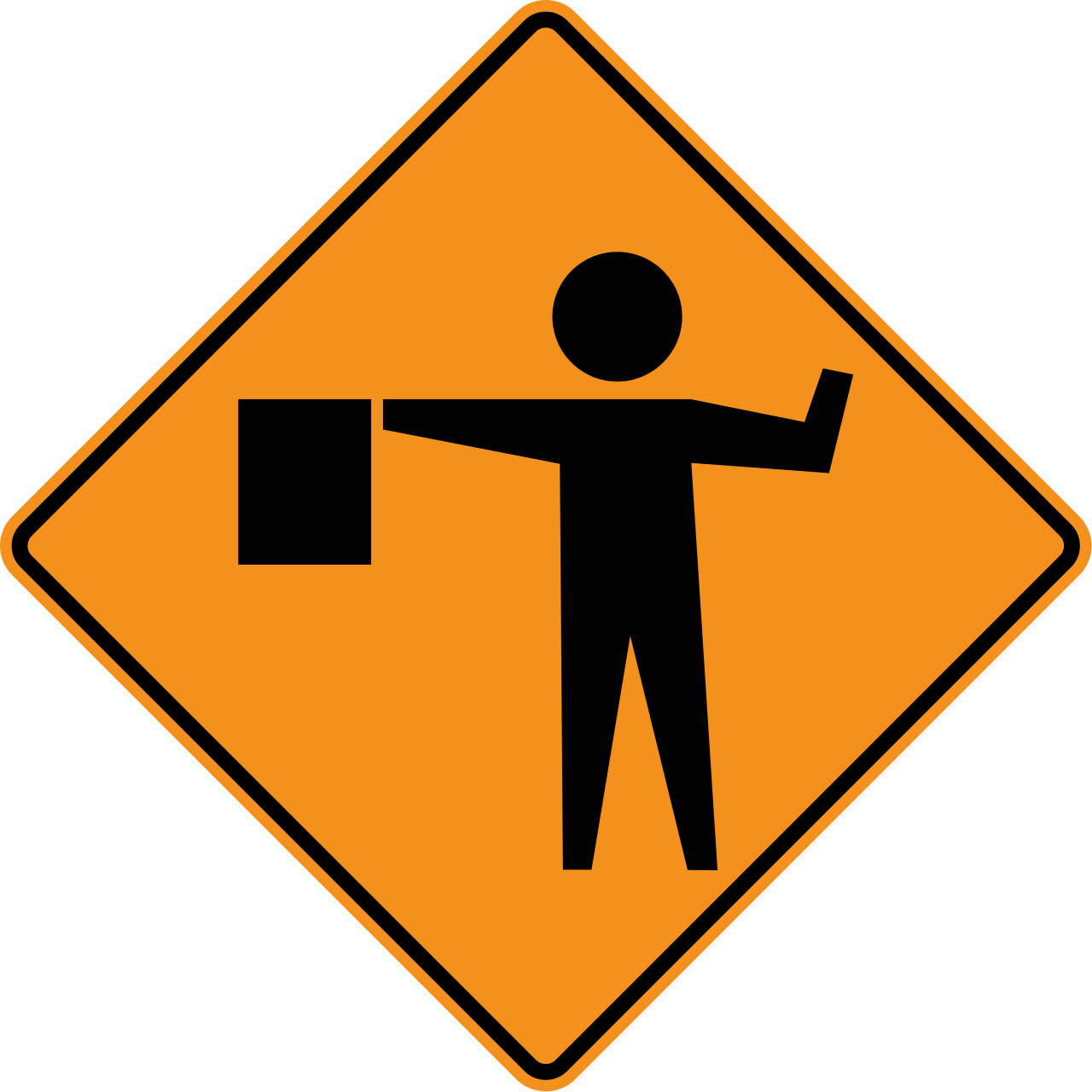
A human traffic control flagger is stationed ahead in a construction or utility work zone. Follow their hand and paddle signals strictly.
This road sign means:
A) Right lane closed
B) Do not block intersection
C) Flagger ahead
10.
Distractions that take your attention away from driving can be caused by ______ while driving.
A) changing the radio
B) eating or drinking
C) using your cell phone
D) All of the above.
11.
You may drive faster than the posted speed limit:
A) when passing another vehicle, as long as it is safe to do so.
B) when your lane is empty.
C) Under no circumstances.
12.
Which of the following is a common cause of a traffic collisions?
A) Following too closely.
B) Excessive speed for conditions.
C) Distracted driving.
D) All of the above.
13.
When you pass another vehicle, before you return to the right lane, you must:
A) look at your interior rear-view mirror.
B) signal.
C) All of the above.
14.
Does a vehicle prepared to enter a traffic circle or rotary have right-of-way over vehicles in the circle?
A) Yes, but only if they are entering the rotary from the right lane.
B) No. Vehicles already in the circle have the right-of-way.
C) Only if the light is green.
D) Yes.
15.
When driving on slippery roads, drivers should:
A) increase their following distance.
B) avoid crossing bridges or intersections.
C) brake harder than usual.
D) change lanes quickly.
16.
If a traffic signal light is green and a police officer signals you to stop:
A) you must stop.
B) you must go.
17.
After passing a vehicle, it is safe to return to your lane:
A) when you can no longer see the vehicle over your right shoulder.
B) after about five seconds.
C) when you see the front bumper of the other vehicle in your mirror.
18.
In work zones, barriers such as drums, panels and cones are used to:
A) reduce the flow of traffic.
B) keep traffic out of hazardous work zones.
C) keep workers out of the work zone.
19.
When passing you should NOT:
A) leave less than 4 feet of space between your vehicle and the vehicle you are passing.
B) signal left to let others know that you will be pulling out.
C) look in your rearview mirrors and glance over your shoulder before pulling out to pass.
D) go far enough past the vehicle you are passing so that you can see the vehicle in your inside rearview mirror.
20.
Which statement about taking medications and driving is true?
A) Cold medications can make a person drowsy.
B) Prescribed drugs are safe to take at any time.
C) Over the counter drugs do not affect driving ability.
21.
Roads are the most slippery:
A) the first rain after a dry spell.
B) after it has been raining for an hour or more.
C) for the first 2 hours of a rain storm.
22.
Before entering an intersection, drivers should look:
A) left, right, then left again.
B) right, left, then right again.
C) left.
23.
Alerts drivers to an upcoming crosswalk where pedestrians frequently cross. Slow down and yield right-of-way to anyone in or about to enter the roadway.
When you see this sign, you should:
A) move quickly toward the oncoming train.
B) slow down and look for trains.
C) look for a train station ahead.
24.
Yellow diamond warning that pedestrians may be crossing ahead. Exercise caution and yield.
This road sign means:
A) School zone ahead
B) Pedestrians must not cross here
C) Pedestrian crossing ahead
25.
If your vehicle has a mechanical problem, you should:
A) signal and pull into the slow lane.
B) stop in your lane and put on your emergency flashers.
C) turn on your hazard lights and pull off the road.
26.
Before turning, you should:
A) increase your speed.
B) sound your horn to alert the other drivers.
C) give the proper turn signal.
D) change lanes.
27.
If you see a 'lane closed ahead' sign you should:
A) make a U-turn. You are on the wrong side of the road.
B) merge into the correct lane when it is safe.
C) speed to the end of the closed lane and try to get into the other lane.
D) None of the above.
28.
Indicates a series of three or more consecutive sharp turns or curves ahead. Reduce speed and maintain lane control.
This road sign means:
A) Winding Road Ahead
B) No turns are allowed on this road
C) Right lane closed
D) Do Not Enter
29.
At a stop sign there is no stop line, you must stop:
A) before you enter the intersection.
B) before you enter the crosswalk.
C) after you enter the crosswalk.
30.
Warns that a one-way street or divided highway is ending, and you are entering a roadway with oncoming traffic in the opposing lane. Stay to the right.
This road sign means:
A) School zone ahead
B) Keep right
C) Two-way Traffic
31.
If you are feeling tired while driving, you should:
A) stop and get some rest.
B) open a window.
C) drink coffee.
32.
You can reduce the chance of a collision with a large vehicle if you:
A) delay near it.
B) cut abruptly in front of it.
C) pay close attention to the turn signals.
33.
What do flashing red lights on a school bus indicate?
A) The bus is stopped to load or discharge passengers.
B) Traffic that approaches from either direction may proceed.
C) The bus is about to stop.
34.
When a hazard is seen ahead, reaction distance:
A) is the sum of perception distance and braking distance.
B) equals total stopping distance minus perception distance.
C) is how far a vehicle will continue to travel, in ideal conditions, before the driver hits the brakes.
35.
Prohibits drivers from making a 180-degree turn to travel in the opposite direction at this intersection or stretch of road.
This road sign means:
A) No left turn
B) No U-turn
C) Detour ahead
36.
A sharp curve is ahead with a recommended safe speed plate. Slow down before entering the curve to prevent vehicle rollover.
This sign means:
A) If you are driving at 40 MPH or less you must stay in the right-hand lane
B) Curve ahead, drive at 40 MPH ot more around the curve ahead
C) Curve ahead, the recommended speed is 40 MPH or less
37.
If you approach a flashing red traffic light, you should treat the intersection the same as:
A) a yield sign.
B) a stop sign.
C) a warning sign.
38.
Yellow diamond warning that pedestrians may be crossing ahead. Exercise caution and yield.
This road sign means:
A) Pedestrian crossing
B) School zone
C) School crossing
39.
Vehicle stopping distance never depends on:
A) the condition of your vehicle's brakes.
B) your own reaction time.
C) the time of day.
D) the condition and type of vehicle tires.
40.
If you suddenly have no control of the steering wheel, you should:
A) turn on your emergency flashers and pull off the road.
B) ease your foot off the gas pedal. Turn on your emergency flashers and allow your vehicle to come to a slow stop.
C) pump your brake pedal to build pressure.
D) react as you would with a blowout.
41.
Only _____ can reduce the alcohol level in the blood.
A) drinking coffee
B) taking a cold shower
C) time
42.
If your accelerator becomes stuck while driving, you should:
A) hold the steering wheel firmly and turn the ignition off while the vehicle is moving.
B) turn the engine off and try to drive the car safely off the roadway.
C) shift to neutral, apply the brakes and try to drive the car safely off the road.
D) shift to park and apply the brakes until you come to a complete stop.
43.
You may park or stop along the shoulder of the freeway:
A) if you need to check your smartphone for directions.
B) only if you have an emergency.
C) if no part of your vehicle is on the road.
D) as long as you turn on your emergency flashers.
44.
Right turns are strictly prohibited at this intersection under all circumstances.
This road sign means:
A) No left turn
B) No right turn
C) No U-turns
45.
A road is likely to be most slippery:
A) when tire marks have been left by other vehicles.
B) in cold, dry weather.
C) when icy and the temperature is near freezing.
D) in spring.
46.
Highway markings:
A) provide information for drivers.
B) only apply to motorcycles.
C) are only found in school zones.
D) are usually red and blue in color.
47.
To enter a freeway:
A) signal, yield, and enter at the same speed that traffic is moving.
B) drive slowly so you can check traffic.
C) signal and enter the freeway. You have the right-of-way.
D) make a complete stop before entering the freeway.
48.
When you see an emergency vehicle with flashing lights behind you, you should:
A) slow down, provide a clear path for the emergency vehicle and stop.
B) keep moving slowly, staying to the right side of the road.
C) disregard the signal if there are other lanes available for the emergency vehicle.
D) immediately come to a complete stop.
49.
Studies show that wearing seat belts:
A) reduces your chances of serious injury in a crash.
B) increases your chances of fatality in a crash.
C) reduces your chances of damaging your car in a crash.
D) All of the above.
50.
Drivers may cross a double yellow line to pass another vehicle if:
A) the yellow line next to the other side of the road is broken.
B) the vehicle ahead moves to the right to let them pass.
C) the yellow line next to their side of the road is broken.
51.
When driving in fog, drivers should use high beam headlights.
A) True
B) False
52.
To avoid hydroplaning, drivers should:
A) slow down.
B) apply the brakes firmly.
C) drive at a constant speed.
53.
Before a school bus stops to load passengers, the driver will usually flash:
A) yellow warning lights.
B) red warning lights.
C) red lights.
54.
When passing another vehicle:
A) pass the vehicle as safely and as quickly as possible.
B) honk your horn repeatedly to warn the other driver.
C) there is no need to signal.
D) you can exceed the posted speed limit.
55.
A steady yellow light at an intersection means:
A) Proceed with caution through the intersection
B) Slow down and be prepared to stop
C) Immediately come to a complete stop
D) Yield to other vehicles
56.
When approaching a curve, remember to:
A) accelerate slightly before entering the curve.
B) drive at the posted speed limit throughout the curve.
C) slow down before entering the curve.
D) drive at the posted speed limit as you enter the curve, then slow down gradually.
57.
When you see an emergency vehicle with flashing lights behind you, you must:
A) slow down and keep moving.
B) drive to the right edge of the road and slow down.
C) pull over to the right and stop.
D) stop as quickly as you can.
58.
Drivers must be prepared for anything coming up in the road ahead. They should:
A) scan the road for traffic conditions and possible hazards.
B) drive with the right foot resting lightly on the brake pedal.
C) stare straight ahead at all times.
D) maintain focus toward the left of the road.
59.
Drivers who eat and drink while driving:
A) have no driving errors.
B) may have trouble controlling their vehicles.
C) must yield the right-of-way.
D) tend to be more aggressive.
60.
When preparing to drive, you should:
A) adjust your seat and mirrors.
B) shift the transmission to neutral.
C) pump the brakes.
ANSWER KEY Check answers after completing the test.
1 A
2 C
3 A
4 C
5 A
6 B
7 C
8 D
9 C
10 D
11 C
12 D
13 C
14 B
15 A
16 A
17 C
18 B
19 A
20 A
21 A
22 A
23 B
24 C
25 C
26 C
27 B
28 A
29 B
30 C
31 A
32 C
33 A
34 C
35 B
36 C
37 B
38 A
39 C
40 B
41 C
42 C
43 B
44 B
45 C
46 A
47 A
48 A
49 A
50 C
51 B
52 A
53 A
54 A
55 B
56 C
57 C
58 A
59 B
60 A