DriveQuiz drivequiz.com

ME DMV PERMİT PRACTİCE TEST 5

Maine
Duration: 54 min
|
Questions: 60
Student Name:
Date:
Correct:      Incorrect:      Score:      
1.
When two cars arrive at an intersection with no signs or signals at the same time, which car has the right-of-way?
A) The car that is traveling faster.
B) The car approaching from the right.
C) The car approaching from the left.
D) The car in which the driver sounds the horn.
2.
Where there is no bicycle lane, where on the road must a bicyclist ride?
A) on the left shoulder of the road.
B) near the right curb or edge of the road.
C) near the left edge of the road.
3.
When approaching someone using a white cane, you should proceed with caution because:
A) the pedestrian might be using a guide dog.
B) the pedestrian might be blind.
C) the pedestrian is deaf.
D) the pedestrian is blind.
4.
You should increase your following distance:
A) at night or if it is raining.
B) when the roads are slippery.
C) All of the above.
5.
Drivers should use the horn:
A) if a driver is moving slowly, and you want them to drive faster.
B) only when necessary, to avoid collisions.
C) when feeling angry or upset.
D) to alert other drivers that they made a mistake.
6.
As your speed increases it is most important to:
A) drive with both hands on steering wheel.
B) maintain a constant speed.
C) look farther ahead.
7.
A flashing red light means:
A) The same as a STOP sign.
B) The light will soon change to steady red.
C) Drive with caution.
8.
At intersections with a yield sign, you must:
A) yield to the vehicles on your left only.
B) yield the right-of-way to cross traffic close enough to cause conflict.
C) slow down and proceed.
9.
The bridge ahead has narrower lanes or shoulders than the preceding road. Use caution when meeting oncoming vehicles.
This road sign means:
A) Low clearance
B) Construction site ahead
C) Pavement is narrowing
D) Narrow bridge ahead
10.
The road ahead is divided by a median strip or physical barrier into two separate one-way roadways. Keep to the right of the divider.
This road sign means:
A) Keep left
B) Divided highway begins
C) Lane ends
11.
In rainy weather, drivers should be most careful when turning or stopping:
A) when it's been raining all day.
B) after it has been raining for at least two hours.
C) during the first half hour of rain.
12.
Warns that a one-way street or divided highway is ending, and you are entering a roadway with oncoming traffic in the opposing lane. Stay to the right.
This road sign means:
A) Divided highway ahead
B) Two-way traffic ahead
C) Four-lane traffic ahead
13.
Roads are most slippery during the first rain.
A) False.
B) True.
14.
Pedestrians at intersections have the right-of-way over vehicles.
A) true
B) false
15.
When changing lanes, __________ to be sure no one is in the 'blind spot'.
A) check your right mirror
B) slow down gradually
C) check your left mirror
D) glance over your shoulder
16.
When driving on roads that may be slippery:
A) do not make any sudden changes in direction or speed.
B) always drive at the highest speed allowed.
C) use cruise control to maintain a steady speed.
D) reduce your following distance.
17.
The roadway becomes particularly slippery during wet or rainy conditions. Reduce your speed, increase following distance, and avoid abrupt braking or steering.
This road sign means:
A) Winding road ahead
B) Warning, slippery when wet
C) Railroad Warning
D) Stop Sign Ahead
18.
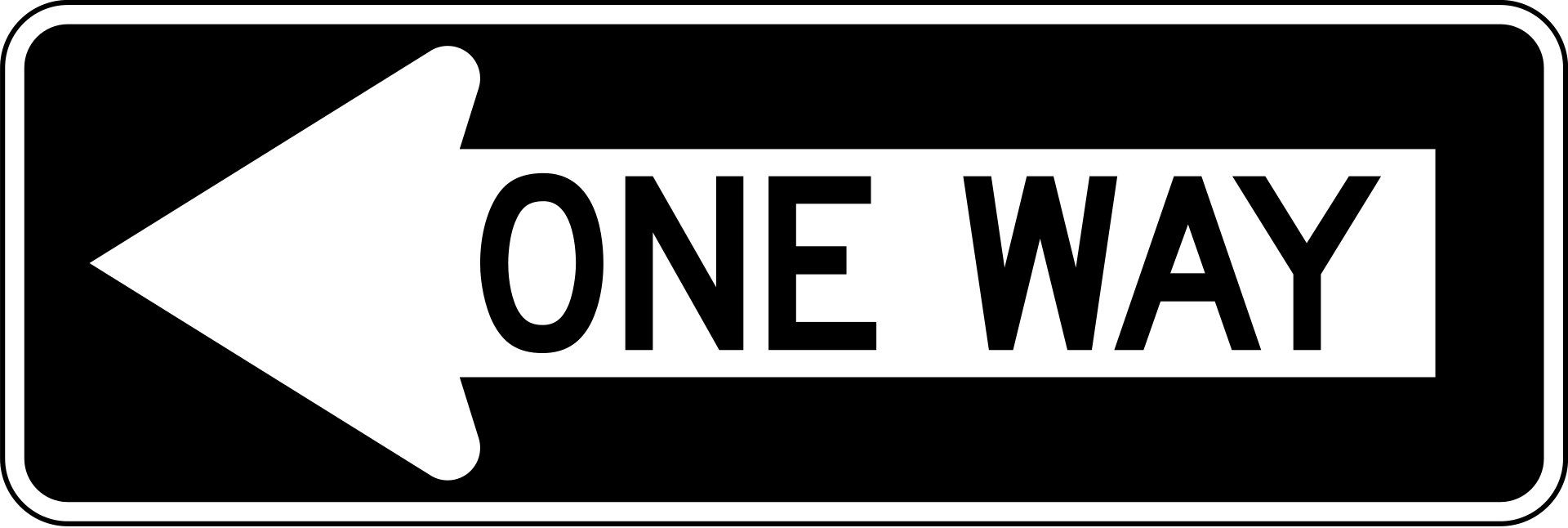
Traffic flows only in the direction indicated by the arrow. Never drive in the opposing direction.
The ‘One Way’ sign means that:
A) only vehicles turning left may travel in the direction of the arrow.
B) there is only one road that turns left at the intersection.
C) drivers may travel only in the direction of the arrow.
19.
If your car breaks down on the highway, you should:
A) use your four-way flashers to warn other drivers.
B) sound your horn to warn passing vehicles.
C) flash your headlights at oncoming traffic.
D) stop in the right lane.
20.
When parked facing down hill, your wheels should be turned:
A) toward the curb.
B) in any direction.
C) parallel to the curb.
D) away from the curb.
21.
When driving behind a motorcycle:
A) allow a following distance of at least 4 motorcycle lengths.
B) allow a following distance of at least 2 car lengths.
C) allow at least 2 seconds of following distance.
D) allow at least 4 seconds of following distance.
22.
If weather requires you to have your lights on, you should use your:
A) low beams.
B) parking lights.
C) high beams.
23.
A vehicle is stopped at a crosswalk to permit a pedestrian to cross the roadway. The driver of the vehicle approaching from the rear should:
A) sound the horn.
B) overtake and pass the stopped vehicle.
C) not overtake and pass the stopped vehicle.
24.
Warns of an upcoming YIELD sign. Prepare to slow down and check for cross traffic before proceeding.
This road sign means:
A) Yield sign ahead
B) Side road entering from the left
C) Side road
25.
Bicyclists making a left hand turn:
A) must cut through all lanes.
B) should wait on the right side of the road.
C) may use the left lane.
26.
Before stopping your vehicle on the roadway, drivers should:
A) check their mirrors for traffic.
B) place their foot on the accelerator.
C) pump the brakes to check if they work properly.
27.
You must yield to other drivers:
A) when it helps to prevent collisions.
B) when they are driving a truck.
C) when the other drivers are on your left and you have reached an unmarked intersection at the same time.
D) when your traffic signal is a green.
28.
Broken white lines can be crossed over:
A) when it is safe to change lanes.
B) only when passing another car.
C) at any time.
D) only in passing zones.
29.
When you approach a railroad crossing without flashing warning signals or crossing gates, you should:
A) always stop.
B) cross the tracks as slowly as possible.
C) yield to all trains at the crossing.
D) speed up to beat the train.
30.
When turning left at an intersection:
A) you should never yield to oncoming traffic and pedestrians.
B) oncoming traffic and pedestrians should yield to you.
C) you should always yield to oncoming traffic and pedestrians.
31.
Drivers may legally block an intersection:
A) under no circumstances.
B) only during rush hour traffic.
C) only after entering the intersection on a green light.
32.
The roadway becomes particularly slippery during wet or rainy conditions. Reduce your speed, increase following distance, and avoid abrupt braking or steering.
This road sign means:
A) Traffic increases ahead
B) Steep grade ahead
C) Winding road ahead
D) Slippery road ahead
33.
When you make a left turn from a one-way road into a one-way road, if the road you enter has two lanes, you:
A) must turn into its right lane.
B) can not turn left.
C) must turn into its left lane.
34.
If cars approaching from opposite directions reach an intersection at the same time:
A) a car that moves straight must yield to cars that turn left.
B) a car that turns left must yield to cars that move straight or turn right.
C) a car that turns right must yield to cars that move straight or turn left.
35.
You are entering a roadway from a private road, and you need to turn left. You have to yield to:
A) vehicles from the right.
B) vehicles from the left.
C) vehicles from both directions.
36.
Indicates the maximum bridge or underpass vertical clearance. Vehicles taller than the posted height must not proceed.
This sign indicates:
A) the maximum width of a vehicle allowed on the highway.
B) the maximum legal height allowed in this State.
C) the overpass ahead has a low clearance.
D) a steep grade
37.
Unlike passenger cars, trucks have blind spots:
A) on the right.
B) directly behind them.
C) on the front.
38.
Drivers should change lanes:
A) often.
B) as quickly as possible.
C) gradually and carefully.
39.
Give the right-of-way to any pedestrian:
A) on the opposite side of the street.
B) if you have the green light.
C) in a marked crosswalk.
40.
When driving through a construction zone, drivers should:
A) come to a complete stop and watch for a flagger.
B) proceed carefully.
C) decrease their following distance.
41.
When you drive into the street from any driveway you:
A) can disregard pedestrians if there is no sidewalk.
B) must drive slowly so approaching vehicles and pedestrians can get out of your way.
C) must honk the horn so approaching vehicles and pedestrians can allow you room.
D) must stop and proceed only when there are no pedestrians or vehicles approaching.
42.
Your ability to drive safely can be impaired by:
A) alcohol.
B) lack of sleep.
C) drugs, even if they are over-the-counter.
D) All of the above.
43.
Drivers must yield to pedestrians:
A) Always.
B) when pedestrians are crossing within a marked or unmarked crosswalk.
C) by slowing down and making sure they are being seen by pedestrians.
D) under no circumstances.
44.
When driving on wet roads, you should remember:
A) driving on wet roads can cause hydroplaning.
B) you should give yourself additional time to stop.
C) to stay farther behind the vehicle ahead of you.
D) All of the above.
45.
Large trucks:
A) have high-tech air brakes which allow them to stop quickly.
B) take longer to stop than passenger vehicles.
C) are more maneuverable than passenger vehicles.
46.
If another vehicle is approaching you head-on in your lane, you should _______, sound your horn and brake.
A) steer right
B) None of the other answers is correct.
C) steer left
D) stay in the center of your lane
47.
When driving in fog, drivers should:
A) not use high beam headlights.
B) use low beam headlights to better illuminate the road ahead.
C) slow down and drive cautiously.
D) All of the above.
48.
In the following situations, drivers should increase their following interval:
A) When following vehicles that are required to come to a stop at railroad crossings.
B) When it is hard to see ahead because of bad weather.
C) All of the above.
49.
If you drink alcohol socially, what helps insure safe driving?
A) Stop drinking one hour before driving.
B) Drink coffee before driving.
C) Take a cold shower before driving.
D) Ride home with a friend who has not been drinking.
50.
BAC is expressed in:
A) percentage of alcohol to blood.
B) percentage of blood to alcohol.
C) ounces of alcohol in your blood.
51.
Drivers should treat a railroad crossbuck sign the same as a yield sign.
A) False
B) True
52.
Which of the following substances can affect the ability to drive?
A) Tranquilizers and sedatives.
B) Cold tablets containing codeine or antihistamines.
C) All of the above.
53.
If traffic prevents you from crossing all the way across a set of railroad tracks:
A) proceed only when at least one-half of your vehicle can cross the tracks safely.
B) wait until the approaching train has come to a stop.
C) proceed only when there is room for your vehicle on the other side.
D) wait until no trains are in sight.
54.
What should you do when another car is trying to pass you?
A) yield the right-of-way to the other driver.
B) speed up.
C) After checking for oncoming traffic, adjust your speed to allow safe passing.
D) pull off the road to allow safe passing.
55.
When is the pavement most slippery?
A) If it's been raining several hours.
B) When it's been raining from at least one hour.
56.
If a vehicle suddenly cuts in front of you creating a hazard, which of these actions should you take first?
A) Sound your horn and step on the brake firmly.
B) Swerve into the lane next to you.
C) Take your foot off the gas pedal.
57.
Right turns are strictly prohibited at this intersection under all circumstances.
This road sign means:
A) No left turn
B) No right turn
C) No U-turns
58.
Drinking alcohol and then driving is dangerous because it affects your:
A) reflexes.
B) judgment and skills.
C) vision.
D) coordination.
59.
To be able to turn quickly, your hands should be:
A) placed outside of the steering wheel on opposite sides
B) next to each other on the top of the steering wheel.
C) on the steering wheel, so they are at the 6 and 12 o'clock positions.
60.
When the driver behind you wants to pass, you should:
A) change lanes.
B) speed up.
C) use your brake lights.
D) slow down to allow room for the other driver to complete the pass safely.
ANSWER KEY Check answers after completing the test.
1 B
2 B
3 D
4 C
5 B
6 C
7 A
8 B
9 D
10 B
11 C
12 B
13 B
14 A
15 D
16 A
17 B
18 C
19 A
20 A
21 D
22 A
23 C
24 A
25 C
26 A
27 A
28 A
29 C
30 C
31 A
32 D
33 C
34 B
35 C
36 C
37 B
38 C
39 C
40 B
41 D
42 D
43 B
44 D
45 B
46 A
47 D
48 C
49 D
50 A
51 B
52 C
53 C
54 C
55 C
56 C
57 B
58 B
59 A
60 D