DriveQuiz drivequiz.com

LA DMV PERMİT PRACTİCE TEST 5

Louisiana
Duration: 36 min
|
Questions: 40
Student Name:
Date:
Correct:      Incorrect:      Score:      
1.
Service signs are ____ with ____ letters and symbols.
A) blue; white
B) white; black
C) green; white
2.
When the road is slippery, you should:
A) brake suddenly carefully.
B) pump your brakes.
C) press your brakes in slow, steady strokes.
3.
Indicates an upcoming bicycle crossing or shared road zone. Always leave at least 3 feet of clearance when passing cyclists.
This road sign means:
A) Yield right-of-way to bicycles
B) Bicycles cross or ride beside traffic
C) Yield to motorcyles, but not to bicycles
D) Bicycles have the same rights as other vehicles
4.
If you are continually being passed on the right, you should:
A) move into the right lane and allow other vehicles to pass you on the left.
B) move into the left lane and allow other vehicles to pass you on the right.
C) increase your speed immediately.
5.
The road curves gradually to the right ahead. Reduce speed before entering the curve.
This road sign means:
A) Wrong Way
B) Merging Traffic
C) Curve ahead
6.
The roadway becomes particularly slippery during wet or rainy conditions. Reduce your speed, increase following distance, and avoid abrupt braking or steering.
This road sign means:
A) Winding road ahead
B) Warning, slippery when wet
C) Railroad Warning
D) Stop Sign Ahead
7.
When approaching any intersection or driveway, drivers should:
A) look both ways and be ready to stop.
B) pass other vehicles and then stop.
C) drive at the fastest speed just before entering the intersection.
8.
When driving on a wet road:
A) as you drive faster, your tires may lose traction.
B) you must be aware that the pavement gets even more slippery when it's been raining for long periods of time.
C) you should follow the vehicle ahead of you more closely.
D) as you decrease your speed, the road becomes more slippery.
9.
If a vehicle is approaching with high beams, drivers should look __________ until the vehicle passes.
A) to the right of the road
B) at the center of the road
C) to the left of the road
D) straight ahead
10.
Warns drivers that two separate lanes moving in the same direction are merging into one. Drivers in the right lane must adjust speed and merge smoothly with existing traffic.
This road sign means:
A) Lane shifting
B) Traffic is entering from another road, drive with caution
C) Stop for other traffic
D) Yield right-of-way
11.
Which shape is a warning sign?
A) Diamond
B) Triangle
C) Pennant
12.
Warns of an extremely sharp 180-degree curve ahead. Decelerate significantly before entering the turn.
This sign means:
A) Hairpin corner ahead.
B) Warning: U-turn ahead.
C) Sharp right turn ahead.
13.
Never make a U-turn from:
A) the lane you’re in.
B) the right lane.
C) the left part of the lane nearest to the centerline of the roadway.
14.
When driving behind a motorcycle, drivers must:
A) remembers that motorcyclists have the right to use a complete traffic lane.
B) pass the motorcycle in the same lane.
C) drive on the shoulder beside the motorcycle.
D) share the lane with the motorcycle.
15.
A broken white line:
A) means passing or crossing is prohibited in that lane.
B) separates two lanes traveling in the same direction.
C) marks the right edge of the roadway.
16.
Another road crosses the highway ahead. Look left and right for crossing or entering vehicles.
This road sign means:
A) Crossroads ahead
B) Side Road
C) Turn right or go through
D) Flagger ahead
17.
Flashing Upraised Hand signal indicates pedestrians should finish crossing if already in the crosswalk, but not start crossing.
A pedestrian in the crosswalk when the 'DON’T WALK' signal begins flashing must:
A) stop immediately.
B) go back and wait the “WALK” light
C) finish crossing the street.
18.
A large vehicle is backing up to unload goods. You should:
A) enter one of the blind spots and wait.
B) try to pass close behind.
C) be patient and wait until the large vehicle has completed its backup maneuver.
19.
A driver who approaches an intersection:
A) must yield the right-of-way to traffic already in the intersection.
B) must drive straight through the intersection, even if another vehicle is already in the intersection.
C) has the right-of-way over traffic already in the intersection.
20.
If an approaching driver does not dim the headlights, you should:
A) move your eyes to the left to help avoid the glare of approaching high beams.
B) move your eyes to the right and avoid looking directly at the bright lights.
C) flash your headlights to low beam for a second, then return to high beam.
21.
If cars approaching from opposite directions reach an intersection at the same time:
A) a car that moves straight must yield to cars that turn left.
B) a car that turns left must yield to cars that move straight or turn right.
C) a car that turns right must yield to cars that move straight or turn left.
22.
What happens if two vehicles reach at the same time an intersection with four-way stop signs?
A) The driver on the right yields to the driver on the left.
B) The driver on the left yields to the driver on the right.
C) The first vehicle to reach the intersection must yield.
23.
Most signs used in street work areas are:
A) round.
B) diamond shaped.
C) rectangle shaped.
24.
What do warning signs mean?
A) Danger ahead.
B) Drivers are approaching a location where there is a special rule.
C) All of the above.
25.
When changing lanes, you should:
A) check your mirrors, signal and change lanes.
B) signal, change lanes and check your mirrors.
C) signal, check your mirrors and blind spot in the direction you plan to move, then change lanes.
D) signal and change lanes.
26.
You want to turn left at an intersection ahead. A car reaches the intersection from the opposite direction and moves straight ahead. You:
A) can turn left. You have the right of way.
B) must wait for the car to go through before you turn.
C) may not enter the intersection to prepare for your left turn if the light is green.
27.
Proceed with caution. You do not need to stop unless pedestrians or hazards are present in the intersection.
What does a flashing yellow light mean?
A) The same thing as a stop sign.
B) Drivers may move forward with caution.
C) All of the above.
28.
It is important for drivers to know that trucks:
A) are easier for the driver to operate.
B) require more space for turning movements.
C) take longer than cars to stop.
D) require less time to pass on an incline than cars.
29.
Paved road surface ends and transitions to gravel, dirt, or unpaved roadway. Reduce speed and prepare for reduced traction.
This road sign warns drivers that:
A) the road surface ahead changes to a low-type surface or earth road.
B) vehicles must leave the pavement immediately.
C) the dirt on the side of the road is soft.
30.
You are driving in the left lane and want to change to the right lane. Before changing lanes, you should check your mirrors, signal and:
A) look over your left shoulder.
B) look over both shoulders for vehicles in front of you.
C) accelerate slightly before looking around your vehicle.
D) look over your right shoulder.
31.
Right turns are strictly prohibited at this intersection under all circumstances.
This road sign means:
A) No left turn
B) No right turn
C) No U-turns
32.
You should use turn signals to indicate your intention with sufficient time to allow other drivers to see the signal:
A) if it’s raining.
B) AFTER you move.
C) BEFORE you move.
33.
If you missed your exit on a freeway, you should:
A) use the right turn signal, check your mirrors and move to the right.
B) None of the above.
C) go to the next exit and come back to the exit you missed.
D) make a quick U-turn from your lane of travel.
34.
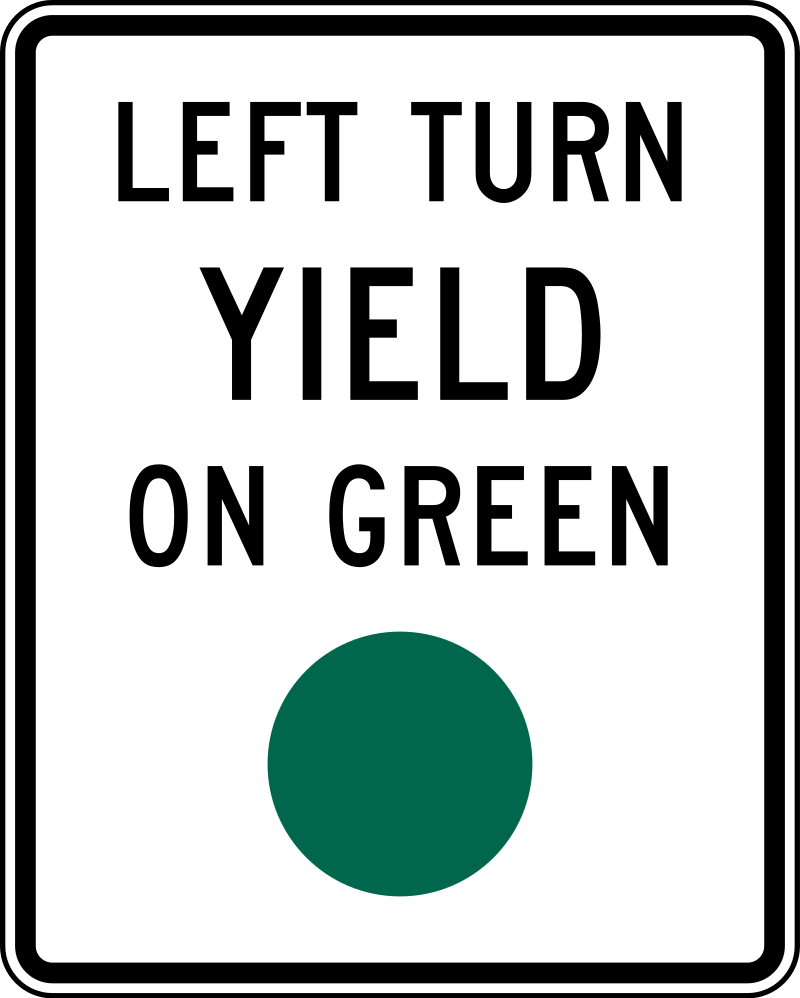
When turning left at a circular green light, you must yield right-of-way to oncoming traffic and pedestrians before completing your turn.
This white sign means you:
A) may turn left on a green light when it is safe to do so.
B) may turn left only on a green arrow.
C) must wait for the solid green light before you turn left.
35.
To reduce their chances of colliding with an animal, drivers should:
A) scan the sides of the road to watch for the reflection of vehicle headlights in the eyes of animals.
B) look well down the road and far off to each side.
C) All of the above.
36.
A driver approaching a flashing red traffic signal must:
A) merge to the left.
B) stop before the intersection.
C) carefully drive through the intersection without stopping.
D) slow down at the traffic signal.
37.
Drivers are required to stop:
A) when a traffic officer orders them to stop.
B) where there is a red light.
C) at an intersection with a stop sign.
D) All of the above.
38.
Which signs have black letters on a white background?
A) Warning signs (diamond)
B) Regulatory signs (vertical rectangle)
C) Guide signs (horizontal rectangle)
39.
To check your blind spot before changing lanes:
A) look into the right side mirror.
B) look into the rearview mirror.
C) look over your shoulder in the direction you plan to move.
D) look into the left side mirror.
40.
An orange-colored sign means:
A) Railroad crossing ahead
B) School zone ahead
C) Construction zone ahead
D) You must change lanes ahead
ANSWER KEY Check answers after completing the test.
1 A
2 C
3 B
4 A
5 C
6 B
7 A
8 A
9 A
10 B
11 A
12 A
13 B
14 A
15 B
16 A
17 C
18 C
19 A
20 B
21 B
22 B
23 B
24 C
25 C
26 B
27 B
28 C
29 A
30 D
31 B
32 C
33 C
34 A
35 C
36 B
37 D
38 B
39 C
40 C