DriveQuiz drivequiz.com

KY DMV PERMİT PRACTİCE TEST 7

Kentucky
Duration: 36 min
|
Questions: 40
Student Name:
Date:
Correct:      Incorrect:      Score:      
1.
Which statement about taking medications and driving is true?
A) Cold medications can make a person drowsy.
B) Prescribed drugs are safe to take at any time.
C) Over the counter drugs do not affect driving ability.
2.
Another road crosses the highway ahead. Look left and right for crossing or entering vehicles.
This road sign means:
A) Crossroad
B) Hospital parking ahead
C) Merge
3.
After parking, are you allowed to open a door on the road side of your vehicle?
A) Yes, always.
B) Yes, but only if it does not interfere with bicyclists and other traffic.
C) No, never.
4.
Regulation signs normally are ____ rectangles with ____ letters or symbols.
A) yellow; black
B) white; black
C) green; white
5.
Indicates the maximum bridge or underpass vertical clearance. Vehicles taller than the posted height must not proceed.
This road sign means:
A) Low clearance
B) Do not enter
C) A steep grade is ahead
6.
Are bicyclists required to obey traffic laws and signs?
A) No, bicyclists are considered pedestrians when it comes to the rules of the road.
B) Yes.
C) Yes, but only if they are riding in a bicycle lane.
7.
When entering an expressway from the entrance ramp, you should:
A) go down to the bottom of the ramp and stop until it is safe to enter the expressway.
B) cross over to the traffic lane as soon as possible.
C) use the acceleration lane to blend into the traffic.
8.
When the traffic light is green, but traffic is blocking the intersection, drivers should:
A) enter the intersection and wait for traffic to clear.
B) not enter the intersection until they can get completely across.
C) honk their horn to establish their right-of-way.
9.
You should never depend on your mirrors when you prepare to change lanes. Why?
A) You should look over your shoulder instead.
B) Mirrors are useless.
C) Mirrors need to be adjusted.
D) Mirrors leave 'blind spots' behind both sides of vehicles.
10.
Gauging the speed of a motorcycle may be difficult because:
A) motorcycles take up less of your field of vision.
B) motorcycles often slow down by downshifting.
C) many motorcyclists do not activate the brake light.
11.
As the percentage of alcohol in your blood (BAC) increases, you become:
A) more reactive.
B) more intoxicated.
C) more sober.
12.
You go with a group of friends to a social event, and you plan to have a few drinks. You should:
A) make alcohol the focus of the event.
B) avoid alternating between drinks with alcohol and drinks without any alcohol.
C) arrange to ride home with a friend who does not drink.
13.
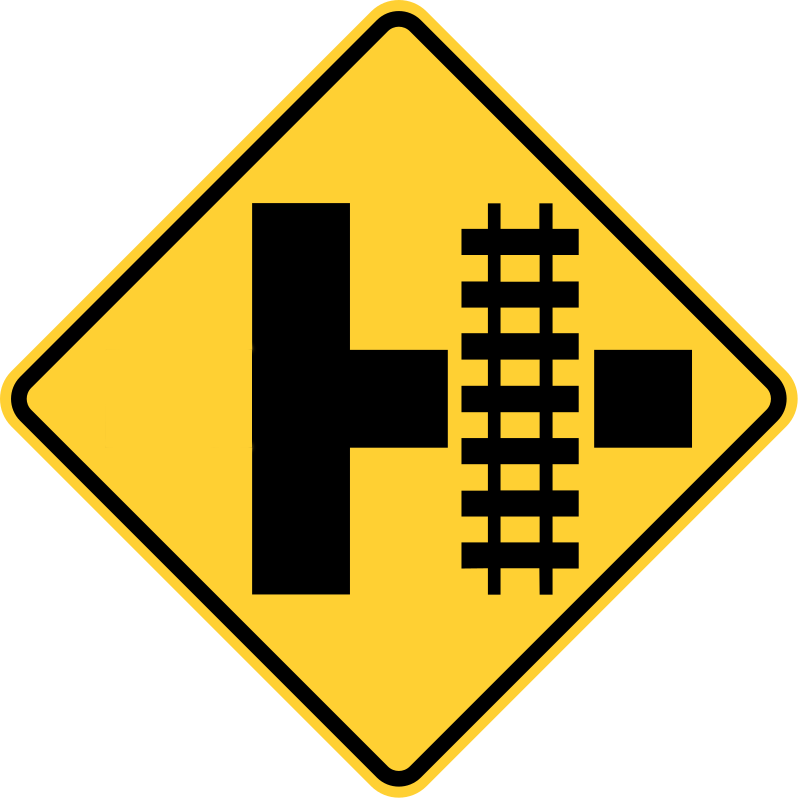
Four-way intersection ahead. Be prepared to yield right-of-way according to traffic control devices.
What does this sign indicate?
A) Parallel railroad crossing (side road)
B) Low ground clearance railroad crossing
C) Parallel railroad crossing (crossroad)
14.
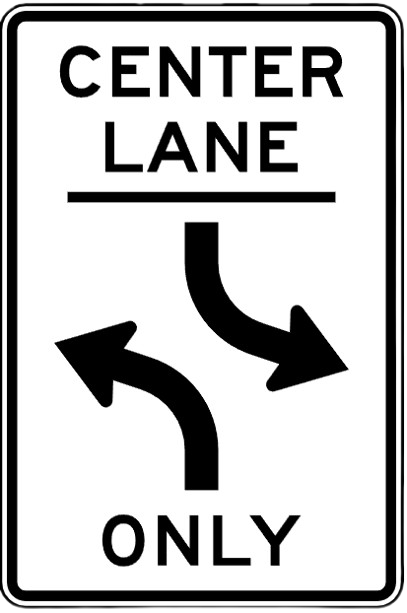
Indicates a two-way left-turn lane in the center of the road. Must only be used to make left turns or U-turns (where permitted), not for regular travel or passing.
This road sign means:
A) Vehicles may only travel in the center lane.
B) The center lane is shared for left turns in both directions of travel.
C) The center lane in both directions of travel will soon turn left.
15.
Another road crosses the highway ahead. Look left and right for crossing or entering vehicles.
This sign indicates:
A) a side road.
B) a cross road.
C) a church zone ahead.
16.
When parking on a public road, drivers should:
A) move as far away from traffic as possible.
B) always park on the left side of the roadway.
C) All of the above.
17.
Which shape is a yield sign?
A) Vertical rectangle
B) Upside-down triangle
C) Diamond
18.
Regulatory signs are:
A) Suggestions
B) Warnings
C) Law
19.
Indicates that traffic is permitted to pass on either the left or the right side of an island, median, or obstruction.
This sign tells drivers that:
A) left and right turns are not allowed.
B) a divided highway is ahead.
C) they cannot go straight ahead.
20.
Designated school crosswalk location. You must yield to all schoolchildren and pedestrians in the crossing.
At a school crossing, drivers should:
A) always stop, whether there’s a stop sign or not.
B) always sound their horn and stay alert.
C) watch for children and be ready to stop.
21.
The ‘Slower Traffic Keep Right’ sign is used:
A) at most intersections.
B) on multiple lane highways.
C) in school zones.
22.
Any use of a cell phone while operating a motor vehicle is considered a distraction because:
A) it occupies the driver's mind, hands and eyes.
B) it draws the attention of other drivers.
C) it causes the driver to be concerned about the latest news.
23.
The road ahead is divided by a median strip or physical barrier into two separate one-way roadways. Keep to the right of the divider.
This sign means:
A) The highway ahead is divided into two one-way roadways.
B) Roundabout ahead. Slow down.
C) The divided highway on which drivers are traveling ends ahead.
24.
If you drive slower than the flow of traffic, you will most likely:
A) improve traffic flow.
B) help create a safe driving environment.
C) interfere with traffic and receive a ticket.
25.
At intersections where two or more drivers stop at STOP signs at the same time and they are at right angles:
A) the driver on the left must yield to the driver on the right.
B) the driver who is late for work has the right-of-way.
C) the driver on the right must yield to the driver on the left.
26.
A vehicle that enters a road from a driveway:
A) has the right-of-way.
B) must yield to traffic approaching from the right, while it has the right-of-way over vehicles approaching from the left.
C) must stop and yield the right-of-way to traffic on the roadway and to pedestrians.
27.
Proceed with caution. You do not need to stop unless pedestrians or hazards are present in the intersection.
What does a flashing yellow light mean?
A) The same thing as a stop sign.
B) Drivers may move forward with caution.
C) All of the above.
28.
Designated school crosswalk location. You must yield to all schoolchildren and pedestrians in the crossing.
When they approach this sign, drivers must:
A) slow down and watch for children crossing the road.
B) obey signals from crossing guards.
C) stop if necessary.
D) All of the above.
29.
At a stop sign there is no stop line, you must stop:
A) before you enter the intersection.
B) before you enter the crosswalk.
C) after you enter the crosswalk.
30.
When passing a vehicle, it is safe to return to your lane when:
A) you look over your shoulder and see no vehicle behind you.
B) you can see both headlights of the vehicle you passed in your rearview mirror.
C) the driver you just passed signals you over.
31.
A signalized intersection is ahead. Prepare to stop if the light turns yellow or red.
This sign means:
A) No traffic signal ahead
B) Traffic signal ahead
C) Open intersection ahead
32.
When a pedestrian carrying a white cane is at the corner ready to cross the street in front of you, before making your right turn, you should:
A) use your horn to help the pedestrian cross the street.
B) turn off the ignition until the person crosses the street.
C) yield the right-of-way and wait until the pedestrian crosses the street.
33.
The first thing affected after drinking alcohol is:
A) balance.
B) judgment.
C) speech.
34.
Who has a greater risk of being involved in a traffic crash?
A) Drivers who are driving alone.
B) Young people.
C) All of the above.
35.
Your BAC depends on:
A) how fit you are.
B) the type of beverage you drink.
C) the amount of alcohol you drink.
36.
When parking uphill on a road with a curb, turn the front wheels:
A) towards the curb.
B) parallel to the curb.
C) straight ahead.
D) away from the curb.
37.
Alerts drivers to an upcoming crosswalk where pedestrians frequently cross. Slow down and yield right-of-way to anyone in or about to enter the roadway.
What should drivers do when they see this road sign?
A) come to a complete stop and wait for a train to cross.
B) slow down, look for a train, and be prepared to stop.
C) look for a human flagger.
38.
In case of skidding, drivers should NOT:
A) take their foot off the gas pedal.
B) pump the brakes gently if they are about to hit something.
C) tap the gas pedal with their foot.
39.
A steep downhill grade is ahead. Trucks and heavy vehicles should downshift to a lower gear to prevent brake overheating.
This road sign means:
A) Truck stop ahead
B) No trucks allowed
C) Hill or downgrade up ahead
40.
A person walking with a white cane or guide dog is likely to be:
A) a deaf person.
B) a traffic enforcement officer.
C) a blind person.
ANSWER KEY Check answers after completing the test.
1 A
2 A
3 B
4 B
5 A
6 B
7 C
8 B
9 D
10 A
11 B
12 C
13 A
14 B
15 B
16 A
17 B
18 C
19 C
20 C
21 B
22 A
23 A
24 C
25 A
26 C
27 B
28 D
29 B
30 B
31 B
32 C
33 B
34 C
35 C
36 D
37 B
38 C
39 C
40 C