DriveQuiz drivequiz.com

IN DMV PERMİT PRACTİCE TEST 6

Indiana
Duration: 45 min
|
Questions: 50
Student Name:
Date:
Correct:      Incorrect:      Score:      
1.

A steep downhill grade is ahead. Trucks and heavy vehicles should downshift to a lower gear to prevent brake overheating.
This sign warns of a ________ ahead.
A) hill
B) no passing zone
C) soft shoulder
2.
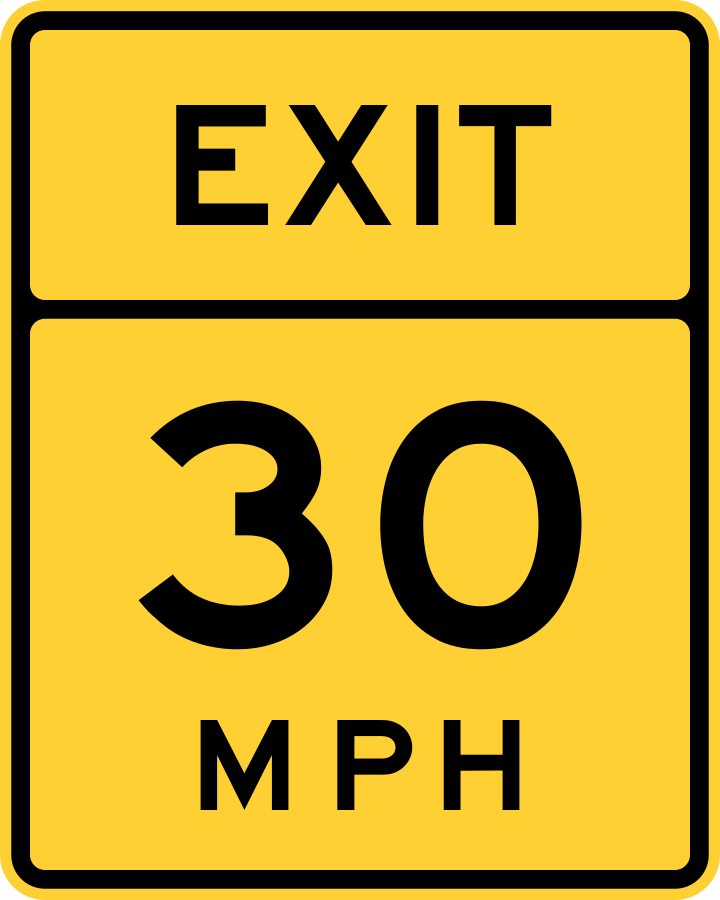
Recommends a safe speed of 30 MPH for negotiating the freeway exit ramp deceleration lane.
The sign in the picture:
A) shows the highest speed drivers can travel at the exit of the intersection.
B) is used to advise motorists of the appropriate ramp speed at the highway exit point.
C) indicates the minimum ramp speed at the highway exit point.
3.
The road makes a sharp 90-degree right turn ahead. Slow down considerably before entering the turn.
This sign warns drivers that:
A) the road will make a sharp turn to the right.
B) right turns are not allowed.
C) another road enters the highway from the direction shown.
4.
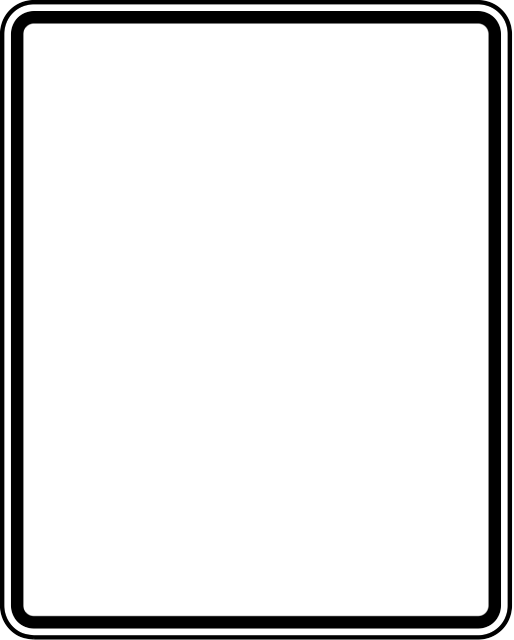
Standard rectangular shape used for general regulatory instructions and speed limits.
Vertical rectangles tell drivers:
A) the law.
B) what is not allowed.
C) the direction they should travel.
5.
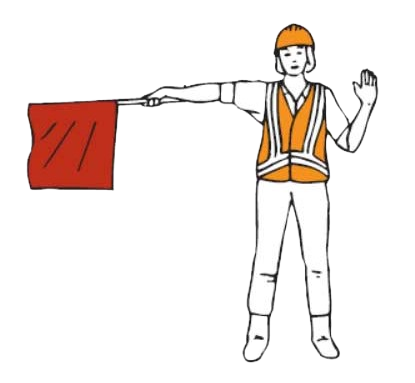
Driver arm extended downward out the left window with palm facing rearward signals an intention to slow down or stop completely.
This signal means:
A) Stop
B) Move to the left
C) Slow down
D) Proceed
6.
After being pulled over by law enforcement, a driver should immediately exit the vehicle and approach the officer’s squad car.
A) False
B) True
7.
Warns of two consecutive curves in opposite directions (e.g., curves right then left). Slow down to maintain control.
This sign warns drivers that:
A) the highway ahead is divided into two one-way roadways. Drivers should keep to the right.
B) there is a winding road ahead.
C) there is a double curve ahead.
8.
Indicates that traffic is permitted to pass on either the left or the right side of an island, median, or obstruction.
This sign tells drivers that:
A) left and right turns are not allowed.
B) a divided highway is ahead.
C) they cannot go straight ahead.
9.
Who is most at risk?
A) Drivers who are fatigued.
B) Drivers who are driving on long, boring roads.
C) All of the above.
10.
Who has a greater risk of being involved in a traffic crash?
A) Drivers who are driving alone.
B) Young people.
C) All of the above.
11.
Roads are most slippery:
A) just before it rains.
B) when it stops raining.
C) when it first starts to rain.
12.
Warns drivers that two separate lanes moving in the same direction are merging into one. Drivers in the right lane must adjust speed and merge smoothly with existing traffic.
This sign indicates:
A) Winding road
B) Merging traffic
C) Divided highway ends
13.
On slippery roads, drivers should:
A) leave more space in front of their vehicle.
B) increase their speed to avoid hydroplaning.
C) come to a complete stop.
14.
The bridge ahead has narrower lanes or shoulders than the preceding road. Use caution when meeting oncoming vehicles.
This sign warns drivers of:
A) low clearance.
B) a narrow bridge ahead.
C) a low place in the road.
15.
If you are turning from a one-way street onto another one-way street, you may also turn left on a red signal after stopping, if traffic is clear and there is not a NO TURN ON RED sign.
A) True
B) False
16.
All approaching traffic must stop completely. The first vehicle to reach the intersection and stop has right-of-way; if two vehicles arrive simultaneously, the vehicle on the right goes first.
A 4-way stop sign means:
A) The first vehicle to reach the intersection should move forward first.
B) Traffic from all four directions must stop.
C) There are four stop signs at the intersection.
D) All of the above.
17.
If an approaching driver does not dim the headlights, you should:
A) move your eyes to the left to help avoid the glare of approaching high beams.
B) move your eyes to the right and avoid looking directly at the bright lights.
C) flash your headlights to low beam for a second, then return to high beam.
18.
If traffic on the other side of an intersection is backed up and you cannot get completely through, you must:
A) enter the intersection and try to avoid blocking it.
B) enter the intersection and proceed with caution.
C) wait until traffic ahead is clear.
19.
Designated school crosswalk location. You must yield to all schoolchildren and pedestrians in the crossing.
When you approach this sign, you must:
A) stop if necessary.
B) watch for workers crossing the road.
C) None of the above.
20.
You must come to a full stop at a yield sign:
A) Always.
B) Never.
C) If traffic conditions require it.
21.
Before a school bus stops to load passengers, the driver will usually flash:
A) yellow warning lights.
B) red warning lights.
C) red lights.
22.
When approaching an oncoming vehicle, drivers are required to dim their high beams within:
A) 250 feet
B) 500 feet
C) 100 feet
23.
If the entrance lane is too short to allow acceleration to highway speed, you should:
A) go to the next entrance ramp.
B) stop and wait for a large gap in traffic, then enter the highway and accelerate quickly.
C) merge into highway traffic as soon as possible.
24.
What is the only effective method to reduce your BAC?
A) Eating before or while you drink.
B) Not drinking over a period of time.
C) Drinking coffee.
25.
Warns of two consecutive curves in opposite directions (e.g., curves right then left). Slow down to maintain control.
When you see this sign you should:
A) increase your speed and try to pass other vehicles.
B) slow your speed and be prepared to stop.
C) slow your speed and do not pass other vehicles.
26.
When children are close, what should you do before you back out of a driveway?
A) Rely on your mirrors.
B) Get out of the car and check behind the car.
C) Look through your back window for children.
27.
When approaching a railroad crossing that has no warning signals (such as electric flashing lights or gates) a driver should look, listen and slow down.
A) False
B) True
28.
In a situation with a flat tire or blowout, the driver should apply the brakes quickly and pull off the road immediately to check the tire.
A) False
B) True
29.
Arrows on the roadway:
A) show which lanes you must use.
B) indicate reserved lanes.
C) indicate HOV lanes.
30.
When approaching a blind person walking with a white cane or guide dog, drivers should yield the right-of-way.
A) False
B) True
31.
If you begin to feel drowsy while driving, you should:
A) open your window.
B) get some coffee.
C) get an energy drink.
D) stop driving.
32.
At a stop sign there is no stop line, you must stop:
A) before you enter the intersection.
B) before you enter the crosswalk.
C) after you enter the crosswalk.
33.
Never make a U-turn from:
A) the lane you’re in.
B) the right lane.
C) the left part of the lane nearest to the centerline of the roadway.
34.
An emergency vehicle that uses lights and a siren can be unpredictable. Why?
A) The driver can legally pass red lights.
B) Emergency vehicles must go faster than the posted speed limit when it is safe to do so.
C) Emergency vehicle drivers are not required to be careful.
35.
If cars approaching from opposite directions reach an intersection at the same time:
A) a car that moves straight must yield to cars that turn left.
B) a car that turns left must yield to cars that move straight or turn right.
C) a car that turns right must yield to cars that move straight or turn left.
36.
Come to a complete stop before the stop line, crosswalk, or intersection. Look left, right, and left again, and proceed only when it is safe and right-of-way is clear.
This road sign means:
A) Slow down or stop
B) Stop
C) Road narrows ahead
37.
When approaching an intersection with a traffic control signal that is not working, drivers should:
A) stop as you would if there were stop signs in all directions, yield the right-of-way, then enter the intersection.
B) speed up and proceed through the intersection.
C) try not to stop if the intersection is clear.
38.
What should you do if your rear wheels start to skid?
A) Steer left if your rear wheels slide right.
B) If the vehicle has ABS, pump the pedal carefully.
C) Turn the steering wheel in the direction the vehicle is trying to go.
39.
To regain their license, drivers whose license has been revoked as a result of DUI must meet several requirements, including an evaluation for alcohol and drug problems and paying a reinstatement fee.
A) True
B) False
40.
Slower-moving vehicles must stay in the right-hand lane to allow faster traffic to pass safely on multi-lane highways.
This regulatory road sign indicates that:
A) Vehicles must slow down and stay in the right lane.
B) The right hand lane is reserved for buses and car-pool vehicles.
C) Slower vehicles traveling on multiple lane highways must stay in the right hand lane.
41.
The following symptoms are associated with drowsy driving:
A) You continue to yawn.
B) You don’t remember driving the last few miles.
C) All of the above.
42.
A yellow arrow means:
A) Do not go in the direction of the arrow.
B) If you intend to turn in the direction of the arrow, be prepared to stop.
C) The same as a steady yellow light.
43.
What does it mean If an oncoming driver flashes headlights at you during a period of low visibility?
A) Your headlights are too bright. You should turn them off.
B) Your vehicle was difficult to see. You should turn on your headlights.
C) Your headlights are too bright. You should use parking lights instead.
44.
At night, if an oncoming vehicle fails to dim its high beams, you should look toward the right edge of the road.
A) False
B) True
45.
Warns drivers that two separate lanes moving in the same direction are merging into one. Drivers in the right lane must adjust speed and merge smoothly with existing traffic.
This sign means:
A) A road crosses the main highway ahead.
B) The divided highway on which drivers are traveling ends ahead.
C) Drivers are coming to a point where another traffic lane joins the one they are on.
46.
Drivers should be aware that a motorcyclist may:
A) decrease speed and rise off the seat when approaching a railroad crossing.
B) quickly change speed or lane position.
C) All of the above.
47.
If an intersection has crosswalk lines but no STOP line, where must you stop for a red light?
A) After the crosswalk.
B) Before the stop line.
C) Before the crosswalk.
48.
Drivers are required to yield to pedestrians in a crosswalk.
A) True
B) False
49.
Your driving privileges will be suspended if you are convicted of illegally passing a stopped school bus.
A) True
B) False
50.
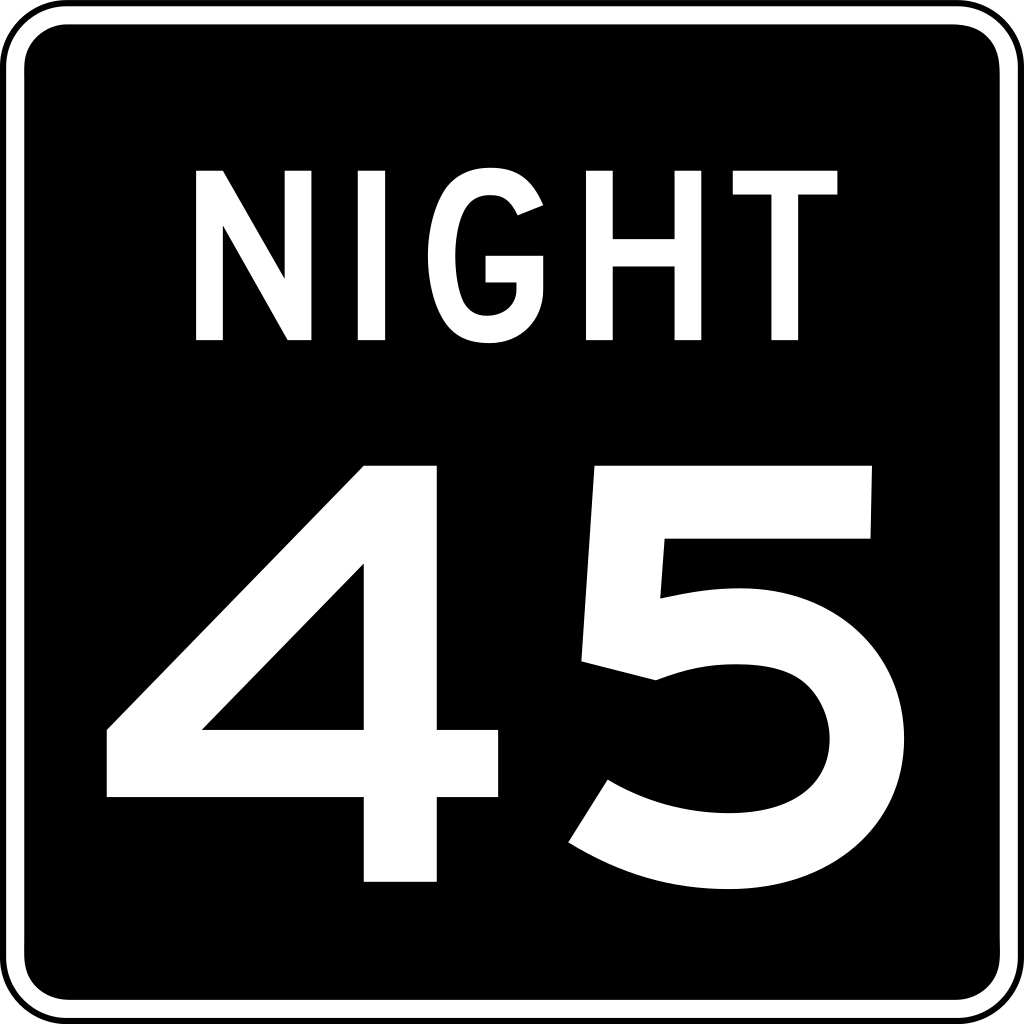
Indicates a lower maximum legal speed limit that applies only during nighttime hours for safety.
This sign means:
A) Take route 45 if you are driving at night.
B) The night-time speed limit is 45 MPH.
C) The minimum speed limit is 45 MPH.
ANSWER KEY Check answers after completing the test.
1 A
2 B
3 A
4 A
5 A
6 A
7 C
8 C
9 C
10 C
11 C
12 B
13 A
14 B
15 A
16 D
17 B
18 C
19 A
20 C
21 A
22 B
23 B
24 B
25 C
26 B
27 B
28 A
29 A
30 B
31 D
32 B
33 B
34 A
35 B
36 B
37 A
38 C
39 A
40 C
41 C
42 B
43 B
44 B
45 C
46 C
47 C
48 A
49 A
50 B