B)Drivers who are driving long distances without rest breaks.
C)Experienced drivers.
2.
When following a motorcycle, drivers must remember that motorcycles can ____________ than other vehicles.
A)accelerate much faster
B)stop much more quickly
C)stop much more slowly
3.
Blind spots around a large vehicle are _________________ than the blind spots around a car.
A)larger and deeper
B)less dangerous
C)narrower and shorter
4.
When they see this sign, drivers should:
A)be ready to brake sharply and stop.
B)be ready to shift to lower gear.
C)yield to trucks coming from the hill on the right.
5.
What type of pavement marking shows you which lane you must use for a turn?
A)Edge line
B)Diamond
C)Crosswalk Lines
D)Arrows
6.
Gauging the speed of a motorcycle may be difficult because:
A)motorcycles take up less of your field of vision.
B)motorcycles often slow down by downshifting.
C)many motorcyclists do not activate the brake light.
7.
Roads are the most slippery:
A)the first rain after a dry spell.
B)after it has been raining for an hour or more.
C)for the first 2 hours of a rain storm.
8.
The traffic light is green and you want to drive straight through an intersection. If a car is already in the intersection and is making a turn, you must:
A)enter the intersection and then stop.
B)drive through the intersection. You have the right-of-way.
C)let that car complete its turn before you enter the intersection.
9.
You reach an intersection that is not controlled at the same time as a driver on your right, and both of you prepare to go straight. Who has the right-of-way?
A)You.
B)No one.
C)The other driver.
10.
To maintain an adequate 'space cushion' to the front, drivers need to:
A)keep a safe distance between their car and the vehicle in front.
B)The other answers are both correct.
C)control their speed to suit the road and traffic conditions.
11.
On what three conditions does your blood alcohol content (BAC) depend?
A)Your weight. How much alcohol you drink. How much time passes between drinks.
B)Your weight. The type of beverage you drink. How fit you are.
C)Your height. How much alcohol you drink. The type of beverage you drink.
12.
While inside the roundabout, you should:
A)remain in your lane until you are ready to exit.
B)change lanes before you check for vehicles behind you.
C)use your left turn signal if you are in position to exit now.
13.
Bicyclists must:
A)ride in a bicycle lane, if available.
B)remain to the right when they prepare for a left turn.
C)remain near the left edge of the road.
14.
If driving in foggy weather, drivers should turn on their high-beams to increase the field of vision.
A)True
B)False
15.
This sign warns drivers that:
A)they cannot go straight ahead.
B)they will soon be facing oncoming traffic.
C)a shared lane starts ahead.
16.
The yield sign means:
A)Drive with caution in wet weather.
B)You must come to a complete stop.
C)Slow down and give vehicles crossing your path the right-of-way.
17.
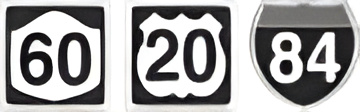
These are:
A)route signs.
B)miles-left signs.
C)speed limit signs.
18.
This sign means:
A)The highway ahead is divided into two one-way roadways.
B)Roundabout ahead. Slow down.
C)The divided highway on which drivers are traveling ends ahead.
19.
What should drivers do in case of a brake failure?
A)Shift to a lower gear.
B)Tie a white cloth on the left door handle.
C)Brake lightly.
20.
Headlights must be turned on from sunset to sunrise.
A)False
B)True
21.
If you see a 'lane closed ahead' sign you should:
A)make a U-turn. You are on the wrong side of the road.
B)merge into the correct lane when it is safe.
C)speed to the end of the closed lane and try to get into the other lane.
D)None of the above.
22.
As you drive on the expressway, make sure:
A)you cut off vehicles behind you when you change lanes.
B)to signal all lane changes.
C)your directional signal goes off before you change lanes.
23.
A parent or legal guardian may request that the driver’s license of a minor be cancelled at any time prior to age 18.
A)False
B)True
24.
You are driving and you are feeling drowsy. You should:
A)avoid drinking coffee.
B)turn on the radio to keep you awake.
C)find a safe place to stop for a break.
25.
When approaching any intersection or driveway, drivers should:
A)look both ways and be ready to stop.
B)pass other vehicles and then stop.
C)drive at the fastest speed just before entering the intersection.
26.
This road sign means:
A)Lane shifting
B)Merging traffic
C)Do not block intersection
27.
This road sign warns drivers that:
A)they are coming to a point where another traffic lane joins the one they are on.
B)a divided highway is ahead.
C)the one-way street or roadway is about to change to two-way traffic.
28.
To drive defensively, you must:
A)anticipate errors by other drivers.
B)assume that a driver who approaches a STOP sign on a side road is actually going to stop.
C)not check behind you through your mirrors.
29.
At intersections marked with stop lines, drivers must:
A)come to a complete stop.
B)slow down and enter the intersection.
C)signal other vehicles to stop.
30.
This sign means:
A)The road will curve to the right, then to the left.
B)Road slippery when wet. Drive slowly.
C)Winding road ahead. Drive with caution.
31.
You may turn left through an intersection with a red light or arrow if you are turning from a one-way street onto a one-way street.
A)False
B)True
32.
This road sign warns drivers that:
A)left turns are not allowed at the intersection.
B)the road will make a sharp turn to the right.
C)another road enters the highway from the direction shown.
33.
Drivers must slow down for a school zone:
A)only when directed to do so by a school flagger.
B)On school days between 7 a.m. and 4 p.m. when children are present and signs are posted.
C)On weekends.
34.
This road sign means:
A)Warning, crossroad ahead
B)All traffic must turn
C)Yield sign ahead
35.
Aggressive driving includes:
A)quick lane changes without a signal.
B)chasing or challenging other drivers.
C)All of the above.
36.
It is illegal to drive around a crossing gate that is down.
A)False
B)True
37.
Drivers must yield the right-of-way to pedestrians in an unmarked crosswalk.
A)False
B)True
38.
BAC is:
A)the acronym for Beer ACcumulation.
B)the number of ounces of alcohol in your blood.
C)the percentage of alcohol in your blood.
39.
It's 10 AM. This sign tells you that:
A)you are allowed to park until 5:30 PM.
B)you must display a special permit in order to park here.
C)you are not allowed to park here.
40.
You face a green light, but traffic on the other side of the intersection does not allow you to travel all the way through the intersection. What must you do?
A)Enter the intersection and wait until traffic ahead clears.
B)Wait for the next green light.
C)Wait until traffic ahead clears, so you do not block the intersection.
41.
You should normally activate your directional ____ feet ahead of your intended turn.
A)50
B)75
C)100
D)25
42.
A four-way stop sign means:
A)traffic from all four directions must stop.
B)if two vehicles reach the intersection at the same time, the driver on the left yields to the driver on the right.
C)All of the above.
43.
When you make a left turn from a one-way road into a two-way road, you must:
A)enter the two-way road to the left of its center line.
B)make a U-turn into the two-way road.
C)enter the two-way road to the right of its center line.
44.
This sign warns that:
A)traffic must merge left.
B)the bridge ahead is wide enough for only one vehicle at a time.
C)traffic must merge right.
45.
_________________ your mirrors when you prepare to change lanes.
A)Never depend on
B)Never use
C)Always rely on
46.
This road sign means:
A)No left turn
B)No right turn
C)No U-turns
47.
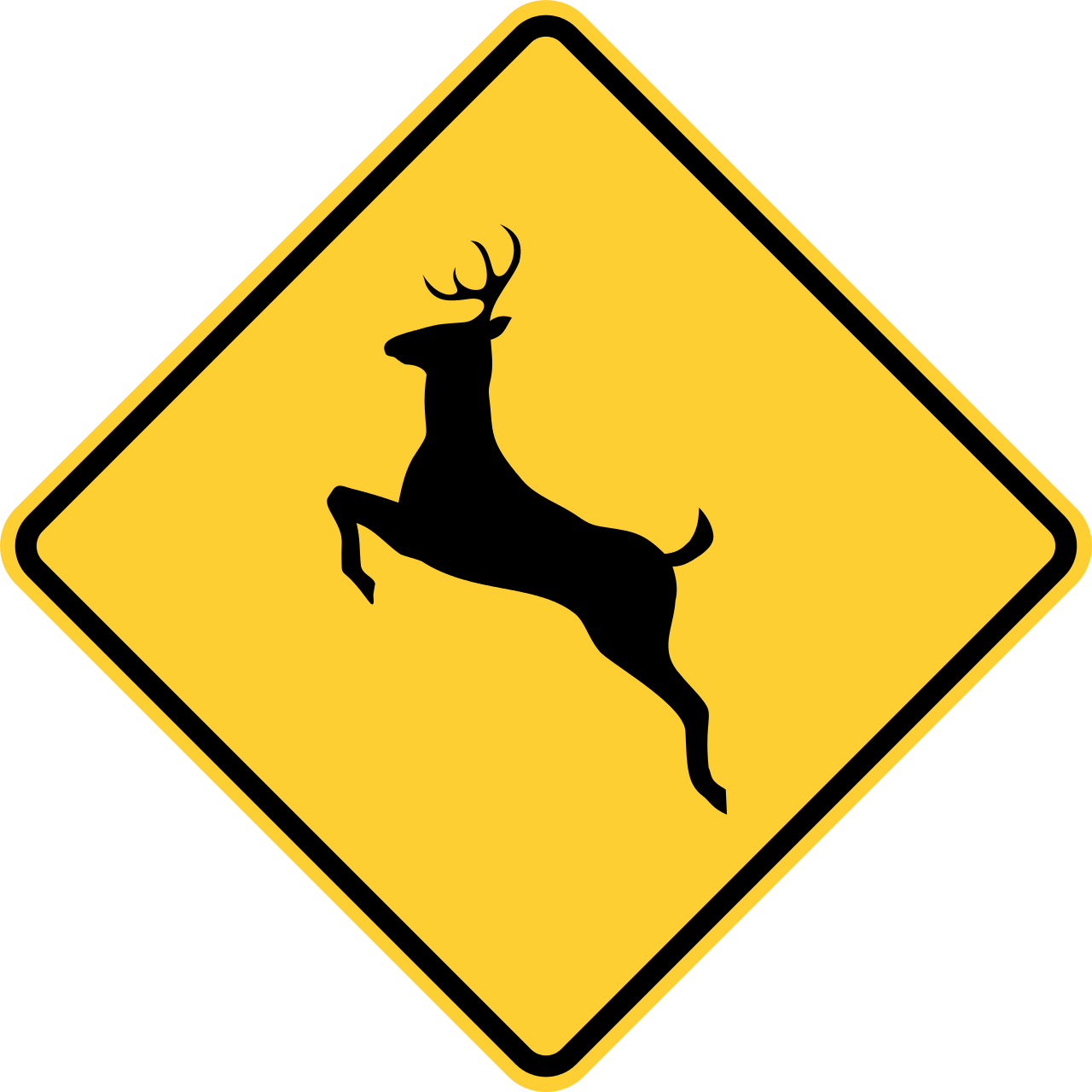
When they see this road sign, drivers should:
A)drive carefully because the animal pictured on the sign is extremely rare in the area.
B)watch for this species crossing the road.
C)park in the zoo area.
48.
This is:
A)a side road sign.
B)a merging traffic sign.
C)a right curve sign.
49.
What is a likely effect when you take another drug while you drink alcohol?
A)The effects of the alcohol and the drug are enhanced.
B)There are no effects, unless the drug is prescription only.
C)If the drug is over-the-counter, there are no effects.
50.
What should you do if your headlights suddenly go out?
A)Brake immediately and activate your emergency lights.
B)Use your emergency lights, parking lights or directional signals.
C)Ease your foot off the gas pedal and brake gently.
ANSWER KEYCheck answers after completing the test.