DriveQuiz drivequiz.com

ID DMV PERMİT PRACTİCE TEST 8

Idaho
Duration: 36 min
|
Questions: 40
Student Name:
Date:
Correct:      Incorrect:      Score:      
1.
When passing other vehicles, drivers should:
A) make sure the passing lane is clear of traffic, and check behind and to the left to make sure another vehicle is not attempting to pass.
B) pass the vehicle as slowly as possible.
C) apply the brake and slow down.
D) All of the above.
2.
Indicates a two-way left-turn lane in the center of the road. Must only be used to make left turns or U-turns (where permitted), not for regular travel or passing.
This sign means:
A) The center lane is shared for left turns.
B) Left turns in both directions of travel are not permitted.
C) Vehicles may only turn left.
3.
To avoid becoming an aggressive driver, you should:
A) Adjust your schedule to drive during times with the most highway traffic.
B) Allow enough travel time to reach your destination on schedule.
C) Listen to heavy metal music.
4.
When you prepare to make a left turn from a one-way road into a one-way road, you must:
A) move into the right lane, or to the left side of a single lane.
B) move into the right lane, or to the right side of a single lane.
C) move into the left lane, or to the left side of a single lane.
5.
Another road crosses the highway ahead. Look left and right for crossing or entering vehicles.
This road sign means:
A) Crossroad
B) Hospital parking ahead
C) Merge
6.
When changing lanes, you should not:
A) signal your intentions early.
B) check your side and rear view mirrors.
C) use the inside rearview mirror to check for blind spots
D) check to see if other drivers are moving into the same lane.
7.
BAC is expressed in:
A) percentage of alcohol to blood.
B) percentage of blood to alcohol.
C) ounces of alcohol in your blood.
8.
You should increase your following distance when:
A) exiting a freeway.
B) following a motorcycle.
C) driving behind a large vehicle that blocks your vision.
D) All of the above.
9.
When parked facing down hill, your wheels should be turned:
A) toward the curb.
B) in any direction.
C) parallel to the curb.
D) away from the curb.
10.
To pass a bicyclist traveling in the same direction on a two-lane road without bicycle lanes, you should:
A) continue driving straight, it is the bicyclist’s responsibility to get out of your way.
B) slow down and wait until there is no oncoming traffic, then pass the bicyclist leaving him or her sufficient space.
C) honk at the bicyclist to let him or her know you are about to pass.
D) not pass the bicyclist until you come to a traffic signal or stop sign.
11.
When driving in heavy traffic, you should:
A) drive with the flow of traffic.
B) maintain a constant speed.
C) drive faster than the flow of traffic.
D) drive slower than the flow of traffic.
12.
Select the most effective safety restraint(s) in a traffic crash.
A) Lap and shoulder belt only
B) Air bag only
C) Pumping brakes.
D) A combination of lap/shoulder belt and air bag.
13.
A side road enters the highway from the right or left. Watch for traffic turning onto or crossing your lane.
This is:
A) a side road sign.
B) a merging traffic sign.
C) a right curve sign.
14.
Work zone signs:
A) mean that road conditions will improve soon.
B) mean that drivers must come to a complete stop and back up.
C) provide information on road work or other temporary road conditions.
D) mean that drivers should drive faster to get out of the work zone.
15.
Road signs that direct drivers to services are:
A) brown and white.
B) blue and white.
C) green and white.
16.
It is important for drivers to know that trucks:
A) are easier for the driver to operate.
B) require more space for turning movements.
C) take longer than cars to stop.
D) require less time to pass on an incline than cars.
17.
Hydroplaning is a situation in which:
A) your tires throw water to the rear, causing problems for the vehicles behind.
B) the tires of the car ahead cause sheets of water to splash on your vehicle.
C) one of your tires goes flat, causing the others to skid.
D) your tires ride up on a thin surface of water, losing contact with the pavement, and resulting in sudden loss of control
18.
The roadway ahead is narrowing or a lane is ending. Merge smoothly into the continuing lane.
This sign warns drivers that:
A) there is a one lane bridge ahead.
B) the right lane ends.
C) the road ahead is narrow.
19.
Warns of two consecutive curves in opposite directions (e.g., curves right then left). Slow down to maintain control.
This sign warns drivers that:
A) the highway ahead is divided into two one-way roadways. Drivers should keep to the right.
B) there is a winding road ahead.
C) there is a double curve ahead.
20.
If you hear a thumping sound while driving, you should:
A) hook your shoe under the gas pedal and see if you can free it.
B) get off the road and check your tires.
C) try your emergency lights.
21.
To reduce their chances of colliding with an animal, drivers should:
A) scan the sides of the road to watch for the reflection of vehicle headlights in the eyes of animals.
B) look well down the road and far off to each side.
C) All of the above.
22.
Left turns on a red light are allowed:
A) from a one-way street into a one-way street.
B) Never.
C) at intersections, after stopping, if the way is clear.
23.
A flashing yellow light means:
A) Merging traffic ahead
B) Pedestrian crossing
C) Come to a full stop
D) Proceed with caution
24.
What should you do in case of a steering failure?
A) Pump your gas pedal a few times to increase the pressure.
B) Don't panic. Turn on your emergency lights to let other drivers know you are having car problems. Move toward the side of the road and bring the car to a gradual stop.
C) Leave the road immediately.
25.
A driver should be extra alert for motorcyclists, bicycles and pedestrians. Why?
A) They obey specific traffic laws.
B) They always have the right-of-way.
C) They are hard to see in traffic.
D) They don’t have rearview mirrors.
26.
Indicates a series of three or more consecutive sharp turns or curves ahead. Reduce speed and maintain lane control.
This road sign means:
A) Pavement ends
B) Winding road
C) Double curve ahead
27.
When you make a left turn from a one-way road into a two-way road, you must:
A) enter the two-way road to the left of its center line.
B) make a U-turn into the two-way road.
C) enter the two-way road to the right of its center line.
28.
An octagonal sign means that drivers must:
A) respect the posted speed limit.
B) come to a complete stop at the marked stop line.
C) be aware possible hazards ahead.
29.
Come to a complete stop before the stop line, crosswalk, or intersection. Look left, right, and left again, and proceed only when it is safe and right-of-way is clear.
This road sign means:
A) Yield the right-of-way to oncoming vehicles
B) Stop if necessary
C) You must make a complete stop
D) Slow down or stop
30.
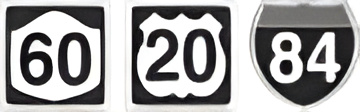
Interstate or State Route numbered highway marker used for route navigation and guide information.
These are:
A) route signs.
B) miles-left signs.
C) speed limit signs.
31.
An emergency vehicle that uses lights and a siren can be unpredictable. Why?
A) The driver can legally pass red lights.
B) Emergency vehicles must go faster than the posted speed limit when it is safe to do so.
C) Emergency vehicle drivers are not required to be careful.
32.
Drivers are required to stop:
A) when a traffic officer orders them to stop.
B) where there is a red light.
C) at an intersection with a stop sign.
D) All of the above.
33.
A signalized intersection is ahead. Prepare to stop if the light turns yellow or red.
This sign means:
A) No traffic signal ahead
B) Traffic signal ahead
C) Open intersection ahead
34.
What do flashing red lights on a school bus indicate?
A) The bus is stopped to load or discharge passengers.
B) Traffic that approaches from either direction may proceed.
C) The bus is about to stop.
35.
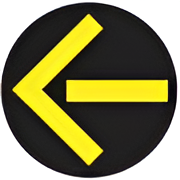
Unprotected left turns are allowed. You may turn left after yielding to oncoming traffic and pedestrians crossing the street.
What does a yellow arrow signal mean?
A) The same as the yellow light, but applies only to movement in the direction of the arrow.
B) The same as a green light.
C) Vehicles moving in all directions must stop if they can. The light will soon be red.
36.
When drivers see the ‘Wrong Way’ sign:
A) they are going the wrong way on an expressway exit ramp.
B) they must drive past this sign and reach the next intersection.
C) they must not leave the pavement except in an emergency.
37.
A flashing red light means:
A) The same as a STOP sign.
B) The light will soon change to steady red.
C) Drive with caution.
38.
Which of the following drugs could affect your ability to drive?
A) A cold remedy.
B) Marijuana.
C) All of the above.
39.
Where are yield signs usually placed?
A) At intersections, if there is no marked stop line.
B) Where auxiliary roads lead into major roads.
C) Where major roads lead into auxiliary roads.
40.
On slippery roads, drivers should:
A) leave more space in front of their vehicle.
B) increase their speed to avoid hydroplaning.
C) come to a complete stop.
ANSWER KEY Check answers after completing the test.
1 A
2 A
3 B
4 C
5 A
6 C
7 A
8 D
9 A
10 B
11 A
12 D
13 A
14 C
15 B
16 C
17 D
18 B
19 C
20 B
21 C
22 A
23 D
24 B
25 C
26 B
27 C
28 B
29 C
30 A
31 A
32 D
33 B
34 A
35 A
36 A
37 A
38 C
39 B
40 A