DriveQuiz drivequiz.com

ID DMV PERMİT PRACTİCE TEST 12

Idaho
Duration: 36 min
|
Questions: 40
Student Name:
Date:
Correct:      Incorrect:      Score:      
1.
If you begin to feel drowsy while driving, you should:
A) open your window.
B) get some coffee.
C) get an energy drink.
D) stop driving.
2.
Slow down and give right-of-way to all oncoming vehicles, cyclists, and pedestrians. Stop completely if necessary before entering the intersection or merging.
This is the shape and color of a ________ sign.
A) yield
B) stop
C) do not enter
3.
Who is most at risk?
A) Drivers who are fatigued.
B) Drivers who are driving on long, boring roads.
C) All of the above.
4.
When changing lanes, you can check your blind spot by:
A) using the outside rearview mirror.
B) using the inside rearview mirror.
C) turning your head and glancing over your shoulder.
D) checking the rearview and outside mirrors.
5.
Another road crosses the highway ahead. Look left and right for crossing or entering vehicles.
This road sign means:
A) Church ahead
B) Intersection ahead
C) Do not enter
D) Side road
6.
When driving through school zones:
A) watch for a school flagger.
B) always drive at 20 MPH or less.
C) obey the posted speed limits.
D) remember that students must always yield right-of-way to vehicles.
7.
The roadway becomes particularly slippery during wet or rainy conditions. Reduce your speed, increase following distance, and avoid abrupt braking or steering.
This sign means:
A) The road will curve to the right, then to the left.
B) Road slippery when wet. Drive slowly.
C) Winding road ahead. Drive with caution.
8.
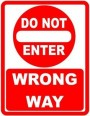
Alerts drivers to a major crossroads intersection ahead. Watch for vehicles entering or crossing the roadway.
This road sign means:
A) U-turns are prohibited
B) You may proceed only if the way is clear
C) You are about to enter a one-way street the wrong way
D) Do not pass
9.
Regulation signs normally are ____ rectangles with ____ letters or symbols.
A) yellow; black
B) white; black
C) green; white
10.
When changing lanes, __________ to be sure no one is in the 'blind spot'.
A) check your right mirror
B) slow down gradually
C) check your left mirror
D) glance over your shoulder
11.
Which of the following is NOT true about ABS?
A) It improves the vehicle stability.
B) It helps increase your stopping distance.
C) It improves the steering ability.
12.
Motor vehicles must yield to pedestrians:
A) when the pedestrian is in a crosswalk at an intersection.
B) when driving at night.
C) only when the pedestrian is blind.
D) only in school zones.
13.
Studies show that wearing seat belts:
A) reduces your chances of serious injury in a crash.
B) increases your chances of fatality in a crash.
C) reduces your chances of damaging your car in a crash.
D) All of the above.
14.
A driver who approaches an intersection:
A) must yield the right-of-way to traffic already in the intersection.
B) must drive straight through the intersection, even if another vehicle is already in the intersection.
C) has the right-of-way over traffic already in the intersection.
15.
Indicates that traffic is permitted to pass on either the left or the right side of an island, median, or obstruction.
This sign tells drivers that:
A) left and right turns are not allowed.
B) a divided highway is ahead.
C) they cannot go straight ahead.
16.
When you park parallel to a curb, you must:
A) park within 24 inches of the curb or edge of roadway.
B) park within 18 inches of the curb.
C) park facing the opposite direction of the flow of traffic on your side of the road.
D) park at an angle with the rear of your vehicle sticking out into traffic.
17.
Night driving can be more difficult because:
A) the ratio of motorcyles to cars is much higher at night.
B) vehicle operators tend to drive faster at night.
C) speed limits do not apply at night.
D) visibility is reduced.
18.
What is the purpose of minimum speed limits?
A) To keep a smooth traffic flow.
B) To halt the traffic flow.
C) To allow emergency vehicles with red flashing lights to safely pass other vehicles.
19.
When you come to an intersection with a flashing red light, you must:
A) stop at the intersection, then proceed when safe and observe the right-of-way rules.
B) slow down and drive carefully through the intersection.
C) stop at the intersection and wait for a flashing green light.
D) stop only if cars are approaching the intersection.
20.
When driving on a freeway, drivers must know that:
A) vehicles may travel up to 95 MPH.
B) a minimum speed limit may be posted.
C) they should change their speed frequently to adapt to keep up with the flow of traffic.
D) they should never change lanes.
21.
A driver approaching a flashing red traffic signal must:
A) merge to the left.
B) stop before the intersection.
C) carefully drive through the intersection without stopping.
D) slow down at the traffic signal.
22.
Warns drivers that two separate lanes moving in the same direction are merging into one. Drivers in the right lane must adjust speed and merge smoothly with existing traffic.
This road sign means:
A) Lane shifting
B) Traffic is entering from another road, drive with caution
C) Stop for other traffic
D) Yield right-of-way
23.
Designated school crosswalk location. You must yield to all schoolchildren and pedestrians in the crossing.
When they approach this sign, drivers must:
A) slow down and watch for children crossing the road.
B) obey signals from crossing guards.
C) stop if necessary.
D) All of the above.
24.
Braking distance is affected by:
A) the condition of your brakes and tires.
B) pavement conditions.
C) the speed your vehicle is traveling.
D) All of the above.
25.
A steady yellow light at an intersection means:
A) Proceed with caution through the intersection
B) Slow down and be prepared to stop
C) Immediately come to a complete stop
D) Yield to other vehicles
26.
The most common cause of traffic crashes is:
A) human error.
B) bad road conditions.
C) wet pavement.
D) bad weather.
27.
Right turns are strictly prohibited at this intersection under all circumstances.
This road sign means:
A) No left turn
B) No right turn
C) No U-turns
28.
Who has a greater risk of being involved in a traffic crash?
A) Drivers who are driving alone.
B) Young people.
C) All of the above.
29.
The road makes a sharp 90-degree right turn ahead. Slow down considerably before entering the turn.
This road sign means:
A) One way
B) No right turn
C) Exit
D) Sharp right turn ahead
30.
The best way to deal with tailgaters is to:
A) slow down to encourage the tailgater to pass.
B) pump your brakes to get them to back off.
C) ignore them completely.
D) speed up to increase the space between you and the tailgater.
31.
Warns of an upcoming STOP sign that may not be immediately visible. Begin slowing down to prepare for a complete stop.
This road sign means:
A) Railroad Warning
B) Stop Sign Ahead
C) Lane ends
D) Stop if necessary
32.
When you see an emergency vehicle with flashing lights, you must:
A) pull over to the side of the road and stop.
B) increase your speed to provide a clear path for the emergency vehicle.
C) slow down until it passes you.
D) drive with your flashers on.
33.
Select the best answer. Before backing a car out of a driveway, you should:
A) check your rearview mirrors to see what is behind you.
B) check behind the vehicle before you get in.
C) turn the car radio on.
D) honk the horn right before backing up.
34.
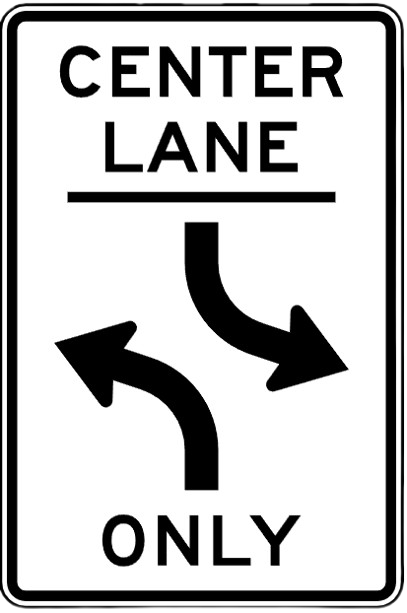
Indicates a two-way left-turn lane in the center of the road. Must only be used to make left turns or U-turns (where permitted), not for regular travel or passing.
This road sign means:
A) Vehicles may only travel in the center lane.
B) The center lane is shared for left turns in both directions of travel.
C) The center lane in both directions of travel will soon turn left.
35.
Pentagonal signs are used to indicate:
A) possible hazards on roadways.
B) no passing zones.
C) school crossings.
36.
A flashing red traffic light:
A) has the same meaning as a yield sign.
B) is used to indicate a pedestrian crossing.
C) has the same meaning as a stop sign.
D) indicates that you should drive with caution.
37.
When approaching someone using a white cane, you should proceed with caution because:
A) the pedestrian might be using a guide dog.
B) the pedestrian might be blind.
C) the pedestrian is deaf.
D) the pedestrian is blind.
38.
Alerts drivers to an upcoming crosswalk where pedestrians frequently cross. Slow down and yield right-of-way to anyone in or about to enter the roadway.
This sign means:
A) Railroad crossing
B) No Passing Zone
C) The road ends ahead
39.
You face a green light, but traffic on the other side of the intersection does not allow you to travel all the way through the intersection. What must you do?
A) Enter the intersection and wait until traffic ahead clears.
B) Wait for the next green light.
C) Wait until traffic ahead clears, so you do not block the intersection.
40.
Warns of an upcoming STOP sign that may not be immediately visible. Begin slowing down to prepare for a complete stop.
When drivers come to this sign, they must:
A) be ready to stop at the stop sign.
B) warn other drivers that a stop sign is ahead.
C) brake sharply and come to a complete stop.
ANSWER KEY Check answers after completing the test.
1 D
2 A
3 C
4 C
5 B
6 C
7 B
8 C
9 B
10 D
11 B
12 A
13 A
14 A
15 C
16 B
17 D
18 A
19 A
20 B
21 B
22 B
23 D
24 D
25 B
26 A
27 B
28 C
29 D
30 A
31 B
32 A
33 B
34 B
35 C
36 C
37 D
38 A
39 C
40 A