DriveQuiz drivequiz.com

FL DMV PERMİT PRACTİCE TEST 3

Florida
Duration: 45 min
|
Questions: 50
Student Name:
Date:
Correct:      Incorrect:      Score:      
1.
A __________ marks the right edge of the roadway.
A) solid yellow line
B) solid white line
C) broken white line
D) broken yellow line
2.
Your license must be revoked if you:
A) are found guilty of 15 offenses for which you receive points within a 5-year period.
B) fail to carry insurance on your vehicle.
C) fail to stop for a school bus.
D) you refuse to take a DUI test.
3.
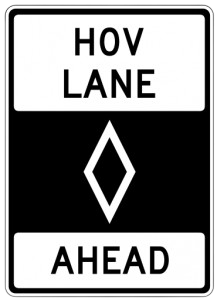
High-Occupancy Vehicle (HOV) diamond lane ahead. Only vehicles carrying the minimum required number of passengers (usually 2 or more) may use this lane.
This road sign indicates that:
A) a lane is reserved for certain purposes or certain vehicles.
B) buses and car pools may not travel in the restricted lane.
C) vehicles cannot go straight ahead. Cars must turn either to the right or left.
4.
You should use a three-point turn:
A) on a hill, if the road is clear.
B) on a curve, to turn your car around in a very small space.
C) when you miss an exit on a highway.
D) only if the road is too narrow for a U-turn and you can’t go around the block.
5.
Which of the following must be avoided when passing another vehicle:
A) On a two-lane road, blinking your headlights to let the other driver know you are passing.
B) Returning to the right side of the road immediately after passing the other vehicle.
C) Giving your signal before you move into the left lane.
D) Checking blind spots to make sure that you have plenty of room to pass.
6.
Passing a stopped school bus will result in __ points being added.
A) 3
B) 5
C) 6
D) 4
7.
When following a motorcycle, drivers must remember that motorcycles can ____________ than other vehicles.
A) accelerate much faster
B) stop much more quickly
C) stop much more slowly
8.
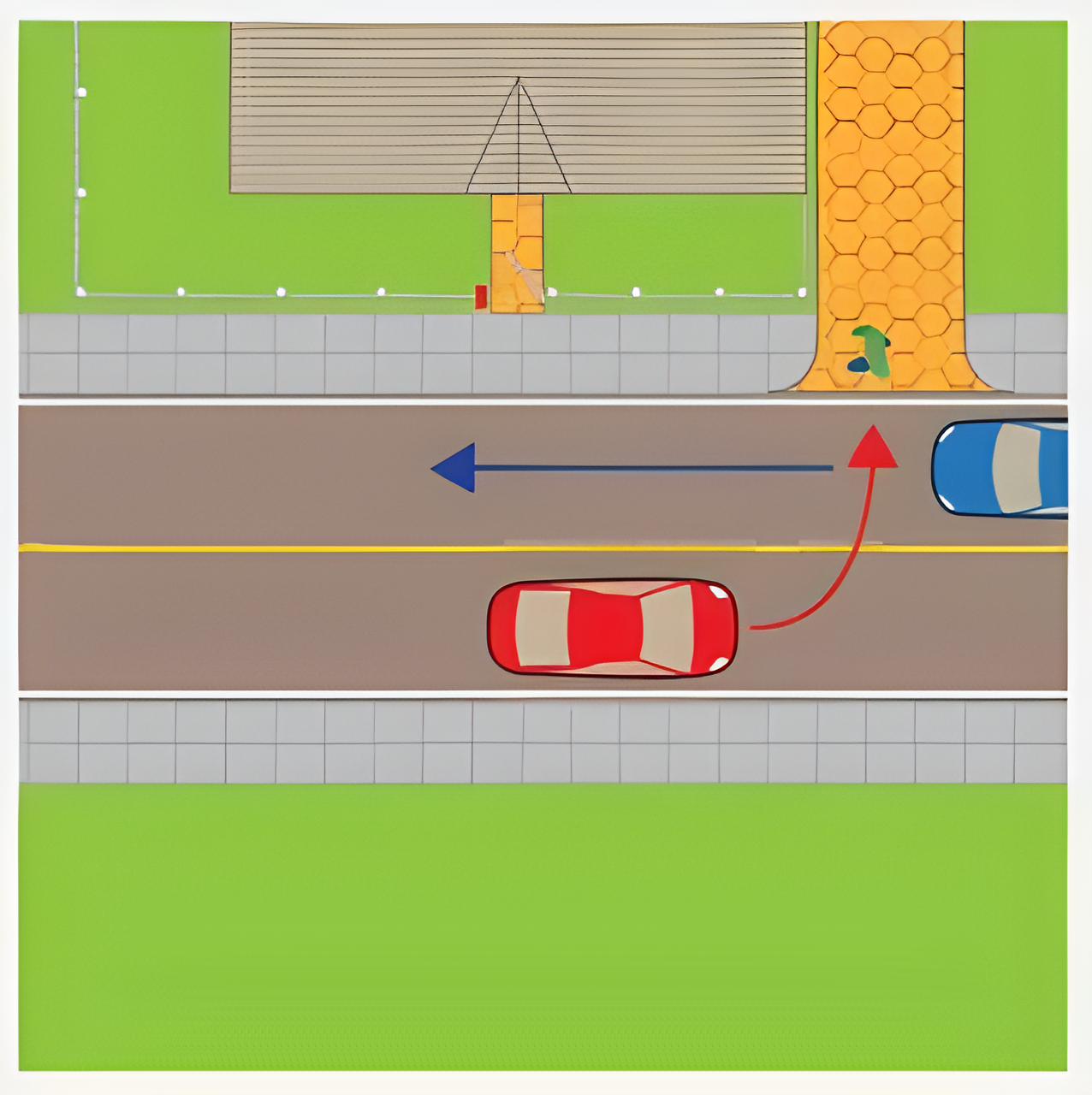
Vehicles turning left must yield to all oncoming through traffic and right-turning vehicles approaching from the opposite direction.
The red car turning left must:
A) yield to pedestrians and traffic before turning.
B) proceed with caution even if it has the right-of-way.
C) turn left before the oncoming car gets too close.
D) None of the above.
9.
Doing all you can to prevent crashes is called:
A) Anti-Collision Driving
B) Crash-Prevention Driving
C) Defensive Driving
D) ABS Driving
10.
A driver needing to turn a car around in a very small space should:
A) always use a three-point turn.
B) drive to the next roundabout.
C) use a three-point U-turn on a curve.
D) make a U-turn if possible.
11.
Roads are most slippery:
A) just before it rains.
B) when it stops raining.
C) when it first starts to rain.
12.
When you see a cyclist approaching at night, you should NOT:
A) use low beam headlights.
B) be careful.
C) use high beam headlights.
D) avoid honking your horn.
13.
At intersections marked with stop lines, drivers must:
A) come to a complete stop.
B) slow down and enter the intersection.
C) signal other vehicles to stop.
14.
A driver who approaches an intersection:
A) must yield the right-of-way to traffic already in the intersection.
B) must drive straight through the intersection, even if another vehicle is already in the intersection.
C) has the right-of-way over traffic already in the intersection.
15.
Driving during restricted hours will result in __ points being added.
A) 2
B) 6
C) 3
D) 4
16.
On a three-lane expressway, drivers should use the ____ lane for passing.
A) center
B) right or left
C) right
D) left
17.
Racing on the highway:
A) is only allowed if you drive at least 5 MPH below the posted speed limit.
B) may result in license suspension.
C) is never allowed.
D) is allowed only if the highway is empty and you are completely sober.
18.
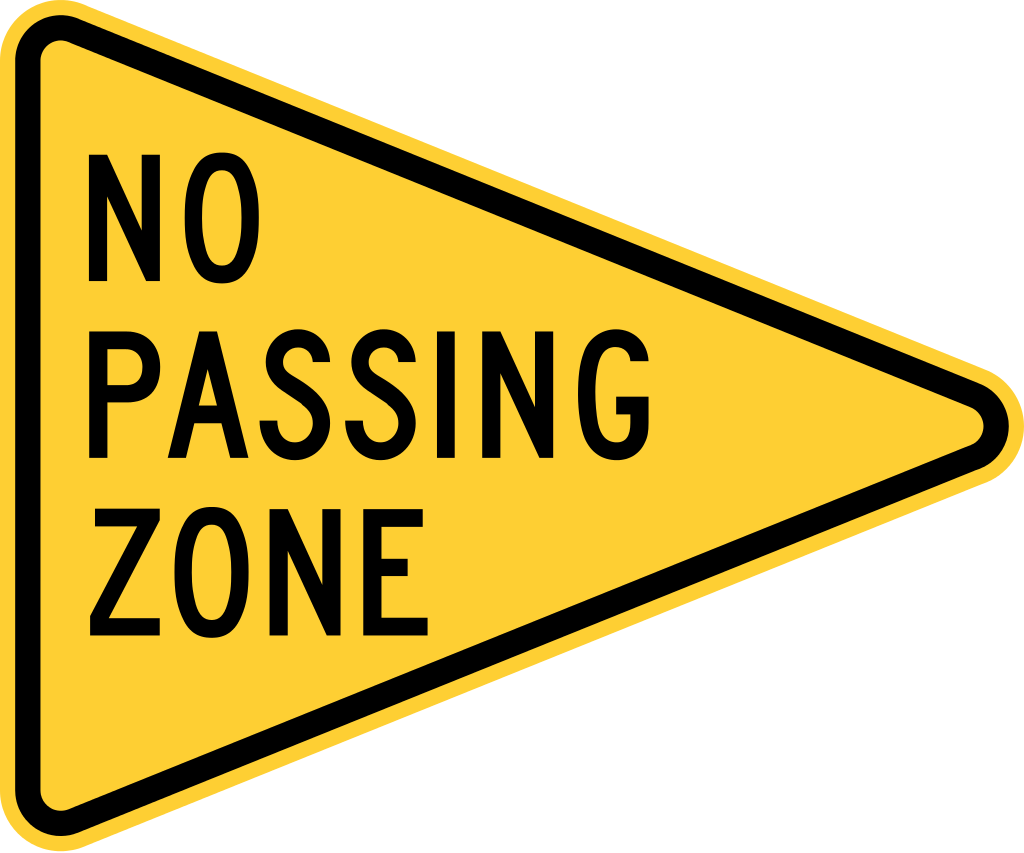
Which shape is used to give advance warning of no passing zones?
A) Crossbuck
B) Pennant
C) Round
D) Horizontal Rectangle
19.
A steep downhill grade is ahead. Trucks and heavy vehicles should downshift to a lower gear to prevent brake overheating.
When they see this sign, drivers should:
A) be ready to brake sharply and stop.
B) be ready to shift to lower gear.
C) yield to trucks coming from the hill on the right.
20.
When there is a green arrow pointing left, and the red light is illuminated at the same time, drivers:
A) must stop if they are in the green arrow lane.
B) should come to a complete stop if they can. The green light will soon be red.
C) have the right-of-way and can turn left from any lane.
D) must be in the proper lane to make a turn in the direction of the arrow, and must yield the right-of-way to vehicles and pedestrians.
21.
Warns that a one-way street or divided highway is ending, and you are entering a roadway with oncoming traffic in the opposing lane. Stay to the right.
This sign warns ____________ ahead.
A) of two-way traffic
B) of a reduction of lanes
C) that a divided highway ends
22.
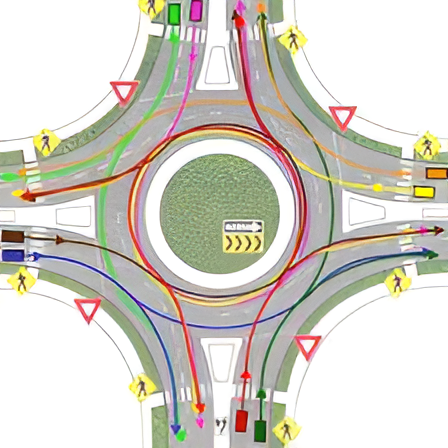
Choose your lane before entering a multi-lane roundabout: right lane for right turns/straight, left lane for straight/left turns/U-turns.
The picture shows:
A) an open intersection
B) a divided highway.
C) a crossing
D) a roundabout
23.
When the posted speed limit is 70 MPH, the minimum speed limit is:
A) 30 MPH.
B) There is no minimum speed limit, it is always safe to drive slowly.
C) 50 MPH.
D) 35 MPH.
24.
Total stopping distance is:
A) the sum of reflex distance, preparation distance and braking distance.
B) perception distance minus reaction distance.
C) the total minimum distance a vehicle has traveled until the driver can bring it to a complete stop.
D) the sum of yielding distance and braking distance.
25.
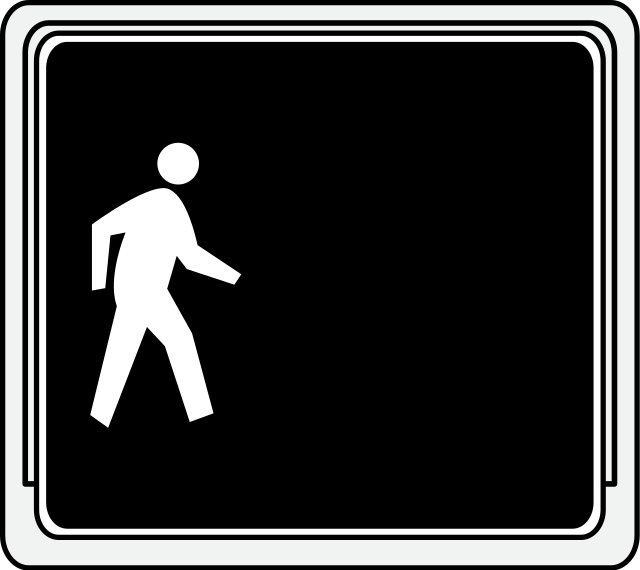
Illuminated white walking person indicates pedestrians have right-of-way to begin crossing the street in the designated crosswalk.
What does the pictured signal indicate?
A) A pedestrian may begin crossing the street.
B) Pedestrians may turn right.
C) A pedestrian may not not begin crossing the street.
26.
Which of the following is NOT true? When entering an open intersection, drivers must yield the right-of-way if:
A) they enter or cross a state highway from a secondary road.
B) they are already in the intersection.
C) they enter a paved road from an unpaved road.
D) All of the above.
27.
The Florida “standard” speed limit in business or residential areas is:
A) 30 MPH.
B) 55 MPH.
C) 20 MPH.
D) 15 MPH.
28.
What do pennant-shaped signs indicate?
A) A school crossing
B) Yield
C) A No Passing Zone
29.
The average perception time for an alert driver is:
A) 0.25 to 0.5 seconds.
B) 0.75 to 1 second.
C) 3 to 4 seconds.
D) 1 to 2 seconds.
30.
Which way should you turn your wheels when parking facing uphill where there is a curb?
A) Turn wheels to right.
B) Any of the above.
C) Turn wheels to curb.
D) Turn wheels from curb.
31.
When a person under the age of 18 is not restrained by a safety belt or a child restraint device, a seat belt violation will be charged to:
A) the driver.
B) the passenger under 18.
C) both.
D) There is no violation.
32.
Designated school crosswalk location. You must yield to all schoolchildren and pedestrians in the crossing.
When you approach this sign, you must:
A) stop if necessary.
B) watch for workers crossing the road.
C) None of the above.
33.
Parking, standing, or stopping is prohibited at all times in this designated zone except for emergency vehicles.
This sign means:
A) U-turns are not allowed.
B) Parking is not allowed.
C) No parking on pavement.
34.
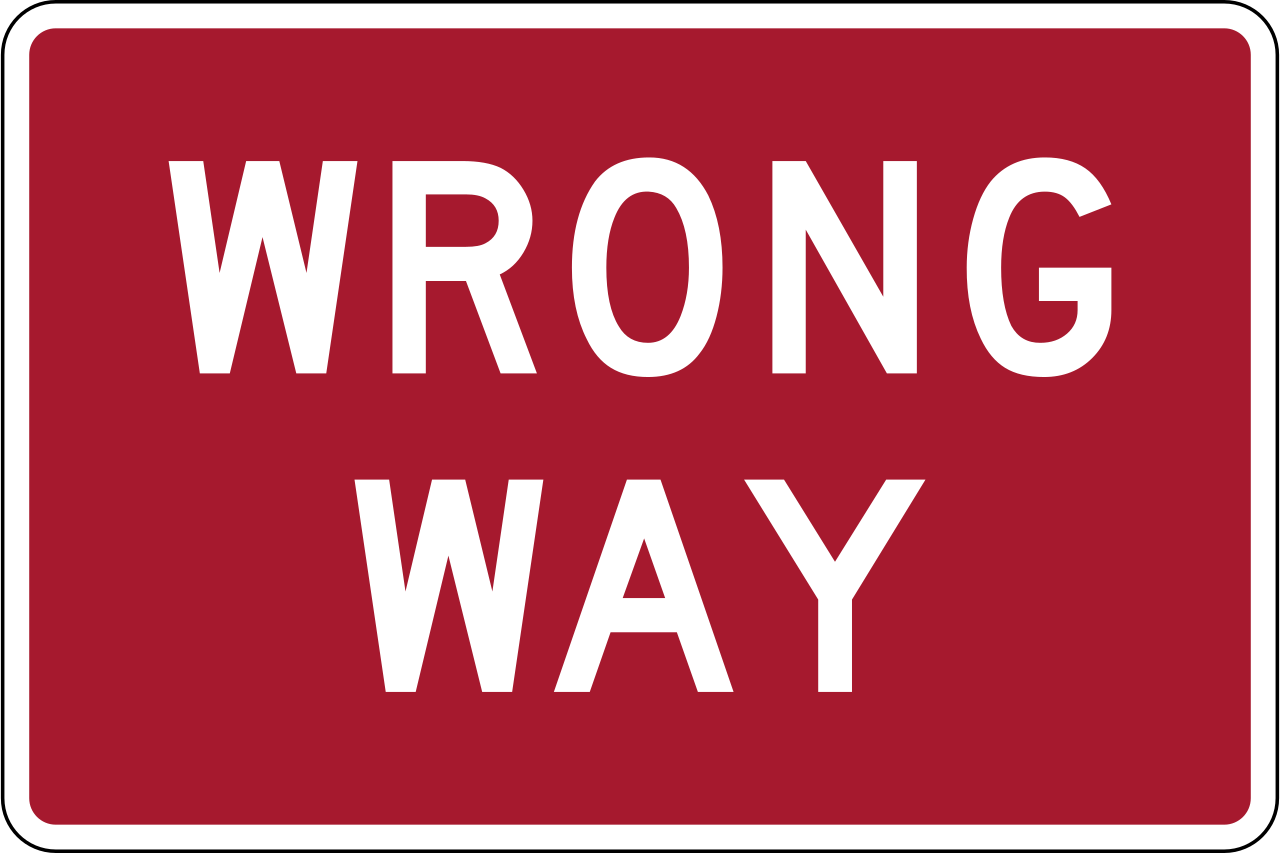
You are driving against the legal flow of traffic on a one-way street or freeway ramp. Immediately pull over, stop safely, and turn around when clear.
When drivers see this road sign:
A) they must come to a complete stop and call the police.
B) they must not drive past this sign.
C) they must turn around immediately.
35.
Your license must be revoked if you are found guilty of ___ cases of reckless driving within one year.
A) 2
B) 6
C) 5
D) 3
36.
The center lane of a three-lane or five-lane highway is used only:
A) when it is safe to pass and passing is allowed.
B) for turning left.
C) to park disabled vehicles.
D) for turning right.
37.
Which shape is a railroad advance warning sign?
A) Crossbuck
B) Round
C) Pentagon
38.
Which of the following is NOT a rule for safe driving:
A) Ask your doctor how your medications affect driving.
B) Do not drink alcohol between 9:00 a.m. and 2 p.m.
C) Always wear a safety belt.
D) Be rested.
39.
Restricted lanes are usually reserved for:
A) special black vehicles.
B) car-pool vehicles or buses.
C) trains.
D) trucks during rush hour traffic.
40.
Triangular pennant on the left side of the road warning that overtaking is hazardous and prohibited due to hills or blind curves.
Where are pennant signs placed?
A) On the right side of the road, facing the driver.
B) On windy roads.
C) Where a highway is divided into two one-way roadways.
D) On the left side of the road, facing the driver.
41.
The main purpose of right-of-way rules is to:
A) gradually remove traffic signals from the roads to improve the deficit.
B) avoid crashes in school zones by helping school buses.
C) make road rules difficult to understand.
D) help with smooth and safe traffic flow.
42.
Expressways are NOT also known as:
A) fastways.
B) freeways.
C) reserved motorways.
D) interstate highways.
43.
The Florida “standard” speed limit in school zones is:
A) 20 MPH.
B) 30 MPH.
C) 25 MPH.
D) 55 MPH
44.
All cars must have two red taillights mounted on the rear, visible from how many feet away?
A) 500
B) 150
C) 1000
D) 50
45.
A flashing red light at an intersection means:
A) Stop if you can.
B) Stop and yield to other traffic, then go.
C) The red light will soon be yellow.
D) You have the right-of-way: other traffic must yield to you.
46.
Which of the following is NOT true? Your license must be revoked if:
A) you are found guilty of drug possession.
B) you are found guilty of not stopping to give help when the vehicle you are driving is involved in a crash causing death or personal injury.
C) you use tobacco and you are under the age of 14.
D) All of the above.
47.
A texting while driving violation is punished as follows:
A) On first offense, two points are added to the primary offense if texting occurred in a school zone.
B) Texting while driving is not a violation.
C) License revocation.
D) No penalty on first offense; for subsequent offenses, two points are added to the primary offense if texting occurred in a school zone.
48.
If a driver reaches an intersection where he/she wishes to make a right or left turn and is not in the proper lane, he/she should:
A) come to a complete stop and wait until the intersection is clear.
B) use the turn signal to indicate their intention to change lane.
C) drive to the next intersection, then make the turn from the proper lane.
D) make a U-turn and go back to the intersection.
49.
If you are following a truck, you should:
A) position your car so the truck driver can see you in his side mirrors.
B) always dim your headlights at night.
C) stay out of its blind spot to the rear.
D) All of the above.
50.
When driving at night, drivers should NOT:
A) use lane lines as visual guides and look quickly to check the other vehicle’s position every few seconds.
B) use headlights between the hours of sunset and sunrise.
C) use high-beam headlights within 500 feet of oncoming vehicles.
D) All of the above.
ANSWER KEY Check answers after completing the test.
1 B
2 A
3 A
4 D
5 B
6 D
7 B
8 A
9 C
10 D
11 C
12 C
13 A
14 A
15 C
16 D
17 C
18 B
19 B
20 D
21 A
22 D
23 C
24 C
25 A
26 B
27 A
28 C
29 B
30 D
31 A
32 A
33 B
34 C
35 D
36 B
37 B
38 B
39 B
40 D
41 D
42 A
43 A
44 C
45 B
46 C
47 D
48 C
49 D
50 C