DriveQuiz drivequiz.com

DE DMV PERMİT PRACTİCE TEST 8

Delaware
Duration: 27 min
|
Questions: 30
Student Name:
Date:
Correct:      Incorrect:      Score:      
1.
Who is most at risk?
A) Drivers who have overslept.
B) Drivers who are driving long distances without rest breaks.
C) Experienced drivers.
2.
You should use turn signals to indicate your intention with sufficient time to allow other drivers to see the signal:
A) if it’s raining.
B) AFTER you move.
C) BEFORE you move.
3.
The roadway ahead is narrowing or a lane is ending. Merge smoothly into the continuing lane.
This road sign means:
A) Right lane ends
B) Highway entrance ramp ahead
C) Left lane widens
4.
Warns that a one-way street or divided highway is ending, and you are entering a roadway with oncoming traffic in the opposing lane. Stay to the right.
This road sign means:
A) Divided highway ahead
B) Two-way traffic ahead
C) Four-lane traffic ahead
5.
Drivers have to yield to pedestrians:
A) only when the pedestrian is in the crosswalk.
B) only if the pedestrians have a green light.
C) even if the pedestrian is not obeying traffic controls.
6.
When you reach an intersection with stop signs at all four corners, you must yield the right-of-way to the driver:
A) on your right.
B) arrived before you.
C) on your left.
7.
When you change lanes:
A) look over your shoulder in the direction you plan to move.
B) look into the rearview mirror.
C) look in the left side mirror.
8.
Warns drivers that two separate lanes moving in the same direction are merging into one. Drivers in the right lane must adjust speed and merge smoothly with existing traffic.
This road sign means:
A) Lane shifting
B) Merging traffic
C) Do not block intersection
9.
There is no crosswalk and a pedestrian is crossing your lane ahead. You should:
A) stop and let the pedestrian finish crossing the street.
B) slow down as you pass the pedestrian.
C) make eye contact and then pass the pedestrian.
10.
The basic color for traffic control devices used in construction zones is:
A) red.
B) orange.
C) yellow.
11.
Which shape is a yield sign?
A) Vertical rectangle
B) Upside-down triangle
C) Diamond
12.
If you see a “lane closed ahead” sign you should:
A) make a U-turn. You are on the wrong side of the road.
B) merge into the correct lane when it is safe.
C) speed to the end of the closed lane and try to get into the other lane.
13.
As you enter a roundabout you should slow down and:
A) yield to pedestrians and bicyclist crossing before entering the roundabout.
B) yield to any vehicle coming from your left in the roundabout.
C) All of the above.
14.
Prohibits drivers from making a 180-degree turn to travel in the opposite direction at this intersection or stretch of road.
This road sign means:
A) No left turn
B) No U-turn
C) Detour ahead
15.
Drivers often fail to see a motorcycle headed toward them. Why?
A) It is difficult to judge a motorcycle's speed.
B) Motorcycles are hard to see.
C) All of the above.
16.
A defensive driver:
A) never drives below the speed limit.
B) knows when it is safe to pass other vehicles.
C) considers what other drivers might do and is always prepared to act.
17.
If your car becomes disabled on a highway, you should:
A) stop in the right lane.
B) park with all four wheels off the highway, if possible.
C) stop where you are.
18.
Another road crosses the highway ahead. Look left and right for crossing or entering vehicles.
This road sign means:
A) A four-way intersection is ahead
B) Do not pass
C) A steep grade is ahead
19.
Warns drivers that two separate lanes moving in the same direction are merging into one. Drivers in the right lane must adjust speed and merge smoothly with existing traffic.
This road sign means:
A) Winding Road Ahead
B) Persons with Disabilities Parking
C) Merge
20.
A steep downhill grade is ahead. Trucks and heavy vehicles should downshift to a lower gear to prevent brake overheating.
This road sign means:
A) Watch for trucks entering from the side
B) Merging traffic
C) Steep hill
21.
What is the meaning of orange traffic signs?
A) Yield.
B) Warning of school, pedestrian, and bicycling activity.
C) Construction and maintenance warning.
22.
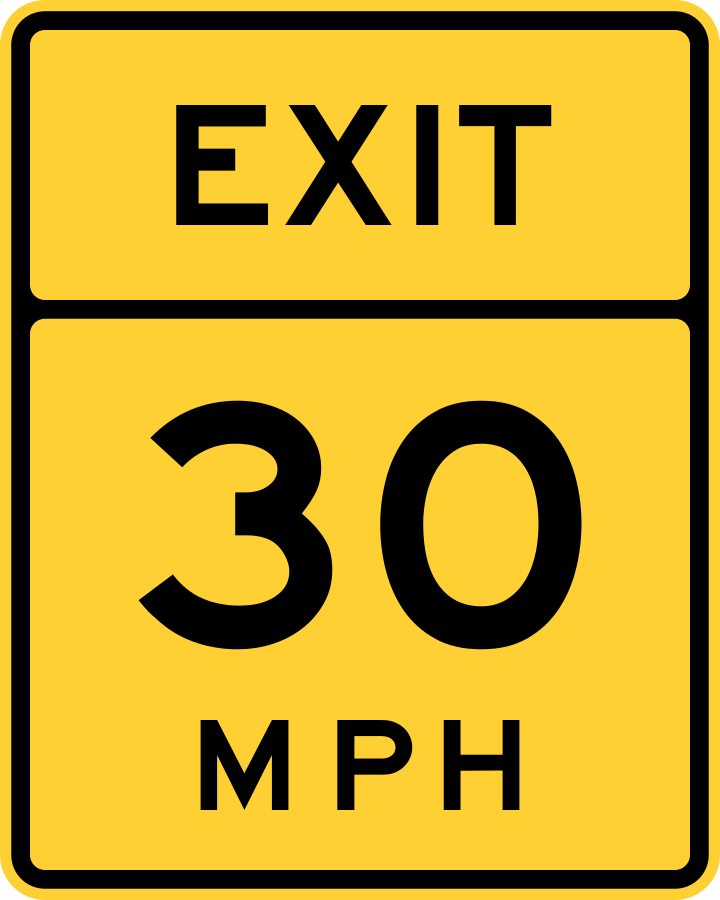
Recommends a safe speed of 30 MPH for negotiating the freeway exit ramp deceleration lane.
The sign in the picture:
A) shows the highest speed drivers can travel at the exit of the intersection.
B) is used to advise motorists of the appropriate ramp speed at the highway exit point.
C) indicates the minimum ramp speed at the highway exit point.
23.
A good rule of thumb for drivers sharing the road with a truck is:
A) it is better to drive to the immediate right of the cab.
B) always try to stay alongside a truck, but never drive right behind it.
C) if you can’t see the truck driver in their side mirror, they can’t see you.
24.
When another vehicle is passing you:
A) stay in your lane and reduce speed.
B) stay in your lane and maintain speed unless there is an emergency.
C) pull your vehicle as far to the right as possible without leaving the pavement.
25.
If you get on a wrong expressway exit, you must:
A) get off at the next exit and look for signs that tell you how to return to the expressway.
B) use the the exit ramp to accelerate to expressway speed and blend with traffic.
C) drive in reverse to return to the expressway.
26.
In heavy rain, tires can begin to ride on the water that is on top of the road pavement. This is called:
A) rideplaning.
B) hydroplaning.
C) pavement-planing.
D) waterplaning.
27.
If cars approaching from opposite directions reach an intersection at the same time:
A) a car that moves straight must yield to cars that turn left.
B) a car that turns left must yield to cars that move straight or turn right.
C) a car that turns right must yield to cars that move straight or turn left.
28.
On slippery roads, drivers should:
A) leave more space in front of their vehicle.
B) increase their speed to avoid hydroplaning.
C) come to a complete stop.
29.
You are considered to be driving under the influence when your blood alcohol concentration (BAC) is ____ or more.
A) 0.05%
B) 0.08%
C) 0.8%
30.
If another driver is following you too closely on a two-lane road, you should:
A) try to increase the distance from the car behind.
B) apply your brakes firmly while turning left.
C) reduce your speed gradually to encourage the tailgater to pass.
ANSWER KEY Check answers after completing the test.
1 B
2 C
3 A
4 B
5 C
6 B
7 A
8 B
9 A
10 B
11 B
12 B
13 C
14 B
15 C
16 C
17 B
18 A
19 C
20 C
21 C
22 B
23 C
24 B
25 A
26 B
27 B
28 A
29 B
30 C