←
Back to Test
Hide Answer Key
Print / Save as PDF
Print / PDF
drive
quiz
.com
DE DMV PERMİT PRACTİCE TEST 2
Delaware
Duration: 27 min
|
Questions: 30
Student Name:
Date:
Correct:
Incorrect:
Score:
1.
When approaching a construction site, drivers should:
A)
accelerate to get out of the way quickly.
B)
slow down and adjust their driving manner.
C)
honk their horn to alert construction workers of their presence.
2.
When following motorcycles, drivers should:
A)
reduce the minimum following distance.
B)
try to pass them as they have different braking capabilities than other motor vehicles.
C)
keep more space in front of their vehicle.
3.
This road sign means:
A)
Low clearance
B)
Do not enter
C)
A steep grade is ahead
4.
Never make a U-turn from:
A)
the lane you’re in.
B)
the right lane.
C)
the left part of the lane nearest to the centerline of the roadway.
5.
This road sign means:
A)
Winding road
B)
Side road ahead
C)
Slippery when wet
6.
Where must a pedestrian walk when there are no sidewalks?
A)
On the side of the road, in the same direction of traffic.
B)
In the middle of the road, facing oncoming traffic.
C)
On the side of the road, facing the traffic.
7.
Regulatory signs are:
A)
white.
B)
yellow.
C)
green.
8.
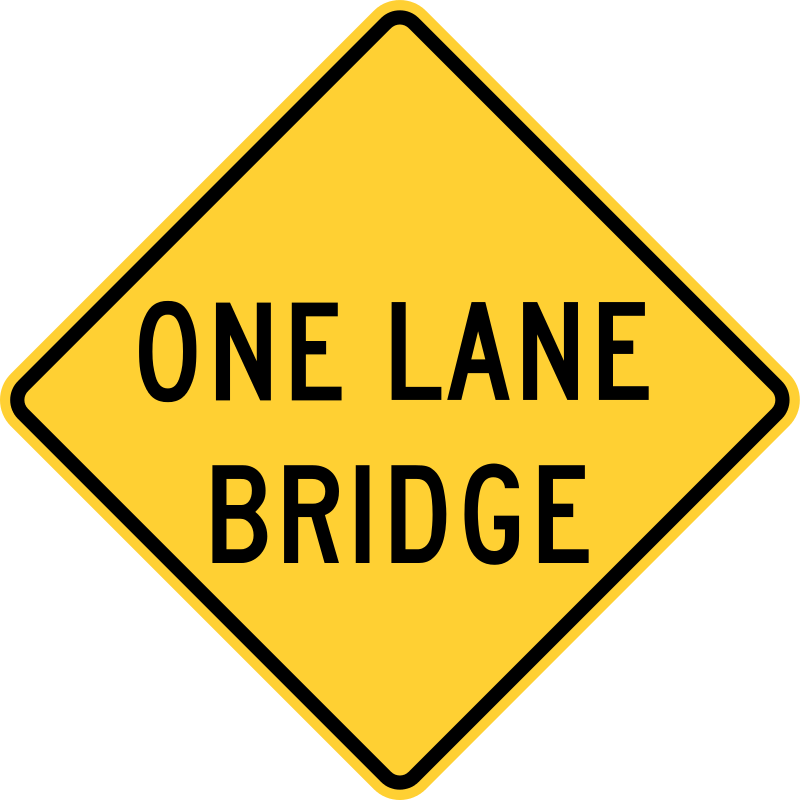
What should drivers do when they see this sign?
A)
Make sure the bridge is clear of oncoming traffic before they cross.
B)
Look to the left and right for other traffic.
C)
Allow others to merge smoothly.
9.
A school bus ahead of you in your lane is stopped with red lights flashing. You must:
A)
stop until all the children have left the bus.
B)
stop until the lights stop flashing.
C)
reduce your speed, change lanes and pass.
10.
Before entering a curve, you should:
A)
pump your brakes several times.
B)
activate your turn signal.
C)
reduce your speed.
11.
When driving at night, if an approaching car is using its high-beams you should:
A)
look toward the left edge of the road.
B)
look toward the right edge of the road.
C)
turn your lights on and off.
12.
At intersections where two or more drivers stop at STOP signs at the same time and they are at right angles:
A)
the driver on the left must yield to the driver on the right.
B)
the driver who is late for work has the right-of-way.
C)
the driver on the right must yield to the driver on the left.
13.
After parking, are you allowed to open a door on the road side of your vehicle?
A)
Yes, always.
B)
Yes, but only if it does not interfere with bicyclists and other traffic.
C)
No, never.
14.
This road sign means:
A)
No left turn
B)
No right turn
C)
No U-turns
15.
At intersections with a yield sign, you must:
A)
yield to the vehicles on your left only.
B)
yield the right-of-way to cross traffic close enough to cause conflict.
C)
slow down and proceed.
16.
When following a motorcycle, drivers must remember that motorcycles can ____________ than other vehicles.
A)
accelerate much faster
B)
stop much more quickly
C)
stop much more slowly
17.
You can reduce the chance of a collision with a large vehicle if you:
A)
delay near it.
B)
cut abruptly in front of it.
C)
pay close attention to the turn signals.
18.
This road sign means:
A)
Watch for vehicles entering from the side
B)
When pavement is wet, reduce your speed
C)
Winding road ahead
19.
You should never depend on your mirrors when you prepare to change lanes. Why?
A)
Mirrors leave “blind spots” behind both sides of vehicles.
B)
Mirrors need to be adjusted.
C)
Mirrors are useless.
20.
Blind spots around a large vehicle are _________________ than the blind spots around a car.
A)
larger and deeper
B)
less dangerous
C)
narrower and shorter
21.
Sudden wind gusts on highways:
A)
are generally caused by dust and dirt blowing around.
B)
can cause one to lose control of their vehicle.
C)
only affect large vehicles.
22.
A flashing yellow light:
A)
warns drivers to proceed with caution.
B)
is used at dangerous intersections.
C)
All of the above.
23.
When driving in foggy weather, drivers should:
A)
put their lights on low beam.
B)
put their lights on high beam.
C)
put their emergency flashers on.
24.
This road sign means:
A)
No left turn
B)
No U-turn
C)
Detour ahead
25.
This road sign means:
A)
Watch for bicycles
B)
Bicycle parking ahead
C)
Bicycles are not allowed in this area
26.
To keep the driver behind you at a safe distance you should:
A)
keep a steady speed.
B)
drive 5 MPH faster than the car behind.
C)
drive 5 MPH slower than the car behind.
27.
If you approach a flashing red traffic light, you should treat the intersection the same as:
A)
a yield sign.
B)
a stop sign.
C)
a warning sign.
28.
When is it safe to pass another vehicle?
A)
Whenever signs and/or markings permit passing other vehicles.
B)
When you are entering a curve and there are no oncoming vehicles.
C)
When you are driving through an intersection and there are no oncoming vehicles.
29.
Where must you position your vehicle when you prepare to make a left turn from a two-way roadway into a one-way roadway?
A)
As far to the right as possible.
B)
On the right curb.
C)
As close as possible to the center line.
30.
This sign means:
A)
The center lane is shared for left turns.
B)
Left turns in both directions of travel are not permitted.
C)
Vehicles may only turn left.
ANSWER KEY
Check answers after completing the test.
1
B
2
C
3
A
4
B
5
C
6
C
7
A
8
A
9
B
10
C
11
B
12
A
13
B
14
B
15
B
16
B
17
C
18
B
19
A
20
A
21
B
22
C
23
A
24
B
25
A
26
A
27
B
28
A
29
C
30
A