←
Back to Test
Hide Answer Key
Print / Save as PDF
Print / PDF
drive
quiz
.com
DE DMV PERMİT PRACTİCE TEST 1
Delaware
Duration: 27 min
|
Questions: 30
Student Name:
Date:
Correct:
Incorrect:
Score:
1.
When driving in fog, drivers should use:
A)
low beam headlights.
B)
parking lights.
C)
high beam headlights.
2.
__________ are blue with white letters and symbols.
A)
Warning signs
B)
Service signs
C)
Destination signs (guide signs)
3.
Air bags are meant to _________ seat belts.
A)
work with
B)
fix
C)
replace
4.
To avoid becoming an aggressive driver, you should:
A)
drive above the posted speed limit.
B)
tailgate the driver in front of you.
C)
relax and concentrate on driving.
5.
Drivers may need more space in front of their vehicle:
A)
when following motorcycles.
B)
when carrying a heavy load or pulling a trailer.
C)
All of the above.
6.
When an aggressive driver confronts you, you should:
A)
Try to move away safely.
B)
Remain calm and relaxed.
C)
All of the above.
7.
You should allow for an extra cushion of space when following large vehicles because:
A)
this will encourage the drivers of large vehicles to drive around you.
B)
large vehicles take longer to stop.
C)
the drivers of large vehicles may not be able to see you when you are directly behind them.
8.
This road sign means:
A)
Railroad Crossing
B)
One Way
C)
Limited parking
9.
This road sign means:
A)
Pavement ends
B)
Winding road
C)
Double curve ahead
10.
This road sign means:
A)
Truck stop ahead
B)
No trucks allowed
C)
Hill or downgrade up ahead
11.
Collisions can happen more often when:
A)
one lane of traffic is traveling faster than the others.
B)
one vehicle is traveling faster than the flow of traffic.
C)
all vehicles are traveling at the posted speed limit.
12.
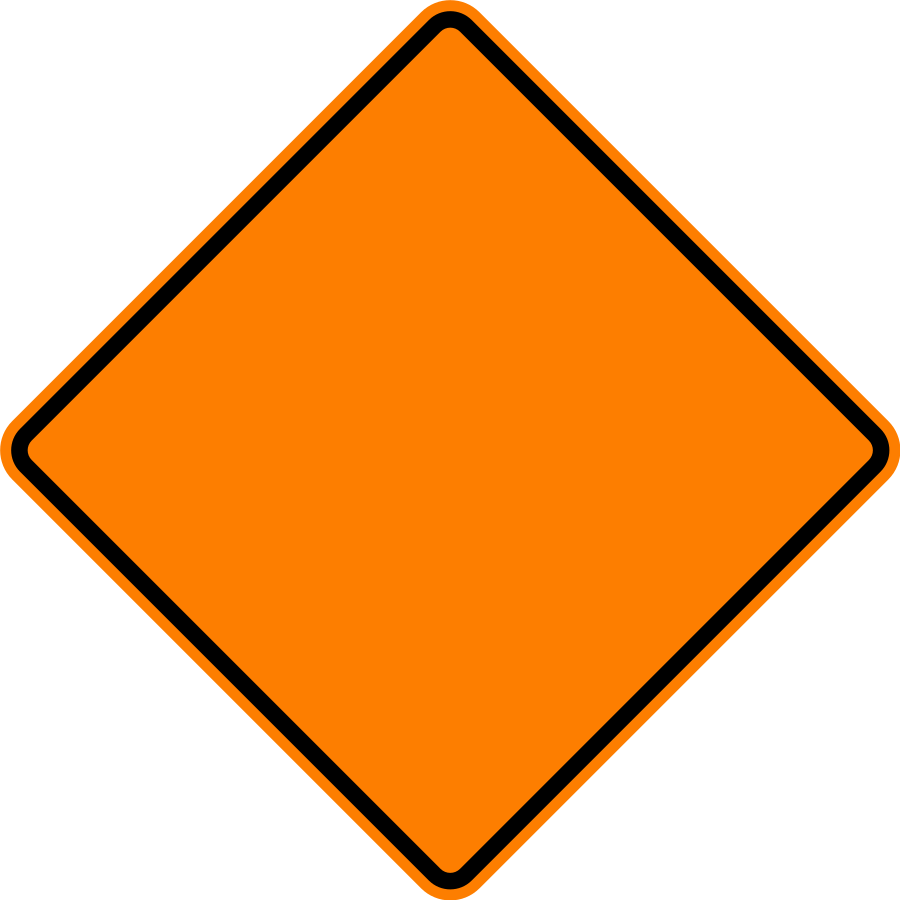
Signs with orange backgrounds mean:
A)
railroad crossing.
B)
side road ahead.
C)
road construction site.
13.
________ are required to stop for railroad crossings.
A)
School buses
B)
Cattle trucks
C)
Dairy trucks
14.
Blocking an intersection during rush hour traffic is not permitted:
A)
under any circumstances.
B)
unless you entered the intersection on a green light.
C)
unless you have the right-of-way.
15.
This road sign means:
A)
Divided highway ahead
B)
Merging traffic
C)
Flagger ahead
16.
Which of the following is true about the Anti-Locking Brake System?
A)
It prevents skidding.
B)
It allows drivers to steer during an emergency braking situation.
C)
All of the above.
17.
This road sign means:
A)
No left turn
B)
No right turn
C)
No U-turns
18.
___________ normally are white rectangles with black letters or symbols.
A)
Warning signs
B)
Destination signs (guide signs)
C)
Regulation signs (regulatory signs)
19.
Stopping distances:
A)
are not affected by vehicle speed.
B)
decrease as vehicle speed increases.
C)
increase as vehicle speed increases.
20.
A bad car suspension can cause:
A)
pumping brakes.
B)
vehicle control problems.
C)
squealing brakes.
21.
This road sign means:
A)
Pedestrian crossing
B)
School zone
C)
School crossing
22.
What is the first thing you should do if your wheels move off the pavement?
A)
Pull the steering wheel back.
B)
Pull over to the right and sound your horn to warn the other drivers.
C)
Ease your foot off the gas pedal and brake gently.
23.
Your red traffic signal changes to green while a pedestrian is crossing in your traffic lane. The right of way should be given:
A)
by the pedestrian, but only when vehicles are turning left.
B)
by the pedestrian.
C)
to the pedestrian.
24.
Alcohol:
A)
makes drivers more prone to take chances.
B)
increases reaction time.
C)
All of the above.
25.
Which of the following must you obey over the others?
A)
Red light
B)
Stop sign
C)
Police officer
26.
Drivers should make room for cars entering freeways by:
A)
maintaining their speed and position.
B)
moving over a lane if there is no other vehicle next to them.
C)
slowing down.
27.
Green and white signs:
A)
give information about directions and distances.
B)
are mainly used at intersections and driveways.
C)
warn drivers of unexpected road conditions.
28.
You hear a siren close by but can not see where the emergency vehicle is. What do you do?
A)
Keep driving until you are sure the emergency vehicle is headed toward you.
B)
Stop immediately and activate your emergency flashers.
C)
Pull over to the right side of the road and stop until you are sure the emergency vehicle is not headed toward you.
29.
What is the most important rule to remember in any emergency?
A)
Do not panic.
B)
Run away.
C)
Call the police.
30.
The use of alcohol and/or drugs affects:
A)
concentration and reaction time.
B)
alertness and judgement.
C)
All of the above.
ANSWER KEY
Check answers after completing the test.
1
A
2
B
3
A
4
C
5
C
6
C
7
C
8
A
9
B
10
C
11
B
12
C
13
A
14
A
15
A
16
C
17
B
18
C
19
C
20
B
21
A
22
C
23
C
24
C
25
C
26
B
27
A
28
C
29
A
30
C