DriveQuiz drivequiz.com

CT DMV PERMİT PRACTİCE TEST 3

Connecticut
Duration: 23 min
|
Questions: 25
Student Name:
Date:
Correct:      Incorrect:      Score:      
1.
When you see a no passing zone sign:
A) maintain your speed and position.
B) you may not pass cars ahead of you in your lane.
C) you must pull off the road and come to a complete stop.
2.
The roadway becomes particularly slippery during wet or rainy conditions. Reduce your speed, increase following distance, and avoid abrupt braking or steering.
This road sign means:
A) Winding road
B) Side road ahead
C) Slippery when wet
3.
Warns that a one-way street or divided highway is ending, and you are entering a roadway with oncoming traffic in the opposing lane. Stay to the right.
This sign warns ____________ ahead.
A) of two-way traffic
B) of a reduction of lanes
C) that a divided highway ends
4.
What do pennant-shaped signs indicate?
A) A school crossing
B) Yield
C) A No Passing Zone
5.
Which statement about drinking alcohol and driving is true?
A) Alcohol affects judgement and coordination, which are needed to drive safely.
B) After drinking, a cold shower will sober you up.
C) If you are under the legal BAC limit, your driving is not affected.
6.
A flashing red light means:
A) The same as a STOP sign.
B) The light will soon change to steady red.
C) Drive with caution.
7.
A steady green light at intersections means:
A) You may drive through the intersection if the road is clear
B) You must increase your speed
C) You may not turn right
8.
Slow down and give right-of-way to all oncoming vehicles, cyclists, and pedestrians. Stop completely if necessary before entering the intersection or merging.
The yield sign means:
A) Drive with caution in wet weather.
B) You must come to a complete stop.
C) Slow down and give vehicles crossing your path the right-of-way.
9.
Give the right-of-way to any pedestrian:
A) on the opposite side of the street.
B) if you have the green light.
C) in a marked crosswalk.
10.
Which statement about driving and drugs is true?
A) Only illegals drugs can impair your driving.
B) Prescription drugs are safe to use if they don't make you feel drowsy.
C) Even over the counter drugs can impair your driving.
11.
When driving in fog, you should never use your high beams because:
A) the light will reflect back into your eyes.
B) vehicles behind you may follow too closely.
C) oncoming vehicles might not see you.
12.
When approaching an intersection with a traffic control signal that is not working, drivers should:
A) stop as you would if there were stop signs in all directions, yield the right-of-way, then enter the intersection.
B) speed up and proceed through the intersection.
C) try not to stop if the intersection is clear.
13.
The first sign drivers see when approaching a highway-rail intersection is usually:
A) a crossbuck sign.
B) an advance warning sign.
C) a speed limit sign.
14.
A driver who approaches an intersection:
A) must yield the right-of-way to traffic already in the intersection.
B) must drive straight through the intersection, even if another vehicle is already in the intersection.
C) has the right-of-way over traffic already in the intersection.
15.
A red traffic sign means?
A) Construction warning.
B) Railroad crossing.
C) Stop.
16.
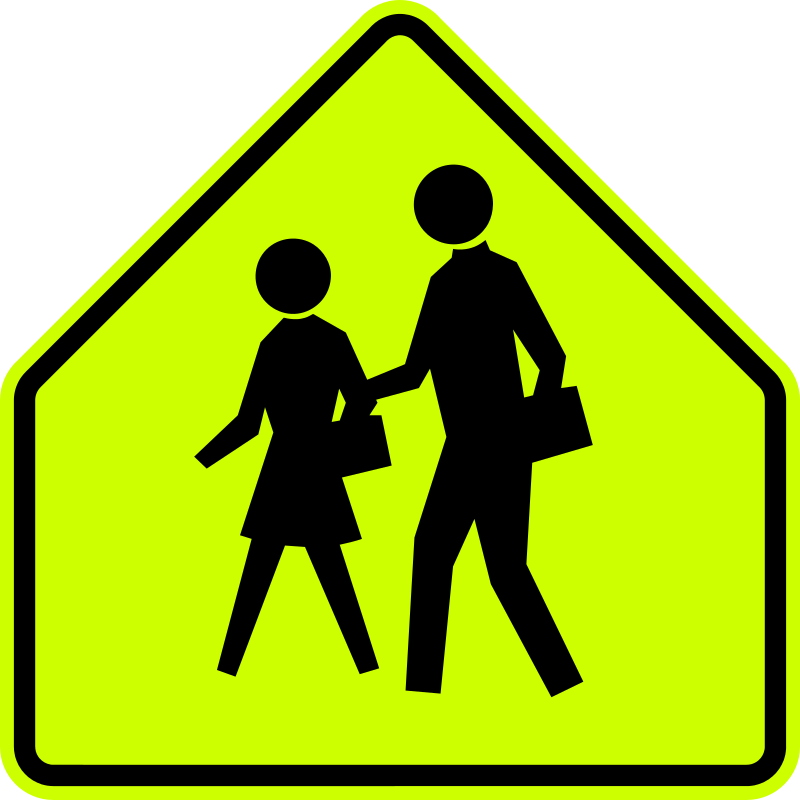
Five-sided pentagon sign indicating an upcoming school area. Watch for children crossing, school buses, and observe posted reduced school speed limits.
This road sign means:
A) School crossing
B) Playground ahead
C) Pedestrian crossing
17.
The amount of alcohol in the blood is measured by:
A) blood alcohol concentration (BAC).
B) Number of Drinks (NOC).
C) Amount of Alcohol Drunk (AAD).
18.
Parking is not allowed:
A) in an intersection, unless permitted by signs.
B) within 300 feet of a pedestrian safety area.
C) on public roads
19.
Warns that a one-way street or divided highway is ending, and you are entering a roadway with oncoming traffic in the opposing lane. Stay to the right.
This road sign means:
A) Divided highway ahead
B) Two-way traffic ahead
C) Four-lane traffic ahead
20.
Excessive speed:
A) helps you to maneuver around obstacles.
B) saves time so you can get to your destination more quickly.
C) increases the likelihood of serious bodily injuries and death.
21.
If you are blinded by headlights on an approaching vehicle, you should:
A) avoid looking directly at the bright lights.
B) glance toward the side of the road, then look quickly ahead to determine the other vehicle’s position.
C) All of the above.
22.
Following another vehicle too closely is known as:
A) speedgating.
B) closetailing.
C) tailgating.
23.
Parking, standing, or stopping is prohibited at all times in this designated zone except for emergency vehicles.
This sign means:
A) U-turns are not allowed.
B) Parking is not allowed.
C) No parking on pavement.
24.
Slower-moving vehicles must stay in the right-hand lane to allow faster traffic to pass safely on multi-lane highways.
This regulatory road sign indicates that:
A) Vehicles must slow down and stay in the right lane.
B) The right hand lane is reserved for buses and car-pool vehicles.
C) Slower vehicles traveling on multiple lane highways must stay in the right hand lane.
25.
What should you do in case of a steering failure?
A) Pump your gas pedal a few times to increase the pressure.
B) Don't panic. Turn on your emergency lights to let other drivers know you are having car problems. Move toward the side of the road and bring the car to a gradual stop.
C) Leave the road immediately.
ANSWER KEY Check answers after completing the test.
1 B
2 C
3 A
4 C
5 A
6 A
7 A
8 C
9 C
10 C
11 A
12 A
13 B
14 A
15 C
16 A
17 A
18 A
19 B
20 C
21 C
22 C
23 B
24 C
25 B