DriveQuiz drivequiz.com

CT DMV PERMİT PRACTİCE TEST 15

Connecticut
Duration: 23 min
|
Questions: 25
Student Name:
Date:
Correct:      Incorrect:      Score:      
1.
Drivers should change lanes:
A) often.
B) as quickly as possible.
C) gradually and carefully.
2.
When the road is slippery, you should:
A) brake suddenly carefully.
B) pump your brakes.
C) press your brakes in slow, steady strokes.
3.
On what three conditions does your blood alcohol content (BAC) depend?
A) Your weight. How much alcohol you drink. How much time passes between drinks.
B) Your weight. The type of beverage you drink. How fit you are.
C) Your height. How much alcohol you drink. The type of beverage you drink.
4.
To avoid hydroplaning, drivers should:
A) slow down.
B) apply the brakes firmly.
C) drive at a constant speed.
5.
You are driving in the far right lane of a four lane freeway and notice broken white lines on the left side of your lane. You are driving:
A) on the entrance ramp.
B) in a special lane for slow moving vehicles.
C) in an exit lane.
6.
A traffic sign with a red circle around and a slash over a symbol means:
A) the maneuver shown by the symbol is not allowed.
B) Do not drive faster than the posted speed limit.
C) the maneuver shown on the sign should be executed with extreme caution.
7.
Flashing Upraised Hand signal indicates pedestrians should finish crossing if already in the crosswalk, but not start crossing.
What does the flashing signal in the picture indicate?
A) The same thing as a stop sign.
B) Pedestrians should finish crossing the street if started.
C) Pedestrians should start crossing the street.
8.
When driving in work zones, drivers should:
A) closely follow the driver in front of them.
B) reduce their speed and be prepared to stop.
C) maintain their speed through the work zone.
9.
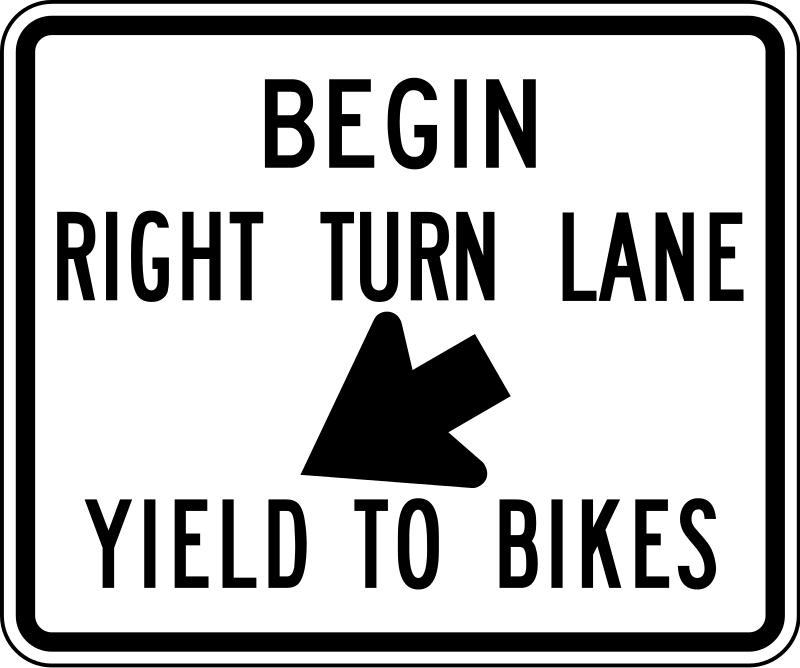
Drivers turning right must merge into the bike lane before turning, first checking mirrors and blind spots and yielding to all cyclists.
What does this road sign indicate?
A) Drivers have the right of way over bikes turning left.
B) Vehicles turning left must yield to bikes entering a right turn lane.
C) Motor vehicles entering an exclusive right-turn lane must weave across bicycle traffic in bicycle lanes.
10.
The roadway becomes particularly slippery during wet or rainy conditions. Reduce your speed, increase following distance, and avoid abrupt braking or steering.
When they see this sign, drivers:
A) should be prepared to make sharp turns at a high speed.
B) need to be prepared to turn right and then left quickly.
C) should not spee
11.
The use of alcohol and/or drugs affects:
A) concentration and reaction time.
B) alertness and judgement.
C) All of the above.
12.
A red arrow on a traffic light means:
A) You may not turn in the direction of the arrow until a green light or arrow light goes on.
B) You may turn in in the direction of the arrow after coming to a complete stop.
C) You must stop and then proceed when the way is clear.
13.
How can you prevent fatigue on a long trip?
A) Plan to drive long trips with a companion.
B) Get enough sleep.
C) All of the above.
14.
Who is most at risk?
A) Drivers who have overslept.
B) Drivers who are driving long distances without rest breaks.
C) Experienced drivers.
15.
If you remain in the back blind spot of a large vehicle:
A) you increase the chance of a crash.
B) the large vehicle will take much longer to stop.
C) you can reduce fuel consumption.
16.
When driving on a roadway with a single broken white line:
A) you may cross the broken white line to change lanes.
B) you may change lanes only if you are in the right lane.
C) you may not cross the broken white line.
17.
If your brakes are wet, you can dry them by:
A) riding the pedal lightly.
B) pull over to the right and wait until it stops raining.
C) having them checked by a mechanic.
18.
Treat the flashing red signal exactly like a STOP sign: come to a complete stop, yield to cross traffic and pedestrians, then proceed when safe.
A flashing red light:
A) is used at dangerous intersections.
B) means the same thing as a stop sign.
C) All of the above.
19.
A sharp curve is ahead with a recommended safe speed plate. Slow down before entering the curve to prevent vehicle rollover.
This sign indicates that:
A) the highest safe speed drivers should travel around the curve ahead is 25 MPH.
B) the safe speed around the curve ahead is at least 25 MPH.
C) drivers may not turn right if traveling at 25 MPH or less.
20.
Your driving ability can be affected by:
A) just one drink.
B) three drinks or more.
C) at least two drinks.
21.
Warns of two consecutive curves in opposite directions (e.g., curves right then left). Slow down to maintain control.
This road sign means the road you're driving on:
A) turns sharply to the left and then right
B) turns to the right and then the left
C) turns only to the left
22.
If you drive too fast on a wet road:
A) other drivers will consider you an aggressive driver.
B) your tires may start to glide over the water.
C) your ability to judge speed will be impaired.
23.
Warns drivers that two separate lanes moving in the same direction are merging into one. Drivers in the right lane must adjust speed and merge smoothly with existing traffic.
This sign means:
A) A road crosses the main highway ahead.
B) The divided highway on which drivers are traveling ends ahead.
C) Drivers are coming to a point where another traffic lane joins the one they are on.
24.
Drivers who are 16 or 17 years of age are not permitted to use any type of:
A) text-messaging device.
B) cell phone.
C) All of the above.
25.
To safely return to your lane after passing another vehicle, you should:
A) sound your horn.
B) see both headlights of the passed vehicle in your rearview mirror.
C) flash your headlights. quickly.
ANSWER KEY Check answers after completing the test.
1 C
2 C
3 A
4 A
5 C
6 A
7 B
8 B
9 C
10 C
11 C
12 A
13 C
14 B
15 A
16 A
17 A
18 C
19 A
20 A
21 B
22 B
23 C
24 C
25 B