DriveQuiz drivequiz.com

CO DMV PERMİT PRACTİCE TEST 7

Colorado
Duration: 23 min
|
Questions: 25
Student Name:
Date:
Correct:      Incorrect:      Score:      
1.
You go with a group of friends to a social event, and you plan to have a few drinks. You should:
A) make alcohol the focus of the event.
B) avoid alternating between drinks with alcohol and drinks without any alcohol.
C) arrange to ride home with a friend who does not drink.
2.
When parking on a public road, drivers should:
A) move as far away from traffic as possible.
B) always park on the left side of the roadway.
C) All of the above.
3.
When approaching any intersection or driveway, drivers should:
A) look both ways and be ready to stop.
B) pass other vehicles and then stop.
C) drive at the fastest speed just before entering the intersection.
4.
A steep downhill grade is ahead. Trucks and heavy vehicles should downshift to a lower gear to prevent brake overheating.
This road sign means:
A) No right turn
B) No left turn
C) Narrow Bridge
D) Steep downgrade
5.
What should you do if a vehicle is approaching head-on in your lane?
A) Pull over to the left and use your emergency lights to stop the other driver.
B) Decrease speed, pull over to the right and sound your horn to warn the other driver.
C) Turn off the ignition if your vehicle has power steering.
6.
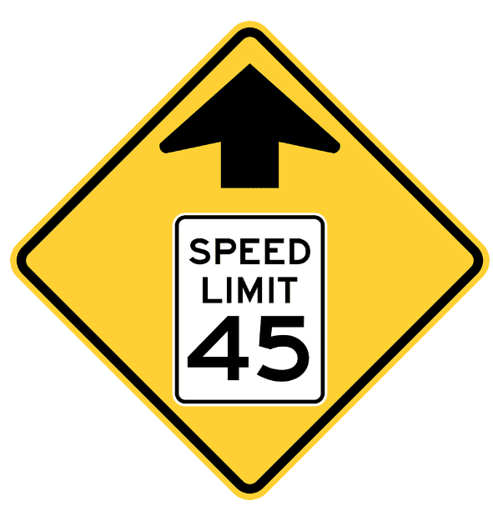
Recommended safe maximum driving speed in ideal conditions for an upcoming curve, ramp, or hazardous stretch of road.
This warning sign:
A) provides advance notice to upcoming speed limit change.
B) shows the current speed limit that all vehicles traveling in the direction of the arrow must not exceed.
C) indicates the suggested highest safe speed.
7.
If you stop along the road at night:
A) turn on your emergency flashers and leave your low beams on.
B) turn off your emergency lights and leave your high beams on.
C) turn on your headlights only.
D) turn off all your lights.
8.
When a driver is turning and a pedestrian is crossing without a traffic light, __________ must yield the right-of-way.
A) the pedestrian
B) the driver
C) both
D) whoever is slower
9.
To avoid being in a truck driver’s blind spot, you should:
A) never pass the truck and put your headlights on.
B) avoid driving on either side of the truck and don’t tailgate.
C) flash your lights.
D) sound your horn.
10.
Before turning, you should:
A) increase your speed.
B) sound your horn to alert the other drivers.
C) give the proper turn signal.
D) change lanes.
11.
What should you do if your brakes fail?
A) Hook your shoe under the pedal and see if you can free it.
B) Turn on your cruise control.
C) Try pumping the brake pedal to increase pressure.
12.
Braking distance is affected by:
A) the condition of your brakes and tires.
B) pavement conditions.
C) the speed your vehicle is traveling.
D) All of the above.
13.
A sharp curve is ahead with a recommended safe speed plate. Slow down before entering the curve to prevent vehicle rollover.
This road sign means:
A) Merge, then slow down to the safe speed indicated
B) The road ahead curves right; slow down to indicated speed
C) Winding road ahead; slow down to the indicated speed
D) Divided highway begins. Slow down to the safe speed indicated
14.
The road curves gradually to the right ahead. Reduce speed before entering the curve.
This sign means:
A) The road will curve to the right.
B) Left turns are not allowed at the intersection.
C) Do not turn right.
15.
If your car goes into water, you should:
A) wait for water to rush in and let it out in small breaths through your nose.
B) call the fire department immediately.
C) remove yourself before it starts to sink.
16.
You ________ traffic headed toward you when you turn left.
A) must not yield to
B) must interrupt
C) must yield to
17.
Aggressive driving includes:
A) quick lane changes without a signal.
B) chasing or challenging other drivers.
C) All of the above.
18.
To avoid having to make an emergency stop while driving in traffic, drivers should:
A) drive in the right lane only.
B) look ahead and maintain a safe following distance.
C) sound their horn to warn other drivers.
D) drive slower than the flow of traffic.
19.
Drivers may continue carefully through a yellow light if:
A) there are no pedestrians crossing.
B) they are turning right.
C) they already are within the intersection.
D) an emergency vehicle is crossing your lane.
20.
When approaching a curve, remember to:
A) accelerate slightly before entering the curve.
B) drive at the posted speed limit throughout the curve.
C) slow down before entering the curve.
D) drive at the posted speed limit as you enter the curve, then slow down gradually.
21.
Tailgating:
A) cannot result in a traffic citation.
B) helps reduce traffic congestion.
C) is a defensive driving tecnique.
D) can frustrate other drivers and make them angry.
22.
Drinking alcohol while taking drugs:
A) reduces the effects of the alcohol.
B) reduces the effects of the drug or medicine.
C) has no effect, they are different substances.
D) could multiply the effects of the alcohol.
23.
Before entering a traffic circle, drivers must slow down and yield to ___________ in the traffic circle.
A) pedestrians
B) vehicles
C) bicyclists
D) All of the above.
24.
When changing lanes, you can check your blind spot by:
A) using the outside rearview mirror.
B) using the inside rearview mirror.
C) turning your head and glancing over your shoulder.
D) checking the rearview and outside mirrors.
25.
Your brake lights tell other drivers that you:
A) are changing lanes.
B) are slowing down or stopping.
C) are making a turn.
D) have your emergency brake on.
ANSWER KEY Check answers after completing the test.
1 C
2 A
3 A
4 D
5 B
6 A
7 A
8 B
9 B
10 C
11 C
12 D
13 B
14 A
15 C
16 C
17 C
18 B
19 C
20 C
21 D
22 D
23 D
24 C
25 B