DriveQuiz drivequiz.com

AK DMV PERMİT PRACTİCE TEST 16

Alaska
Duration: 18 min
|
Questions: 20
Student Name:
Date:
Correct:      Incorrect:      Score:      
1.
BAC is:
A) the acronym for Beer ACcumulation.
B) the number of ounces of alcohol in your blood.
C) the percentage of alcohol in your blood.
2.
When driving through a curve, you should:
A) speed up as you enter, slow down as you exit.
B) stay near the right of your lane.
C) maintain constant speed.
D) slow as you enter, speed up as you exit.
3.
When an aggressive driver confronts you, you should:
A) Try to move away safely.
B) Remain calm and relaxed.
C) All of the above.
4.
You want to turn left at an intersection ahead. A car reaches the intersection from the opposite direction and moves straight ahead. You:
A) can turn left. You have the right of way.
B) must wait for the car to go through before you turn.
C) may not enter the intersection to prepare for your left turn if the light is green.
5.
What is the most important rule to remember in any emergency?
A) Do not panic.
B) Run away.
C) Call the police.
6.
___________ are green with white letters and symbols.
A) Warning signs
B) Destination signs (guide signs)
C) Regulation signs (regulatory signs)
7.
All approaching traffic must stop completely. The first vehicle to reach the intersection and stop has right-of-way; if two vehicles arrive simultaneously, the vehicle on the right goes first.
A 4-way stop sign means:
A) The first vehicle to reach the intersection should move forward first.
B) Traffic from all four directions must stop.
C) There are four stop signs at the intersection.
D) All of the above.
8.
While driving you come upon a sign which says, “reduced speed 35 MPH”. You as a driver should know:
A) that the new 35 MPH speed zone begins at the next “speed limit” sign.
B) that the sign is put there to harass “good” drivers.
C) that the new 35 MPH speed zone begins at this sign.
D) that you have plenty of time to slow down before the speed zone.
9.
Drivers may continue carefully through a yellow light if:
A) there are no pedestrians crossing.
B) they are turning right.
C) they already are within the intersection.
D) an emergency vehicle is crossing your lane.
10.
Drinking alcoholic beverages:
A) gives you a feeling of false confidence.
B) impairs your judgement.
C) slows your reaction time.
D) All of the above.
11.
When you want to turn right at the next intersection, you should signal your intention to turn:
A) after the vehicle ahead of you has turned.
B) at least 50 feet before the turn.
C) at least 100 feet before the turn.
D) when you reach the intersection.
12.
You are stopped at a railroad crossing and the train has just passed. You should:
A) look to see if another train is coming, then cross the tracks if it is safe to do so.
B) start to cross the tracks.
C) pull aside to have a better view and then cross the tracks.
D) wait 15 seconds, then cross the tracks.
13.
At a stop sign there is no stop line or crosswalk. You must stop:
A) before you enter the intersection.
B) at the next crosswalk.
C) after you enter the intersection, if you have a clear view of traffic on the intersecting roadway.
14.
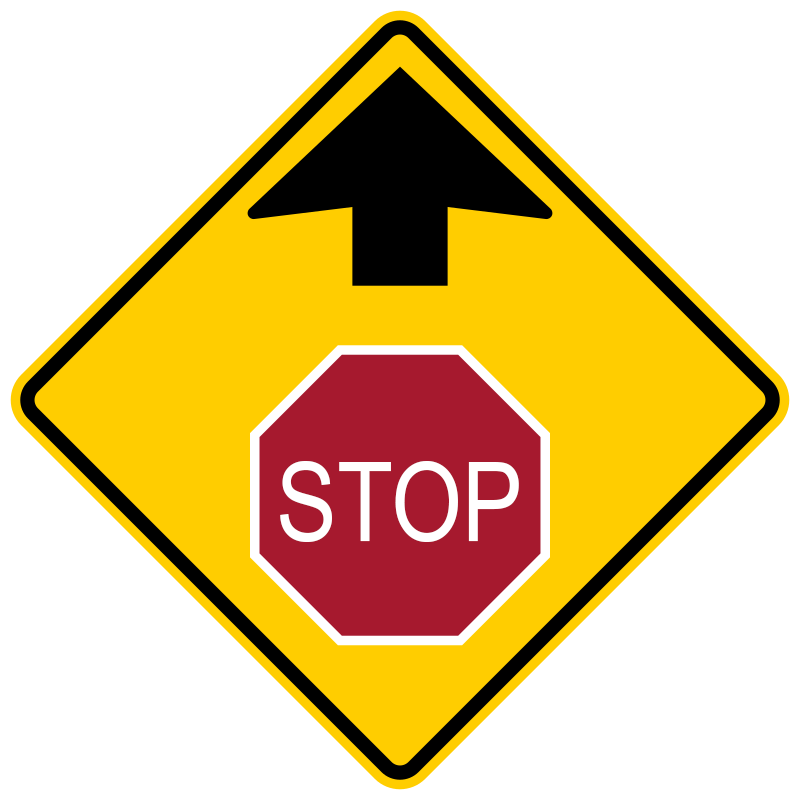
Warns of an upcoming STOP sign that may not be immediately visible. Begin slowing down to prepare for a complete stop.
This road sign means:
A) Railroad Warning
B) Stop Sign Ahead
C) Lane ends
D) Stop if necessary
15.
What is the main reason night driving is more difficult than daytime driving?
A) The use of headlight is required by law.
B) Reduced visibility.
C) Driving within the range.
16.
When parking down hill, the front wheels should be:
A) pointing in any direction.
B) pointed straight ahead.
C) turned toward the curb or shoulder.
D) turned away from the curb.
17.
Unlike passenger cars, trucks have blind spots:
A) on the right.
B) directly behind them.
C) on the front.
18.
A broken yellow line means:
A) Residential area
B) Warning: construction zone
C) No passing zone
D) Passing is permitted when safe
19.
Where must you position your vehicle when you prepare to make a left turn from a two-way roadway into a one-way roadway?
A) As far to the right as possible.
B) On the right curb.
C) As close as possible to the center line.
20.
A vehicle that enters a road from a driveway:
A) has the right-of-way.
B) must yield to traffic approaching from the right, while it has the right-of-way over vehicles approaching from the left.
C) must stop and yield the right-of-way to traffic on the roadway and to pedestrians.
ANSWER KEY Check answers after completing the test.
1 C
2 D
3 C
4 B
5 A
6 B
7 D
8 C
9 C
10 D
11 C
12 A
13 A
14 B
15 B
16 C
17 B
18 D
19 C
20 C